
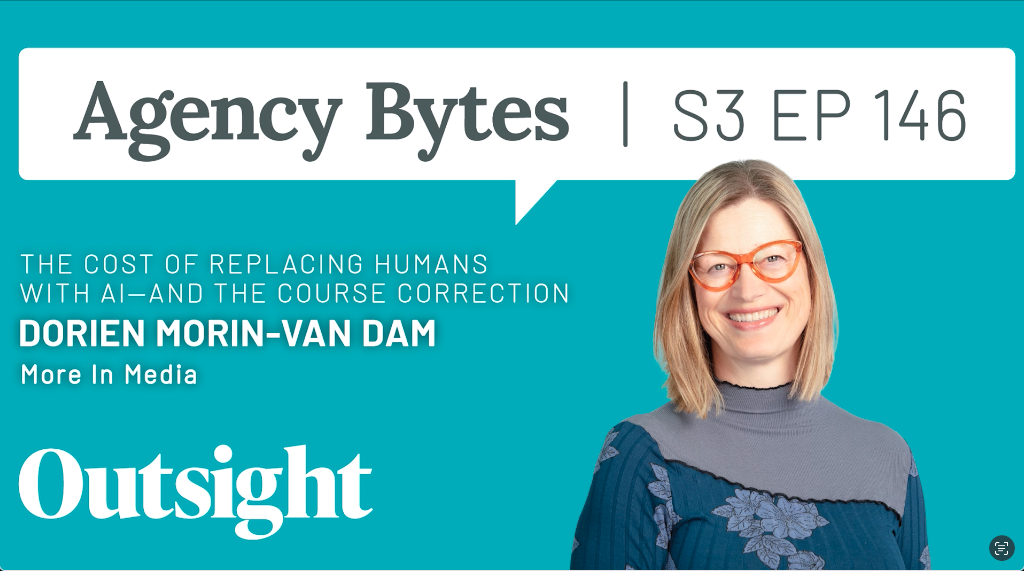
Ep 146 – Dorien Morin-van Dam, More In Media – The Cost of Replacing Humans With AI—and the Course Correction
Listen & subscribe on the platform of your choice
Featuring: Dorien Morin-van Dam, More In Media
In episode 146, I’m joined by Doreen Morin-van Dam, a content strategist with more than 15 years of experience helping brands grow through smart, sustainable marketing. Doreen works with teams on how to use AI responsibly and effectively, hosts the Strategy Talks video podcast, and is known for blending emerging tech with deeply human content strategies.
We dig into what really happened when companies rushed to replace humans with AI in 2025—and why many of them quietly reversed course by Q4. Doreen shares what she’s seeing brands regret most, how “AI slop” became a real problem, and why human-led content is becoming a competitive advantage again. We also explore how agencies can use AI as a strategic partner (not a shortcut), why long-form content matters more than ever, and how organic and paid media must work together. This is a grounded, practical conversation for agency owners trying to navigate AI without losing trust, quality, or their voice.
Key Bytes
• Why replacing humans with AI backfired for many brands in 2025
• How AI slop diluted trust, performance, and differentiation
• Why humans must remain the source of truth in content strategy
• How to use AI to analyze, enhance, and scale—not replace—expertise
• Why long-form, opinionated content performs better with LLMs
• How organic social still drives testing, trust, and paid performance
• Why being different beats being “better” in crowded markets
• How agencies should rethink in-house marketing investmentChapters
00:00 Why 2025 became the “AI correction year”
02:30 What brands got wrong when they replaced people with AI
05:45 Why agencies must treat themselves as their best client
08:55 AI avatars, ethical concerns, and consumer trust
11:30 From AI slop to human-led strategy
15:05 Humans as the source of truth in content
19:45 Why long-form content matters for AI discovery
21:20 Organic social isn’t dead—it’s misunderstood
26:25 Organic + paid: why they must work together
28:00 Rapid-fire questions and practical takeaways
Dorien Morin-van Dam is a Vermont-based content strategist with over 15 years of experience helping brands grow through smart, sustainable strategies. A Certified Social Media Manager and Agile Marketer, she also consults on AI strategy for small businesses, showing teams how to use AI in marketing responsibly and effectively. Dorien turns organic content and emerging tech into measurable results, speaks internationally, and hosts the Strategy Talks video podcast. You’ll recognize her on stage and online by her signature orange glasses, a nod to her Dutch heritage.
Check out Dorien’s website, connect on LinkedIn, or tune into the Strategy Talks podcast.
-
Steve Guberman (00:01.154)
Welcome to Agency Bites. I'm your host, Steve Guberman from Agency Outsite, where I help agency owners build the business of their dreams. This week on Agency Bites, I'm joined by Doreen Morin-Van Dam. She's a content strategist with over 15 years of experience helping brands grow through smart, sustainable marketing. She's a certified social media manager and agile marketer, and she works with teams on how to use AI in marketing responsibly and effectively. She hosts the Strategy Talks video podcast.
speaks internationally and is known for turning organic content and emerging tech into measurable results. And if you've seen her on stage or online, you probably remember the signature orange glasses. Doreen, great to have you on the show today, but you're wearing the wrong glasses, darn.
Dorien Morin-van Dam (00:43.797)
Thanks. I know and I'm just looking going, I pulled the wrong glasses out. I usually always wear red ones, I, orange ones, but I have blue ones. So, well, this time I'm just going to go with what I have on.
Steve Guberman (00:48.834)
Hahaha!
Steve Guberman (00:56.728)
Blue is on brand also, it's all good. Well, it's great to see you. Thank you for joining me today. What is going on in your world? How is, how was your 2025?
Dorien Morin-van Dam (01:07.937)
2025 was interesting. I think that's the word I'd like to use. You and I were just talking in the green room and a lot of us marketers have kind of experienced the same thing. Not of us were talking about it during the year, but now that the year has ended, we kind of have this collective sigh of relief. God, thank God it's over. Q1, two and three were pretty rough. I think everybody doubled down on AI, meaning that
a lot of companies decided to go all in on AI and actually let go some of their team members, let go some of their strategies and let go some of their common sense and use AI to, you know, replace people. And from what I've seen, and I think a lot of, you know, people have seen this too, Q4, at the end of Q3, they probably got some reporting that stated and showed that the numbers weren't really up to par. So Q4 has been,
was much better for me. got a bunch of new clients, new inquiries, lots of leads of people who wanted to get ready for 2026 and was serious about content marketing again. So I'm very excited for this coming year. So 2025 was kind of meh. I think we had to go through that to kind of prove why we still need humans in the mix of marketing, very much so. And I'm very excited to be on the other end of that and now be into 2026.
Steve Guberman (02:32.066)
Yeah, I'm all for the humans on on the side of the team. Give your kind of backstory of like what you're doing, how you got into what you're doing, some of the things that you've kind of learned along the way. Let's dig into that stuff about running your own freelance endeavor.
Dorien Morin-van Dam (02:46.401)
Sure. Well, I started at age 40. My youngest one started kindergarten and everybody else, you all the mothers were crying, leaving their last one or their first one. And I was like, I'm skipping out of here. I got home that day and I'm like, I have seven hours a day and I don't know what to do with. was the youngest of four, stay at home mom for a lot of years. And so that was in 2010. And there was a lot of buzz about social media. wasn't necessarily very interested. But my husband said, can you just figure out Twitter?
Uh, had his, had his own business. So I did that and then took an online course on how to become a social media manager. I literally hung my flag out on LinkedIn and said, I'm a social media manager. Now the timing was perfect. Um, very few people were doing social media management. People were using social media at that time for personal use, kind of like where we are in that AI age or where we were in 2025, they were using AI for personal use, for personal gain, but.
That's the same what happened in 2010, 2011, where people were using social media to connect with people, but not necessarily to use it for business, but they were curious about it. So I became a Facebook page manager and kind of led the, especially in the area where I was living in South Carolina, a lot of local companies into the land of the social media. was connecting the offline and the online for them.
And then about three years and met somebody from a different state and started working with an agency as a white labeler, like doing their content and realized that I was getting paid more 30 agency, even though they were getting a cut. So that was kind of like a business aha moment. I was a community manager. After that, I started working for a bunch of different companies all over the US and find the kind of the circle came around when I worked for the company who I trained with.
They had an online course to become a social media manager and I became their community manager and content manager for a couple of years. So that was really great. It was wonderful to work with that team and that kind of launched me into social media strategy because they also had a bunch of courses. So I took social media strategist course and really started thinking about the big picture and that has led me to into content strategy. So now I'm in, for example, an inside and inside marketer for an agency.
Dorien Morin-van Dam (05:07.673)
And I'm in charge of all their content strategy for the coming year. And that includes everything from newsletters to live shows, to webinars, to blogs, to all of that, you know, coming up with a strategy and then implementing that along with, you know, project managers and content writers. So it's really exciting to kind of move through all of those phases. And it's good for me to have seen all of those roles because I really know what
what it entails to be a social media manager, to be a video editor, do all of those pieces. So I'm very excited of where this is going and where I'm headed.
Steve Guberman (05:46.36)
Love that. So inside at an agency doing their marketing, not their clients marketing. That's not often like the role that you hear. Most agencies are not investing in that. They're trying to figure out themselves. They're going to, you know, the, the founders like I'll take lead on the strategy and then we'll get like an intern to do it or everybody will share it and then nothing gets done. so what size agency is this that is making this investment?
Dorien Morin-van Dam (05:50.698)
Yeah.
Dorien Morin-van Dam (06:10.033)
It's pretty, it's pretty big. There's about, um, 25 to 30 people working for it. So it's pretty big and yeah, I applaud them very much. So I think it's a brilliant move. Um, the pieces of content, what we've laid out for 2026 is amazing. And I'm very excited to push that forward to get all of that done. So I spend the last two months, um, of 2025, putting the strategy together and laying out.
Steve Guberman (06:16.046)
Okay.
Dorien Morin-van Dam (06:36.929)
all of the SOPs and all the templates and everything. And we're on a roll. We've got blogs approved, we're going, newsletters, our templates are going up and yeah, we're implementing all of that. So it's very exciting to see that. And if you're a marketing agency and you don't have all of this, you do this for other people, but you don't do this for yourself. That was my motto for 2025 when work was a little bit light.
And when we were kind of wondering what's going on with AI, I have a friend who has this motto and I took her motto. I am going to be my own best client. So I've really put more in media, my company as my best client every week. I spend more time on more media than any of my other clients, which meant that, you know, my live show became a podcast and that had been a podcast, but now I'm a serious podcaster and I invest a time in my website and, putting content out. I'm constantly testing stuff.
Even though we know we're supposed to do this, all of us in agencies get really bogged down in doing the things and not looking at the big picture. And I had that time to do that. And I think when you're an agency and you make yourself your own best client, that is going to benefit you in a whole host of different things. And so if you take anything away from this talk that we're having today, do that. And that takes money, that takes time, it takes budget, all of that.
But I'm very excited to see where we're heading with this because I know we're going to do great things.
Steve Guberman (08:08.15)
I love it. Yeah. Again, just the fact that they're making the investment, whether it's time or bringing somebody else in, making the investment in their own marketing. Most shops don't do it. And then they're like, why, why are we getting no business? Why are we only referral based? Like you have to market like you do your clients. And I also say the ones that say, treat our own website or our own marketing, like a client. They typically still push that to the bottom of the priority list when they get very busy. So it's gotta be an immovable client mindset, right? It can't get.
Dorien Morin-van Dam (08:30.323)
Yeah.
Yep. Yep.
Steve Guberman (08:37.454)
pushed off and pushed off. So it's, yeah, it's the shoemaker's kids. So that's great that they're doing that. What are some of the things that you're seeing that brands were shifting into from an AI standpoint in 25 that they're kind of like regretting? Like what were some of those activities that you see agencies taking back control of now?
Dorien Morin-van Dam (08:57.857)
So in the beginning of 2025 I saw a lot of people talking about you know video and AI was big and people making avatars and and creating courses and All kinds of videos with their avatar and what happens is you know if you if you've done any of this you you know how this works you upload a couple of videos of yourself and then the avatar is literally wearing the same clothes every time and looks the same way because that's what an avatar is
And even though it's a clone of you and it sounds pretty good, it's fake. People know it's fake and it got a little bit of traction. And then everybody was like, yeah, we're not doing that anymore. So that is, I'm glad that is gone. I think using video for marketing and AI, any video for marketing is great. Use AI video for B roll, use it for point of view videos, use it for, you know, just fantasy videos. know, you don't have to, but
trying to recreate a person. It's just, it's, we're not there yet. I don't know if we'll get there, but we're not there. So I saw a lot of people kind of walk that back, which I'm really glad to have seen that. so that's one thing that they were doing. And the other one was people were just producing a lot of content with AI and not thinking about the quality, not going deep enough. And I think the more we're learning about GEO and about, you know, writing for both AI and humans,
I think that people started to realize that the way they were blogging before, which was for SEO and maybe for people, now we have to really add, know, add writing for the AI, you know, LLMs that are scanning your, you your website. So you need to have a new approach to how you're writing and how you're structuring your blog articles and,
who, you what's the intent? Do you want the AI bots or do you really want people to read it and take action? Maybe read a blog article and then subscribe to your sub stack, right? So you really have to have that strategy in place on how to use AI. And if you're just only using it just to create more and more content. And that's where that word in the second half of 2025, AI slop, that became the word of the, I would give it the word of the year in marketing AI slop. Everybody was calling it that. And
Dorien Morin-van Dam (11:17.973)
That's what happened. People realized that they can create a lot more content and very few people were concerned about what the content looked like and what it actually going to move the needle in business for anybody. So those are kind of the things that I saw that I was like, hmm.
Steve Guberman (11:32.398)
Yeah, the video part is interesting. I agree. Like, yeah, B roll or, uh, kind of walk through videos or whatever, but people, you know, when we were seeing actors literally create themselves to be hired out digitally by brands. Uh, and, and not only is it creepy, I just think there's a, an ethical, like, I don't devaluation of if I see an actor, I don't remember which actors in particular, but like, if I see an actor saying,
You can't hire me for a million dollars. You can hire my digital self for a half a million dollars. Like that's just disgusting. And I'm like, yeah, I don't think there's going to be brand loyalty to the brands that are doing that from consumers. They don't want, they don't want it. know, Coke got eviscerated for their Superbowl or their Christmas ad this year for doing it all in AI. So.
Dorien Morin-van Dam (12:21.345)
Yeah. Yeah. Well, I think the other, the other part to that is, know, you're talking about the ethical part and you know, the brand, uh, you know, whether people would believe the brand and loyalty, but there's also as a standpoint, as a person, you're putting a lot of stuff at risk. Once you sign a contract and you say, yes, you can use my likeness. mean,
is there an end then anybody can copy that and go from there. So Denmark actually, I don't know if that legislation went through, but Denmark was working on copyright, allowing people to copyright themselves as a person, like have the right to, you know, your own likeness that it's yours to own and that nobody else can use it. And so I think we'll see more of that. So there's the ethical and then the legal part to this.
And then it's the human part, like who wants to watch an avatar mumble, you know, and just kind of talk and show no emotion. It's the shows like this where our hands go up in the air and we get closer to the camera and we're talking and we're excited. And, know, my, my prediction for 2026 is that more and more people are going to go live because that's the one thing that AI can't really do yet. Right. You can put an AI, you know, in AI avatar, maybe live, but
If we're going live, that's nobody else can really duplicate that and it's unexpected and you can do fun things when you go live and you have people come in and ask questions. And even though you have a run a show, it's going to go different because there's people here. So I think live is that last frontier where AI hasn't really entered in yet. And I think that that's a lot of people going to jump on that. And along with that live shows, as well as in-person more in-person meetings, connections, conferences, retreats.
I kind of saw that last year, but I also see that happening this year.
Steve Guberman (14:07.086)
Yep. Yeah, I'm all for the more and more of the in-person stuff. I don't know if it's, we're still very fatigued from all the Zoom stuff we did during lockdown and during COVID and whatever, but there's nothing like in-person connections and events and networking and retreats and all that. So I'm all for that. You did mention the AI slop and the incestual creation of content where
AI creates the content, we publish it, AI learns from the content, they create new content based on what they learned from what they already created. And so I do hope that does get walked back even more. I don't know what guide rails like the LLMs or the owners of the LLMs or the engineers are putting in place. But, you know, talk about kind of what you're seeing from a process standpoint, from content development and how we can keep it human driven, authentically driven, how we can keep it
you know, in line with, you know, the traditional creation process, I guess.
Dorien Morin-van Dam (15:07.617)
Yeah. So what I do for my clients is I want them to be a source of truth. So if you are my client, Steve, I would have a meeting with you. I would have either zoom call or a telephone call or share a document. And I want you, your flow, your thinking, your words, your mannerisms. I want to capture that. And from that, whether that's a video or documents, then I take the transcript, say it's a video.
I take the transcript and I use that to create AI content, but you are the source of truth. You are the expert. And so every time we go into AI without a source of truth, then you're somebody that's somebody else's source of truth. So that's why I think it's important. Do you have somebody on your team? If you're watching this, if you're, if you're a business owner or an agency that designates somebody in the company, the expert, right? The, the, the knowledge holder who
who in the company, and there could be many, is really an expert on the topic that you wanna educate your audience about. And so start with them, extract from them what they know. Then you can use AI to come up with different ways to bring that different perspectives. But if you have a transcript of a 30 minute conversation, that's gonna be really valuable. And that is new information that you're now creating, putting into AI.
And of course you, the guardrails will be, you know, don't change the tone of voice, you know, use the same language, you know, quote the person who's talking in the transcript. So all of those things, but the, the people have to be the source of truth. think that's for content marketing. That's where I'm going with. And if you can't be the source of truth, then really do you have a business? If you are not the knowledge expert, then then what do we have? You know, so, the stories that you can tell about why you started your business.
Steve Guberman (16:57.358)
Hmm.
Dorien Morin-van Dam (17:02.529)
what you're doing to grow your business, who you're meeting within your business, what you're doing at conferences, all of that. That's uniquely to a human. And if you as a content marketer can extract that, then you're golden. Then use AI to tell the stories.
Steve Guberman (17:18.062)
Yeah, I love that. I, you know, I've gone the route of training and LLM to interview me based on a topic I drop into it and it prompts questions and records me. And then I've got transcript for articles, posts, video, et cetera, like that. Um, so, you know, using the robots on the other side of things, but in your case, let's take the agency. Like you've got a series of 20 something people who are all experts that you can cycle through. There's no shortage of, you know,
SMEs at that agency to take perspective and help you write content and you can interview them and now you've got a month's of months worth of content. Yeah.
Dorien Morin-van Dam (17:54.815)
Yeah, exactly. Exactly. And, and it's, that if, if you're doing that, if you're implementing that type of strategy, you're going to outplay outlast everybody else who are just putting a prompt in and say, write me an article about why tick tock is winning the internet. You know, you're just going to regurgitate other people's content. But if you're on, if you know somebody who's on tick tock and is doing really well and had a viral video and did some really cool thing and you interview them,
Now you have a much better piece of content. So you really have to go with that. It's the thought leadership, the opinion. When new things come out, new tools come out, ask your expert to say, what's your opinion about this? There you go. Get their opinion, get their five minute observation, do a screen share, whatever it is. Then you can use AI to write a comprehensive, well laid out article.
going deep into that content. And the other thing I want to say is AI LLMs, they want to not have a quick list or quick tips. They want the deep data. They want the deep content. So if you're just kind of topic, you know, topic service writing with AI, that also is not going to work long-term. You really want to dive deep into a topic. You want to, know, the who, what, where, when, why, you know, how, all of that.
of that same topic. You want to go deep. If you have data, add the data. The other thing I'm going to tell you is if you're not putting dates at the top of your content and reference like Q1 or, you know, 2026 Q1. And if you don't update older data, the LLMs are not going to find it. So that's just an easy thing to do. Just reference the here and the now and the data source. If that's really relevant and new.
because that's how you get found. That's how they know that your content's good.
Steve Guberman (19:50.464)
Interesting. I didn't realize the date part, but you also said something that, I want to dig into. So the AI, the LMS don't want short snippet content. They want to dig into the longer stuff. Why? What's that about? I don't understand that fully.
Dorien Morin-van Dam (20:02.195)
Yeah. So if somebody says, you know, for example, how, what is the best way to become a professional photographer? Right. So that, so that's my question. There's going to be a lot of quick tips, but that's not going to make somebody a professional, you know, so they want a place where they can send somebody to that has all the information a person needs. So they're going to go to trusted sources who has longer form content that answers a lot of the questions because
Steve Guberman (20:22.062)
Gotcha.
Dorien Morin-van Dam (20:29.811)
a long, a source with long form content is now by default, the expert, right? I can, I can learn something about quilting and I could give a short form, Hey, the five quilting tips I learned cause I went to one class, right? But if I am a lifelong quilter and I'm going to teach somebody how to quilt, I'm going to write a way longer article and get really deep into it. And that's the LLMs know that. So if you just have quick, fast,
short little tips in your articles and your articles are short, it's very different than when they're really deep and longer, then they're gonna trust that source because there's more information in there. Yeah.
Steve Guberman (21:07.842)
Yeah. All right. That makes a lot more sense. Yeah. As you started to say, was like, that makes sense. So what about like organic social and like trends that you're kind of seeing playing out this year in 2026?
Dorien Morin-van Dam (21:13.823)
Yeah.
Dorien Morin-van Dam (21:21.505)
Yeah. So organic social, you know, I don't know as early as 2016, I heard organic social is dead and I've been an organic specialist for 15 years. So it's not dead. Anything that people post online that does not have money behind us is called organic social. So those Tic Tacs, Tic Tacs who go viral without a paid ad behind it. It's organic social. There is still a way to get noticed. The biggest thing I think you have to do is you have to be different.
different is better than better. heard Marcus Sheridan say that. I know, you know who that is. I was inbound last year. Different is better than better. If you're trying to, trying to out best somebody with your content, it's not going to work. But if, if everybody in the industry, say it's a button down lawyer industry and everybody wears blue suits and everybody, you know, has their scale in the background and their logo on the images, you're going to get lost in the sea of what everybody else does.
But if you're a lawyer and your background is pink and you're doing a hosting a live show and you're talking about the same topic, but people are going to be like, why are you doing that? Why is pink? This is the experiment we did one time. I was working for a company that was selling products online and they were very adamant that they kept looking at their competitors. They wanted to do what their competitors were doing. Well, their content, their products were Chrome, right? There was an accessory for a home.
And so what we did is we went to Pinterest and put in the name of the, of the product that they were selling. And then we zoomed out like really out. So there were like a hundred pictures of Pinterest on there. You know, which ones we picked on, we clicked on the ones that were pink or lime green. Cause every other product was Chrome colored, right? With silver. was like, you're in a sea of everybody else. So if you're different, you stand out. So that's where.
Steve Guberman (23:08.334)
They jumped out at you.
Dorien Morin-van Dam (23:19.873)
your opportunity lies. And that's hard when you're a content marketer. you're listening to this and you're a content marketer, you have to have buy-in from your stakeholders to be different because I have heard it once, I've heard it a hundred times. Well, look at what they're doing. We need to do what they're doing because they're having success. Well, if that's your competitor, they're having success because maybe they've been in business for 20 years or maybe their name is well known. You can't out-compete them because they might be better. But if you're different,
And if you know who you serve really well, and you can touch on their pain points and your stand for something, then people are going to gravitate to what you do. So don't be afraid to be bold. You don't have to be rude. You don't have to be, you know, just be different, do something that nobody else in your industry is doing. And another great way to look at that is see in a different industry, what's working for them that nobody is doing. do social media audits all the time and say, you know, you're a
Again, you're a law firm and everybody else is not on, on Pinterest, but maybe you have a really cool blog and maybe you think there's an opportunity. Well, go, the opportunity is maybe do go on Pinterest and start pinning stuff and create boards for people because then maybe that is where your opportunity is. Cause everybody else is going right. You go left. And so look for those gaps in content and an opportunity because of everybody does what everybody else does. You're just going to be in that sea of everybody else. And.
You've got to be different and different usually is cheaper. I'm going to tell you that too. Different usually cheaper because you got to throw a lot of money out to do that. And organic content is not free. You post it for free, you have to invest, you invest in strategy and creating content and writing and all of those things. And then of course you have to do listening and talking and engagement and commenting. But
you don't have to put a bunch of money behind it if you do it right. So yeah, oftentimes organic is an organic is another great thing is a great testing ground. If you're a little bit worried about what are people going to think, take your audience along on the journey and say, we're trying something new. We're testing something new. What do you think as their opinions? You get a buy-in from somebody about a pink background and then you use the pink background.
Steve Guberman (25:28.824)
Hmm.
Dorien Morin-van Dam (25:40.885)
People are gonna show up to watch a show with a pink background, because now they have a buy-in. They told you it was gonna be great, and so they wanna be part of that journey. So getting people involved in what you're doing and organic is great for testing that way.
Steve Guberman (25:54.732)
Very interesting, very cool kind of way to approach it. I love the, you know, certainly be different. You know, I think that goes a long way. So super helpful tips on how to be successful in organic. I coach a ton of agencies who say that they just can't be profitable when they do organic for their clients, unless it's bundled in with a lot of other services. So the idea of like, here's some tips on how you can do things, not necessarily to increase profitability in delivery, but how you can do it better for yourselves.
I think it goes a long way as well. So great tips.
Dorien Morin-van Dam (26:28.093)
Yeah, I'm going to say this. If you're only if you're an agency and you're doing only paid for clients, you're doing them into disservice. One, because organic is your testing ground. We always start with what if we starting a new campaign for paid, we go what was the best performing organic posts for this audience. And we start with that we might adjust it, we might, you know, change the video a little bit or the image. But we know that worked. We know that copy worked. Why would we start over? That's the starting point. So one that makes
you know, creating ads a little bit easier. And then, you know, having the conversations with people is really great. And it builds social proof, organic built social proof. If you go and start a campaign and you have a brand new Tiktok account or a brand new Facebook page, or you're running ads on LinkedIn, but you're not active, people are going to call your bluff. They're like, I get this ad and I go to the page and there's nothing on it. There's nobody there. It's like a wasteland. It's like,
having a store, turning on the lights, but having nobody to serve you. So that's what happens when you do paid advertising, but there's nobody to answer the question. So it's really important to have at least, even if it's a light organic strategy, to really boost that paid. Because organic boost paid, paid boost organic. They really work together really well. And if you're only doing one or the other, it's usually, you're not gonna get the results that you really want. So they enhance each other.
Steve Guberman (27:55.969)
Yeah, they've got to go hand in hand. Fully agree. Doreen, I want to shift real quick and throw a couple random rapid fire questions at you to wrap things up today. So the first is what's a small daily habit that makes a bigger difference in your work than people might expect?
Dorien Morin-van Dam (28:01.845)
Of
Dorien Morin-van Dam (28:10.273)
Ooh, at the end of the day of each day, I write down my to do list for tomorrow. I don't leave my desk. Yeah, I don't leave my desk until I have an understanding of what my meetings are, what I'm going to work on. And, you know, what I have to get done the next day, because once I write it down, it's out of my head and I can have a good evening with my family.
Steve Guberman (28:16.813)
as go into the day.
Steve Guberman (28:34.025)
I love that. What's a piece of advice that you followed early on in your career that you would not give to somebody starting out today?
Dorien Morin-van Dam (28:40.993)
that I would not give somebody who be follow, follow like what everybody else, you know, I, people say that all the time. you know, people were surprised how I ran my business. I was a say at home mom. I'd never been in corporate. I didn't know how to run a business. So I did it my way. And that's not the advice that you normally give somebody, but that really worked well for me. So I, you know, I would say maybe
Steve Guberman (28:42.657)
Mm-hmm.
Dorien Morin-van Dam (29:07.826)
I wouldn't necessarily give that to somebody right now, but it really did work for me. Go your own way. It took me a long way to get where I am, but I'm very happy where I am. So it was the right choice for me.
Steve Guberman (29:21.069)
Interesting, very cool. And then finally, what's one way that you've seen agencies misuse AI and one simple shift that makes it genuinely useful instead?
Dorien Morin-van Dam (29:31.72)
a lot of people, mean, agencies, people, content creators, marketers, they're still using AI as they were using Google. You know, there's so much that can be done if you're not using AI as a strategic partner. If you're not using notebook, LLM, for example, LM for, know, getting images and all kinds of, you you put all your data in there and then, you know, you can create.
slideshows and images and just wonderful things to organize your data and your data and your words. If you haven't used AI for sentiment, know, like put in a bunch of text and say, you know, what's the sentiment of our customer? You know, if you have phone calls, get those transcripts in there, ask questions and say, what do our customers really say about us? If you're not using it to get answers to really important questions about
your customers, you're not really using it right. Use AI and feed it the data that you have and ask it to help you analyze the data. think that's what a lot of people are missing.
Steve Guberman (30:40.801)
Love that. Yeah. I think it is vital for that. It can't be just a simple Google. It's got to be a strategic partner. All right, Doreen. Thank you so much for joining me today. Super grateful for your experience and all that you've been able to share from like organic social and AI blunders. Folks, Doreen runs more in media and check out Strategy Talks, her video podcast. I've seen it mostly on LinkedIn. So Doreen, thank you very much for joining us today.
Dorien Morin-van Dam (31:09.098)
Thanks for having me, Steve. It was awesome.