
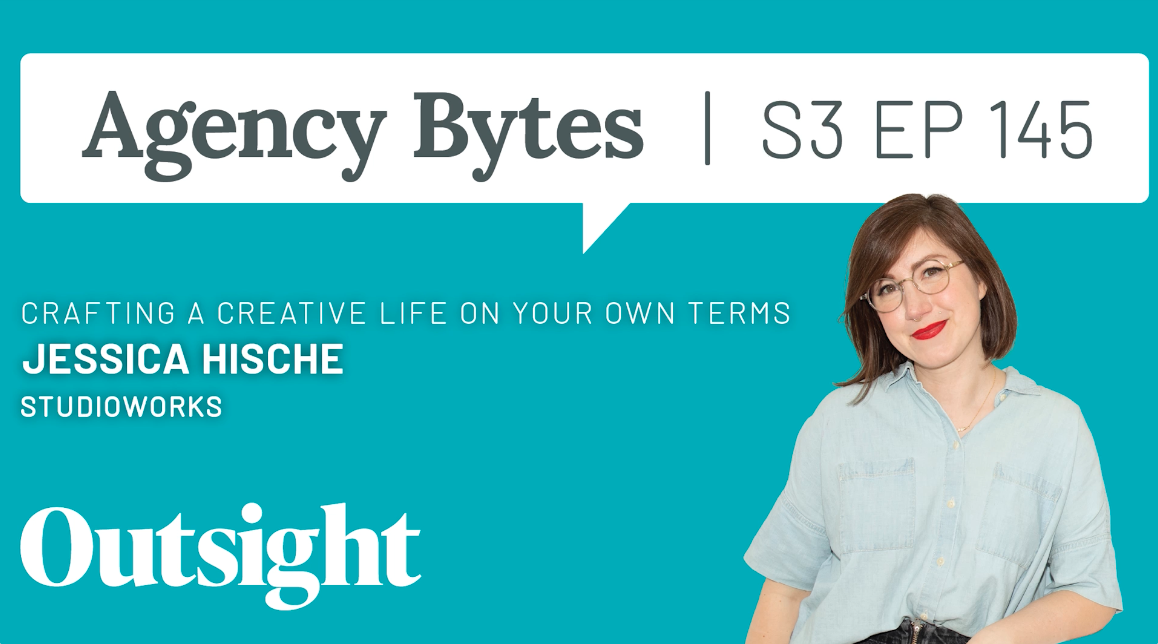
Ep 145 – Jessica Hische, Studioworks – Crafting a Creative Life on Your Own Terms
Listen & subscribe on the platform of your choice
Featuring: Jessica Hische, Studioworks
In episode 145, I sit down with Jessica Hische—a world-renowned lettering artist, New York Times bestselling author, and one of the most thoughtful creative voices of our generation. And full transparency: I’ve been a huge fan of Jessica’s work for a long time. Her ability to pair obsessive craft with clarity, intention, and humanity has influenced how I think about creative work for years.
This conversation goes far beyond tactics or tools. We dig into what it really means to answer a creative calling—and then protect it. Jessica shares how she’s built a career that honors her instincts, values her time, and stays deeply connected to her craft, without burning out or selling out. We talk about the choices she’s made to stay true to her creative voice, even when external pressure—clients, platforms, trends, or scale—could easily pull things off course.
We also explore the less romantic but absolutely essential side of creative freedom: boundaries, systems, pricing, and self-advocacy. Jessica opens up about how she’s learned to put structure around her work not as a constraint, but as a way to preserve joy, sustainability, and long-term creative integrity. Whether it’s choosing the right projects, saying no without guilt, or building tools that support creatives instead of exploiting them, her through-line is clear: creativity thrives when it’s respected.
For agency owners and creative leaders, this episode is a powerful reminder that building a business—or a career—on your own terms isn’t about sacrificing ambition. It’s about defining success for yourself, staying grounded in your craft, and making intentional choices that allow your work, and your life, to evolve together.
This one felt special to record—and I think it’ll resonate deeply with anyone trying to build something meaningful, creatively and personally.
Key Bytes
• Why answering a creative calling is an ongoing commitment, not a one-time decision
• How staying true to your craft doesn’t require self-sacrifice
• The role boundaries and structure play in long-term creative freedom
• Why defining success for yourself is the real creative advantage
• How creatives can grow without burning out or losing their voiceChapters
00:00 Following a creative calling
06:40 Staying true to your craft over time
14:10 Defining success on your own terms
22:35 Boundaries, pricing, and protecting creative energy
31:20 Structure as a support, not a constraint
40:05 Evolving creatively without losing yourself
48:30 Advice for creatives building sustainable careers
Jessica Hische is a lettering artist and New York Times Best-selling author based in Oakland, California. She specializes in typographical work for logos, film, books, and other commercial applications. Her clients include Wes Anderson, The United States Postal Service, Target, Hallmark, and Penguin Books and her work has been featured again and again in design and illustration annuals both in the US and internationally. She’s been named a Print Magazine New Visual Artist (20 under 30), one of Forbes 30 under 30 in Art and Design, an ADC Young Gun, a “Person to Watch” by GD USA, and an Adweek “Creative 100”. She's also the co-founder of Studioworks, invoicing software for creatives by creatives.
Contact Jessica on their website, Threads, and Instagram, and learn about Studioworks here.
-
Steve / Agency Outsight (00:01.058)
Welcome to Agency Bites. I'm your host, Steve Guberman from Agency Outsite, where I coach agency owners to build the business of their dreams. This week's guest needs no introduction, but we're going to do it anyway, just for those who don't know. So Jessica Hish is a world renowned lettering artist and New York Times bestselling author whose work you've probably seen whether in a Wes Anderson film, on a US Postal Service stamp, or gracing the shelves of your favorite bookstore. She's collaborated with brands like Target, Hallmark, and Penguin Books.
been recognized by Forbes, Print Magazine, and Adweek, and recently co-founded StudioWorks, an invoicing platform built for creatives by creatives. So, super pumped to have you. Great to see you. Thanks for joining me.
Jessica Hische (00:42.461)
Yeah, happy to be here.
Steve / Agency Outsight (00:44.622)
Yay, so there's a million places to dig into, but I guess first I'll start with, I've watched since back in the days of like the K10K message boards, your career just like skyrocketed. And you've been on your own like the entire career, navigated so many obstacles and challenges and just like stayed the course. And I'm like dying to know like for you to share with other.
entrepreneurs, aspiring lettering artists, aspiring whatevers, like what kept you driven on I'm gonna stay on my own? What were some of like the bigger things that you learned along the way?
Jessica Hische (01:25.299)
Well, one of the things that kept me always wanting to be independent instead of having a bigger studio or a lot of staff to support is just wanting the flexibility of both my time and what I choose to do, and then also the kind of work that the studio takes on. I just was able, I was afraid to start a studio, which was the real.
like at first, because I was like, that feels scary to be in charge of other people's futures. And also, anybody that starts freelancing or starts their own business, it takes so long for you to really believe that the work will keep coming to you. just kind of, every time you get a job, you're like, so I guess this is the last job I'll ever do. And that feels that way for five years, maybe, until you have a pretty good like,
Steve / Agency Outsight (02:10.39)
Hahaha
Jessica Hische (02:16.591)
know, nest egg in your business account that hasn't been disappeared by quarterly taxes. And then you're like, okay, I think that money might actually belong to me and it's not future tax money finally. And then that makes you feel a little braver and a little more secure. So it started kind of out of the place of freelancer fear. And then it kept going just because as I stayed the course with that, I saw folks set up studios and have to deal with
managing the overhead of the studio of just like, okay, well, because we have a staff of five, it means only this kind of work can come in and we have to be constantly outreaching and doing biz dev and doing a lot of like the fast, quick, cheap, know, free charitable stuff or whatever was harder to do for them. And so I didn't want the studio set up.
to dictate the kind of work that I had to do to support it. I wanted to be able to grow into the work. And so I kind of just had this ethos of like, I always want to be able to do everything myself. And if I can't, I want to pull in people to help me with it, but do it as more of like a case by case rather than it being like a permanent, all right, let's always be set up to do strategy. Let's always be set up to do web dev. Let's always be set up to do all these things.
So then I can really flex my business based on the stuff that's coming in and the stuff that I'm interested in.
Steve / Agency Outsight (03:49.08)
So the intentionality was I want to stay true to the craft that I love as opposed to be set up to do all kinds of stuff I don't love doing, covering all this overhead for nonsense that I don't love doing. Where did that kind of intentionality come from? Did you see others doing that? Like who inspired it in you?
Jessica Hische (04:04.895)
I think what inspired it most is just like I was just so excited about design when I first started out that it was easy for me to like want to work on absolutely everything. And then I started to feel like more passionate about certain things than other things. And rather than just accept that of just like, okay, well, the thing that I like is actually 20 % of the work, but the work is 100%. And we just got to do the bad stuff as a part of the good stuff.
Steve / Agency Outsight (04:15.895)
Mm-hmm.
Jessica Hische (04:34.301)
I was just like, if it's just me, I can only do the stuff I like and just tell people I don't do the other stuff. And that's like, that's a thing that you can do if you have lower overhead. Because once you have high overhead, you can't make those choices. You know, like you can't decide, I'm actually gonna tell this client who's coming at me with like a hundred thousand dollar budget that I don't want to take on a project of that scale.
Like, but if they want to hire an agency and then pull me in as a specialist with 20 to 30,000 of that budget, I'm happy to like do my thing. And what I really found from that is like, for one thing, it's sort of like a, like a weird, like negging the game kind of thing where in terms of psychology, where if you're less available, people want to work with you more and they just assume that you're like, you know, really know what you're doing.
And then there is this level of self-awareness and self-assuredness that you communicate to clients by just being straight with them about stuff that they shouldn't pay you to do. Because I would be like, man, it seems like this project has a lot of production to it. And what you don't want to do is pay me my very high day rate to do this stuff, because that's just a waste of money. I want to make sure that you're actually spending your money really efficiently.
Steve / Agency Outsight (05:52.162)
Mm-hmm.
Jessica Hische (05:58.781)
really happy at the end of the project with the work that's done, but then also the money that's been spent because you're not in a position to just throw money into the wind. And I think everybody really appreciates just like approaching projects from a like protective to their business standpoint. It just instantly builds trust. And so it's like, I'm able to protect my business and my time while also
Steve / Agency Outsight (06:20.215)
Mm-hmm.
Jessica Hische (06:25.894)
respecting their business and their budget. And I think that's just really worked very well.
Steve / Agency Outsight (06:31.863)
Yeah, you've become a steward of their business from the initial engagement. And so, so many agencies are like, we're true partners, but they're really not. They'll take every cent they can get out of the client where you're like, truly, I'm gonna be your partner. And if there's money you should spend elsewhere, just spend it elsewhere. My craft is, yeah, I love that. You mentioned like, there's those projects you get where you're like, this is gonna be my last project ever. What was your first like pinch me, my God, I can't believe so-and-so is hiring me project.
Jessica Hische (07:00.478)
So wasn't even like, I can't believe so and so, but my first like real big budget project was I did the illustrations for the IRS's tax calendar in like 2008 or something like that, it was maybe even earlier than that. And it was like a big budget project for me. I think it was like, you know, 30 or $40,000. And so at the time, I think this was either when I was working for Louise or very soon after for Louise Feely.
Steve / Agency Outsight (07:12.588)
Ha ha ha ha
Jessica Hische (07:30.226)
the budget of that project was my salary. It matched what I made in a calendar year at my other job. And I was like, holy shit, this is like a three month project and I'm making what I make in a whole year at my job. And that was like my big, this could actually be a real thing projects, yeah.
Steve / Agency Outsight (07:53.622)
And the irony that that's for the IRS, like the man, you know what I mean? That's amazing. What about...
Jessica Hische (07:55.846)
I know.
Well, I learned really early, I just learned really early on that the money is in all the uncool projects and all the cool projects have no money. And so I used to joke with friends all the time that I'm just like, you want to pay me to draw a hamburger, I'll draw a hamburger. You want to pay me to draw whatever, I'll draw whatever. Because I just didn't have a lot of ego about it. I just was like, I just like drawing. And so I don't mind what I'm drawing as long as I'm drawing. That's not all.
The case, of course, but ideally you're excited about the thing you're making while also just being excited about the process of making. But in general, I can get excited about almost anything just because the process is fun. If it's a boring project, gives me boring, or a phone it in project, gives me permission to just marathon old episodes of The Wire while I like...
like work on that, like, oh, this is like work spa, I love this. And if it's like fun and challenging, then it's like exciting and fun and challenging in different ways. So I don't know, I feel like there's different things to love about different kinds of projects.
Steve / Agency Outsight (08:53.357)
Hahaha
Steve / Agency Outsight (09:03.693)
Yeah, and you've woven design through like every aspect of, I mean, easy to say your life, like the home that you and your husband have like restored. And I say that from stalking from, you know, Instagram over the years and all that, but the businesses that you run and, um, you know, all the businesses that you run, mean, everything is design centric and that's just you in your heart. And I feel like you've also got this style. I've seen so many people like in the past, maybe decade jump into procreate and start to
Jessica Hische (09:15.654)
And I'm here, yeah.
Steve / Agency Outsight (09:33.089)
You take your lettering courses and like kind of jump onto your style. had a designer that worked for me and she is a huge lettering nerd. so like you've, you've set almost a movement of lettering in place, probably unintentionally. don't know. Like, was that a focus for you of like, want to teach other people and get that going.
Jessica Hische (09:52.763)
It wasn't necessarily an intention, but I'm definitely a person who like, I feel like I'm like a pass through for data. Like as soon as I learn something, like it's very exciting for me to tell other people about the thing that I learned. And that's just like a natural part of me learning. And I think I get a benefit of that, of just like,
you know, if you're explaining something to someone else, it actually like helps really like solidify that information in yourself. And like, you know, I would always, the way that I would study for tests, for instance, when I was in like elementary school is I took like really meticulous notes and I would just copy my notes. You know, I would just like rewrite my notes like once or twice and that was my studying. So it's just about like sharing information as a way for me to like,
really hard coded into myself. And then also just because if I learned something and it took me a minute to find it or I had a real eureka moment, like it gives me immense joy to like have someone else have that eureka moment because we're all sort of built on people that have helped us along the way and like, know, it's awesome. And so when I was first starting out, there just weren't that many people doing lettering.
professionally and really calling themselves lettering artists just because, you know, in the 80s and 90s it was like so big and huge and then it kind of fell out of favor just I think because of display typefaces being so readily available and just people not wanting to budget for it and things like that. Or just not thinking that like that kind of craft was important because it was very much that like design system, know, like Swiss, blah, blah, blah. And then there is just this like secular
Steve / Agency Outsight (11:40.045)
Mm-hmm.
Jessica Hische (11:45.902)
circular interest in craft, right? Where like people are like, wow, like we miss craft. And then it's like, like, I'm kind of bored of this. Like it feels like we're getting too fussy. Let's tone it down. But like, there's maybe like a five year to 10 year cycle about people being into craft and people not being into craft. And I just didn't realize it that like my career basically started when people were really, really hungry for people
doing things by hand and doing things in a slower, more process-driven way. And so when I discovered lettering for myself, I was basically just taking existing typefaces and drawing my own versions of them that better matched my illustrations. say I was working with a typeface on a book cover.
Steve / Agency Outsight (12:33.261)
Hmm.
Jessica Hische (12:38.249)
And I needed like the title big and the author name smaller and a novel smaller than that. But I wanted it to all be in the same style, it only came in one weight. I would then like redraw the letter form so that they all felt cohesive or added flourishes or whatever. So it started by like manipulating things that were out there in the world, but quickly escalated to just me drawing things from scratch. And I wanted to shout it from the rooftops because I felt like nobody knew what this was.
And within the younger design sect, I even got this piece of lettering tattooed on my arm that says type, and then all the nerds would be like, actually, that's lettering, I should say lettering. But even then just having them explain that to me then made me like, okay, well all the graphic designers are using this word wrong, I should tell them that they're using the word wrong. And then it became like every time I had a speaking event,
Steve / Agency Outsight (13:15.821)
love that.
Steve / Agency Outsight (13:21.197)
Ha ha.
Jessica Hische (13:35.899)
like me educating the audience of being like, hey, did you know that a font actually means this, type actually means this, calligraphy actually means this, lettering actually means this, and kind of just showing people where all those things fit within creativity and design. And part of that was just for myself because I would have clients coming to me and saying, like, I want you to draw a font for this thing. And they didn't mean, I want you to make.
a typeface with a software at the end of it, they meant I want you to do lettering. But sometimes they did mean that, even though they didn't need that. And so I just wanted to make it so everybody could clarify what they wanted. And as a result of that, so many more people sort of ended up understanding what lettering is and getting excited about lettering as a discipline. And so it was like me and a handful of maybe like 10 other
other folks at the time that were really like the lettering artists that kind of kicked it off. And then there's been like a second and third wave and now I bet a bunch of the folks that get into it like just have no idea who I am. but yeah.
Steve / Agency Outsight (14:44.939)
I highly doubt that. I think you have an anchor in the craft and in the industry. So I highly doubt that.
Jessica Hische (14:49.435)
Well, you never know. Some of them have been better at being influencers than me. Like, I'm not a, I don't play the influencer game that much. And even though I have like online classes, it's not my, I only do them every few years. The last time I did like an online lettering class was probably like 10 years ago. And so the folks that are doing them regularly are the ones that are kind of like educating the younger folks. And if they mentioned me, cool, but I don't expect them to.
Steve / Agency Outsight (15:07.297)
wow.
Steve / Agency Outsight (15:14.433)
Yeah. Yeah. Yeah. But you so I mean your website's got a few kind of evergreen courses and learning about lettering the business side of lettering and you've got templates and things for the entrepreneurs that are focusing on their craft and building a business. Like myself you went to design school you didn't go to business school. So talk about like balancing the business side of creativity and how you juggle the two so you can focus on the craft.
Jessica Hische (15:34.022)
Yeah.
Jessica Hische (15:42.162)
Well, a lot of my, like with the online learning stuff and just sharing resources, like again, just whenever I learn a thing, I wanna teach a thing. But I'm really like allergic to the idea of being this like design guru. So anytime it seems like that's like mostly what I do, I run away from it like big time. you know, the last I did.
an online course called the Dark Art of Pricing a couple years ago. It probably like four or five years ago. And then I redid it two years after that as the Dark Art of Creative Business, which was like a much bigger, broader one. And those were meant to be like, I had a illustration rep for 15 years and I've been running my business for 17 years. And I just felt like there were things that
I knew that I would, or like, you know, learned along the way about managing a business that I wanted to share. And then also I just wanted to like demystify pricing and come up with a framework that was kind of scalable for creative pricing that made sense and was defensible. Because I think a lot of the way that people price projects is just sort of thinking about like, what's the industry standard, which is a really hard thing to defend against to a client.
Steve / Agency Outsight (16:41.869)
Mm-hmm.
Jessica Hische (17:03.655)
You know what I mean? Like a client doesn't care that like the industry standard for a logo is X, what they, cause they're like, yeah, but I'm not in your industry. I know what money I have, whatever. So when I made the Dark Heart of Pricing, what I really wanted to do was to come up with a thing that you could really easily defend to clients. So it's sort of based on this like understanding of your time and what your time is worth.
and what a typical work week looks like when you're full-time employed as a designer, as full-time self-employed. And just kind of being real with folks to be like, you're not gonna bill 40 hours a week. You're gonna bill 20 to 25 hours a week. Like if you're billing 40 hours a week, you're working 70 hours a week. And so like the whole point being, how do you make it so that you can feel more comfortable running a creative studio? You can set boundaries with your time.
and actually have a really good understanding of what you should charge and what your bottom line has to be in terms of what you'll accept as a negotiation. So then if a client comes to you and they're like, yeah, but so-and-so does a logo for $2,000, you can be like, OK, here's how that works. If you pay me $2,000, I'm essentially making $30 an hour to make this logo.
And honestly, I would rather go make $30 an hour having a bullshit retail job and just like sitting and playing Candy Crush than doing something that is actually like utilizing years of my experience and all of this time and money I've invested into learning all of this stuff. And my new favorite thing to tell folks that don't want to spend a lot of money on like, especially logos.
is that if you don't have a decent budget for your logo, like you don't wanna invest in your logo, what that communicates to me is that you don't believe that your business will be successful. So like, if you don't believe your business will be successful, I don't know if I want to do your thing because I don't wanna put a thing in my portfolio that's gonna fail in six months. So if you believe this will be successful,
Steve / Agency Outsight (19:12.214)
Absolutely. Yeah.
Jessica Hische (19:27.36)
I am here with it and I will work with a smaller budget, but that budget says to me I don't have faith in my business and I don't want to work with folks that don't believe in what they're doing, you know.
Steve / Agency Outsight (19:38.523)
I love that. I love that a lot. The one thing I think you, I don't know if you missed, but like that, that goes into that formula of like, what's that hourly rate? What's it worked down to is so many creatives just don't know how to price themselves because there's like low self confidence. Like, sure, I'm really good at drawing or I can make really beautiful things, but I can't charge more than, you know what mean? That whole like self trepidation, imposter syndrome, whatever you want to call it. and I just feel like so many creatives struggle with that.
Jessica Hische (19:59.729)
Yeah.
Jessica Hische (20:06.151)
Well, you have to also be aware of the market that you live within. If in your town, people that are full-time employed at a design agency are making $40K a year, then you can sort of expect to make $60 to $70K a year as a freelance person, because you don't have the stability and the benefits of the $40K person. But it's probably harder for you to command $200K a year if a person that's doing your job is making $40K a year.
And so you have to pay attention to the local market, but then you can work backwards from there and be like, okay, well, if I want to make 75K a year, that equals this many, like 20 times 52 weeks, and then divide that out of how much I need to make per hour, like minus my expenses and all this kind of stuff. Yeah, yeah, there's so much stuff you have to take into account. You also have to set aside like,
Steve / Agency Outsight (20:57.046)
And minus my vacation time and minus the days I don't want to work. And yeah.
Jessica Hische (21:05.23)
money for health insurance, money for anything else like that. people don't plan that stuff out. So that was the purpose of my course that I did was just to kind of give people permission to actually think about all that stuff, do a little light financial planning, and then to be able to use that to help inform the prices that they charge. Because you might think it's hard to charge more than 40 bucks an hour for design work, but then when you actually go and math that out.
You're like, wait, that's not actually sustainable as a salary at the end of the year, which means that I'm either just gonna struggle or this whole thing is gonna be a side hustle or I know that in five years I'm gonna have to look for a full-time job. And so then you could just be real about it. Like if you're like, I can't find work that's more than 40 bucks an hour, you're like, okay, well I just gotta go on LinkedIn and start sending resumes out because if it's not working, it's not working, you know?
Steve / Agency Outsight (21:59.769)
Yeah, yeah, yeah, I guess that's the great way to formalize it, but I'm a big fan of like, especially in the freelance world, doing more value-based pricing, project pricing. I want freelancers and entrepreneurs and even small agencies to run fast and far from hourly billing. I just think it's a trap.
Jessica Hische (22:15.868)
yeah, yeah, I don't use hourly billing as the way I bill. I use it to inform how I price projects. So I actually think of things as, I usually use day rate rather than hourly, and then for me, a day is anything over four hours. It's like, if I'm at my office, if all of us are real with each other, how many hours in the day can you spend just blazing through a project?
Steve / Agency Outsight (22:19.179)
Okay. Yeah.
Love it.
Jessica Hische (22:43.74)
It's usually like four to six hours. And then after that, you're just burnt and you need to just be doing like admin work or whatever. And so to me, I take that hourly and think of it as a day rate, but the day rate is not times four hours, it's times eight hours or 10 hours or whatever. And then I have some flexibility if I want to work a longer day or a shorter day or whatever. And then on top of that, so that's how I calculate the creation fee.
So just sort of like the flat rate of what I believe the project will take me to do with buffer built in of 10 to 20%. And then I have like a usage and licensing fee on top of that, which scales to the project. And so that's how I work for everything. It doesn't always work that way for graphic design because you're not licensing work that way. So you have to figure out how to.
Steve / Agency Outsight (23:17.944)
Mm-hmm.
Jessica Hische (23:37.634)
scale your work in a way that doesn't involve licensing, since you're usually doing stuff that's basically work for hire. But yeah, so I use it as a framework for coming up with flat rates rather than thinking of it as a thing that I build.
Steve / Agency Outsight (23:55.511)
Love it, yeah. So wait, you just made my mind kind of explode. Do you get like a royalty every time a movie plays that has your lettering in it?
Jessica Hische (24:03.268)
don't tell, let's not talk about movies, because movies don't play things, movies don't pay money. you know, that's again, going back to the cool projects don't pay well and uncool projects pay very well. No, it's usually like, like say I did a bunch of stuff for Salesforce for like Dreamforce. So what they'll do is they'll pay for an unlimited use license for one year of the stuff that I use.
Steve / Agency Outsight (24:06.134)
Okay. No, I didn't think they did. Yeah.
Jessica Hische (24:33.147)
And then if they decide next year they want to use the same asset, they repay for a license. Or they have the option, if they want to buy out the rights to the artwork, then they can just own the artwork outright. And so what that allows me to do is to have this really scalable way of working with people. So then if I'm working with a mom and pop company and they have a logo that I'm doing, I can charge them $5,000 for the buyout, which is like,
super low, but if I'm working with a bigger company, I can charge $20,000 for the buyout. And then if they're like, we don't have $20,000, and I was like, well, maybe you don't need the buyout rights. Maybe you just are going to use this for the Valentine's campaign that the art is for. So maybe you don't need buyout. And it allows me to sort of scale the work without actually scaling my creation fee. So I don't have to scale what I'm being paid for my time. I'm only having to scale the use of the work.
Steve / Agency Outsight (25:31.192)
Gotcha, interesting, yeah, yeah. No, I know movies don't have budgets. We did a website once for a movie and I was like, that's all that they want, that's all the money they have and they're like, yeah, that's pretty standard. was like, yeah, we're never doing this again. So yeah, yeah. But I was thinking royalties and rights managed and all that. was thinking, wait, every time something gets replayed, the actors typically get a penny or whatever the heck it is. So didn't know if lettering also played in.
Jessica Hische (25:43.18)
Yeah, totally.
Jessica Hische (25:54.78)
Yeah, there's no way of tracking that stuff. Like maybe there's a future in which there's like, I think this was the grand desire of Web3, which is why like when all that stuff was happening, I wasn't like initially 100 % opposed to it. Of course, the fallout of it was a bunch of grifters ruined the grand plan, but there, know, the optimists of it were.
things like this, like where we can actually track the provenance of digital assets and see where they end up and there's a kickback to the artist when it's reused. Like that was the thing that I found to be like exciting and promising about it, but of course it didn't really pan out that way.
Steve / Agency Outsight (26:35.79)
Yeah. Yeah. From an entrepreneurial standpoint, like you are, I think, super entrepreneurial. Obviously, you've got a few businesses you operate. You've been running your studio for, I you said, 17 years. Where do you get that from? Is it like, your parents entrepreneurial? Is that in your blood?
Jessica Hische (26:53.909)
It's like kind of a, it's kind of a mix. Like my dad was a dentist and so he like ran his own dental practice. So he had his own business. But I honestly think like the biggest push was when my parents got divorced. My mom like didn't really have a career at that point and just never like totally got back on her feet. And it made me just feel like I couldn't
Steve / Agency Outsight (27:19.352)
Mm-hmm.
Jessica Hische (27:24.505)
Like I couldn't put my eggs in any one basket. And part of that too is just being the age that I am. Like I'm 41, so I'm like an elder millennial. And I think our generation and maybe like the younger Gen X just saw people getting laid off after working at places for like 20 years. And they're just being no loyalty, no repercussions or whatever. So our like boomer parents, like the older boomers, my parents are like kind of
Steve / Agency Outsight (27:44.386)
Mm-hmm.
Jessica Hische (27:53.572)
middle boomers, but the older boomers were like, what are you doing? You should go work somewhere and get a pension and get a whatever, because they just didn't understand where the winds were shifting. And so it was like a combination of like seeing my mom never really get back on her feet and just like really wanting to make sure that I could like make my own money and be in charge of my own future. And then also just kind of knowing that that was the way that the winds were starting to shift where
you you couldn't trust that if you committed to a place that it would be your forever. You know, like this idea that you would be somewhere for more than five years was, like, seemed crazy. Yeah.
Steve / Agency Outsight (28:34.702)
Crazy, yeah. Yeah. From the female perspective, so I'm asking this because more than two thirds of the agency owners I work with just tend to be female and I love that and I support the heck out of that. I want to give voice and platform for that. I want to support any marginalized audience, but for some reason that just seems to be a majority of my clients. And so I'm curious from your standpoint, downfalls or pitfalls rather and or
opportunities as like a female entrepreneur that you've experienced.
Jessica Hische (29:07.931)
feel like, generally I feel like I've had a lot of opportunities because of being a woman or looking like a woman or whatever identity is in this body. Mostly, people are generally really excited about getting more voices out, because it makes them look good to have not a bunch of white dudes on a panel or whatever.
So I mean, I do feel like I've had a fair amount of opportunities from that, but I also feel like part of that is just because I'm a really extroverted person and very happy to step into those opportunities. And I've definitely seen, I've talked to men that organize events and they're like, yeah, we have invited all these people and they say they're too busy or they say that this or I think that a lot of the, even folks that are really trying to.
have diverse panels and lineups and stuff like that. What tends to happen is that women and just anybody that is not a hyper confident, low self-awareness white guy is so focused on making sure that their business is running well and that they're taking care of their people and that they're taking care of their families and taking care of whatever, that they tend to just be like, I'm too busy for this.
like and not want to do it, whereas, you know, like people that are not as on top of it are just like, pick me, you know, so it's harder to, it is harder sometimes to populate those things because we tend to be pretty on top of our shit and not wanting to step away from responsibilities and things like that. So yeah, I feel like I've gotten a fair amount of opportunities because I've also just been like willing and able, but we also like, my husband and I are both,
Steve / Agency Outsight (30:42.36)
Mm-hmm.
Jessica Hische (30:56.814)
really ambitious, hardworking people. And one thing that I've noticed that is a little more rare is couples where both people in the couple are equally into their careers. Because I've been to a lot of creative summits that are like women agency people, or women in tech, and women in whatever. And almost all of them have stay at home husbands, if they're like C level people.
it's much harder to find people where like it's a couple and both of them are doing stuff and they all and they don't have like 50 nannies or whatever. Like we don't have like an au pair or a nanny or like whatever. We my mom lives near us but she's also my employee and so I'm like mom pick up the kids please I'm running late on this thing but that's kind of like a normal like you know you live anywhere close to family and you're doing that you're leaning on them. But
Steve / Agency Outsight (31:53.592)
Yeah, it takes a village. Yeah.
Jessica Hische (31:55.417)
Yeah, exactly. And so I do think that the harder thing as like just a creative in general is being with a partner where you do have that relationship where you can kind of push and pull on each other's careers and understand that like right now is my time to do things that are risky and then next time is your time to do things that are risky and just to be able to kind of go back and forth because the people that
I think have been the most successful that I know, like the couples that have been the most successful are the ones that make space for each other and they kind of flip-flop back and forth, you know, and that's what we've really done. So.
Steve / Agency Outsight (32:37.526)
And when it's not your time to take the risk, you're being the super supportive one, and whether it's emotionally or however you're being supportive. Absolutely, I love that. Seems like a good balance, the yin and the yang.
Jessica Hische (32:48.154)
Yeah, and so I've been able to be entrepreneurial lately because Russ has had a full-time job lately. So I'm able to take a little bit of a risk and not do as much client work and work on StudioWorks, which has been the majority of my time this last year, just because we know that we have consistent income from him. And while I'm still working on client stuff and I still have other income sources, we live in the Bay Area, our lives are expensive, and as much as we do,
our best to keep our expenses at a minimum. Even just property taxes and insurance are enough to have one of us need to a full-time job.
Steve / Agency Outsight (33:27.758)
Well, that's an awesome segue. I want to learn a little bit about StudioWorks before I let you go. So I followed the progress. I know you've been meticulous in the design aspect of it all, in the process aspect, in your partnership, and what inspired the need for this app. Talk about what StudioWorks is about, what solution it's solving for.
Jessica Hische (33:52.315)
Yeah, totally. So it started actually just selfishly because I was like, you know, I feel like I haven't had any fun tinker on the internet projects in a while. And I used to love doing that. And I loved making these like websites that solved somebody's small purpose or whatever. Like I made so many of them. Like basically 2011 was my year of launching a thousand businesses. I think I launched 11 that year or something like that.
Steve / Agency Outsight (34:19.746)
Wow. Yep.
Jessica Hische (34:20.75)
But it was all little small potato stuff. It was like a website to find a printer called Inker Linker. It was like quotes and accents dot com to learn how to type quotes and accents. was like, how did mom, this is how Twitter works. You know, like all these things that were kind of one pagers, but were instructional. And I just loved doing it. And it was just also a great way for me to, you know, play around with CSS and just web development because I found it really satisfying and, but I would never want to do it for a client.
You know, like so. And so I was thinking like, yeah, I'd love to do that again, but man, I'm stretched really thin. I obviously should not do this by myself. Maybe I'll like ask a friend of mine who like also loves this stuff. And maybe he also wants to do some like, you know, for fun stuff on the side because we're all like doing our full-time thing, you know, having real businesses and it's fun to have fun. And so out of the blue, I called my old studio mate, Chris Shifflett.
who we are not like phone-a-friend people. Like I have plenty of phone-a-friend people, but when I just thought of like who's someone that I know that is super competent and amazing at what he does with web stuff and also does, has a very different skillset than me. Like, but also is like chill and like loves doing little small community projects and is, and kind of has this very similar mindset about.
like small businesses and taking care of people and like building community, I just thought of him. And so we had this call and I was like, hey, do you wanna just like make like something easy? Like, you know, let's just make like a brand strategy workshop or like, know, something, like something that'll be useful for like branding people or something like that. And we talked for like two hours. And as we kept talking, we were like,
man, but wouldn't it be so good if we could solve this problem? man, actually like this is the thing that would be so great. And at the end of the call, we were like, okay, well like this is all awesome. We definitely can do something, but like everything that we just talked about means we need like an actual engineering team because he's like, I'm like an engineer, but I haven't like built anything since before CSS existed. And so I was like, okay, cool. Let's just table it. You're going on a trip. We'll talk to you later. And then a week later,
Jessica Hische (36:40.858)
Nick and Sean, who are our front end and back end half of the team, emailed him separately to be like, hey, we're leaving our jobs. Do you want to do something together? And so he had worked with them at multiple startups and companies and things like that and was just like, my god, these guys are the best developers I've ever worked with and they're super chill and amazing. So he reached back out to me and was like, hey, you know all those things that we talked about?
that might be happening. Yeah. so, but they had like a meeting of the minds. So they all like got together and kind of like pitched each other on ideas of what they were thinking about working on. So StudioWorks was one of those ideas. But of course, like, you know, Chris is really entrepreneurial as well. He's been like a CEO of a couple of companies. And so he had other ideas he was thinking of. They had other ideas they were thinking of.
Steve / Agency Outsight (37:10.776)
Pick something. Yeah.
Jessica Hische (37:35.31)
And over the course of like three days, like StudioWorks rose to the top of everyone's pile of like what they were the most interested in working on and the thing that they felt could be successful. And so that's kind of, and then he called me and he was like, hey, I think we just made a business. And so it all just kind of started from there. And we just had this idea, like always of, you know, there's this sort of lie within tech.
that in order to create a software company, you have to raise money and you have to, it's like growth above all. It's about the pump and dump. Just like you build a thing, sell it off as fast as you can, find the audience, find the value and then get rid of it because that's really like the biggest thing is that first thing or whatever. And we just were so allergic to that and we were like, let's...
let's make just like a real business that makes real money. And let's make a thing that just delivers on the promises and isn't trying to just like F people at every turn. Let's actually make like generosity, like the core of the business model and just like transparency and like trying to do the opposite of what all of these companies have always done to everyone. And so we were all just like crazy values aligned about what we wanted to do.
Steve / Agency Outsight (38:54.392)
Yeah.
Jessica Hische (39:00.525)
We had this really big roadmap of all the things we wanted to do, but we wanted to start with invoicing because I was just thinking about my own journey as a creative and the things that I did to sort of upscale my business. And I had only just started using QuickBooks for invoices maybe three or four years earlier because I was just sending PDFs, just PDF invoices from the same InDesign doc. so I kind of knew, and I knew plenty of other people.
that that was kind of how they did it. The very first thing they dipped their toes into was using an invoicing software platform. So I knew that for the folks that we wanted to help, which were people that are very small business owners or solo people, independent creatives, that would be the biggest help. One thing I didn't realize, and so we wanted to basically, a lot of the software, QuickBooks, FreshBooks, all these things.
they're super bloated because what happens is they start off by solving one problem and then they start having a growing customer base and then the customer base makes a bunch of requests and they just try to make as many of those requests as possible. But then the actual core customers that signed up are like, I don't need all these things and now I have to click through eight menus to find the one thing that I use. And they're also just like, none of them prioritize design, none of them prioritize just trying to make the...
customer itself look good. Like it's just like they're basically selling their product at every touch point. So if you're invoicing through like FreshBooks, QuickBooks, whatever, the invoice is from QuickBooks. The invoice is from whatever. There's no, there's no like pushing forward the studio or the customer itself. And so we wanted to create an invoicing product that could feel kind of like white labeled to the studio.
so that the studio actually looked more professional by using it. Instead of it being like you feel more professional because you use it, you actually look more professional to your clients, which allows you to back up those prices. Because as soon as you look like you have your shit together, you can actually charge like you have your shit together. So that was one big thing is make it so that the studios that use StudioWorks actually
Jessica Hische (41:22.519)
can look more professional to their clients and in that way can get more trust from their clients, can get paid more and can get paid faster. And then the other thing was taking just what the studios needed out of the product and not focusing on any of the other little stuff that's just kind of like an add-on that makes it feel like the product should be more expensive but doesn't actually add value. So.
Steve / Agency Outsight (41:48.408)
So features, bells and whistles, or benefits, not features, Yeah.
Jessica Hische (41:50.306)
Yeah, keeping it simple on purpose. And then the last thing, which was something that we discovered along the way, was that, you know, like QuickBooks, and I keep mentioning them just because I have the most experience with them, but there's a million other platforms. They used to have like a $10 cap on transaction fees when you got paid through ACH. And they just kind of silently took that away.
We just did, it was really actually quite hard to do research about what all of the competitors were doing in terms of transaction fees. But what we basically figured out is that everyone save from harvest, which is fine and people love, but it's very under designed. It's very bare bones as a product. They charged like one to 1.5 % with no cap on ACH fees.
And then all of the credit card fees are what they are because you can't really control credit card fees. But a lot of times they charge these random like additional like 1 % handling fee or like whatever. And so there's this thing where it's this huge bait and switch where they charge a lower subscription rate but uncapped fees, which then means that you're getting secretly charged or like without really your knowledge about all this stuff that's happening. And it's not, and it's like,
That thing about how it's really expensive to be poor, know, like people that don't have money tend to waste the most money. And we just really wanted to, it's already so hard to run a creative studio. We were just like, this is awful. And like, this is like predatory that people are just looking for ways to skim money off of every single interaction. So we,
A lot of these places use Stripe as their foundational financial platform because building a financial platform is crazy and there's just so much involved in it terms of security and adhering to every localized rule about taxes and all this kind of stuff. So a lot of these things are built on Stripe. But what they do is like, Stripe is like a wholesale financial platform for this reason.
Jessica Hische (44:14.969)
people use their infrastructure and then Stripe literally encourages you. Like we had calls with their sales team where they're like, oh yeah, and then you can just charge 1 % for this and 2 % for that or whatever. And we're like, yeah, but we're not gonna do that. And they're like, what? They're built so that people can do that. So we just are choosing to not do that. And the thing that's really great about that,
is we don't need anything more than the subscription fee that we're charging. So we're trying to be really transparent about that. It's just like, this is it. Like you're never gonna get upsold. You're never gonna get rug pulled or anything. And we just want you to make more of your money. But then because we don't have any skin in the game in terms of the transactions, we can build really cool interactions around the reality of how people actually get paid. know, like any of these invoicing
platforms are not building in a way for clients to tell you how they're paying you outside of this platform because they don't want to encourage you to not do it because they make so much money from you if they pay you through it. So we're actually taking that all into account. So we have all these neat flows for like if someone pays you by check, we show you the address, they can mark it as paid and say the date that the check was sent. So then there's this mechanism for a client to actually tell you they've paid you.
to turn off the reminders to them and then it's on you, the studio, to go in and says, look, they marked this as paid. I know the info about when it was sent out and now I can go check. So then if I don't receive that check, I can reach out to them and say, hey, it looks like you sent the check two weeks ago but I haven't received it. Can you check on your side or resend it? So it just makes the conversations around getting paid way more straightforward.
And so we're building that out for like PayPal, Zelle, like all that kind of stuff so that if you like getting paid through Zelle, you can just have a thing that says, that the client can select Zelle and it just shows your phone number or your email address that is your Zelle thing. It's not like an API connect because that would probably involve some form of fee that we would have to incur or you would have to incur. Instead, it's just like, just take it elsewhere. It's okay. It doesn't have to happen here. We just want to make it easy to track it. So it's sometimes doing it
Jessica Hische (46:34.124)
the way that is a little bit more stripped down is actually just the way that is the cleanest, that benefits everybody the most, and is the most flexible for all people. So if you're talking about another country and everybody gets paid through this random financial service that we don't know about in America, we can build in a thing where they can say, I paid through this thing on this date.
And it's just really nice that nobody else is doing that because why would they? If they want to make their money out of transaction fees, they have no reason to do that.
Steve / Agency Outsight (47:07.426)
Yeah. So fast forward a few months, you launched I think earlier this year. How has traction gone? How is customer base growing? Is it surpassed what you thought?
Jessica Hische (47:17.848)
It's been good. What we did was we had like a pre-launch sign up, which was, yeah, and so the whole thing was like, we're not gonna charge you until we have a product that you are using, right? But we want you to sign up as if we're gonna charge you because that gives us real data about like who's interested in this. And like basically like you're telling us you believe in this and that you want this to the point where you're literally hooked in as a customer.
Steve / Agency Outsight (47:25.048)
Yeah, I remember that.
Jessica Hische (47:47.608)
And then at a certain point we cut that off so that we could do a private beta release to those folks and so we did the private beta release and we had about 980 people that were signed up and I think now we might be just shy of 900 in terms of the retention. It's been a few months of billing which is pretty great.
Steve / Agency Outsight (48:09.4)
Awesome.
Jessica Hische (48:15.705)
And so we're just about to get to the public launch where people that weren't part of that private beta can sign up. when does this episode go up, for instance? Oh, yeah, you'll be fully able to sign up. So today is September 24. We are pushing the soft launch out today.
Steve / Agency Outsight (48:28.728)
December.
Steve / Agency Outsight (48:42.135)
Yay.
Jessica Hische (48:44.692)
officially sign up as of today, but we're not like announcing it as a big thing because we want to sort of let a few slow roll customers test out the new onboarding flow just to make sure that nothing is weird. And we have this really fun referral program that we're going to launch with our existing members and to anybody else that like you get a code to refer people and for every person that signs up and converts to a paid customer, you get a free month.
And so you could basically just have free StudioWorks if you believe in it and you share it with people. And then other people get a free month and it's like the way to get a free trial without us having like an unlimited random people can have a free trial. Because I don't think that like free trials can be really helpful because you want to be able to test out software, but it doesn't actually give you useful information about who's going to stick around. And we just don't want a bunch of ghost accounts. We want people that actually like Karen.
Steve / Agency Outsight (49:13.934)
Nice.
Jessica Hische (49:42.604)
want to be a part of it.
Steve / Agency Outsight (49:44.333)
Yeah, I love it. I'm excited for you. think it's a needed solution for the industry, for solopreneurs, freelancers, et cetera. There's a lot of solutions out there, some better than others. But the thing I love about it for you is you're like, hey, there's a need. I'm gonna make it happen. And you tapped into your creativity of things that passionately set you on fire. So yeah, I just think it's awesome. I'm a raving fan and...
Wish you the most success with it, so yeah.
Jessica Hische (50:14.71)
Thank you. I mean, there's been so many things that have been great about it, but like the biggest thing is it is amazing to make a thing that you yourself want to use and that you need. And so it's been like incredible to just like be invoicing my own clients with this platform that I built. And when they are like being like, what's your wire instructions? I'll be like, no, actually you can pay me through this.
it's not gonna take away all my money if you do that. Because they're so used to people reaching out and being like, just send it through the bank because I don't want them to take the fee. I'm like, it's a $5 fee, just go for it, I don't care. And that's just, it's really nice and really refreshing to be able to do that. yeah, I don't know, it's so cool. So that's really cool. And just the whole thing that the whole team is just really stoked on just making things that actually like,
make other people's businesses work better and it's a passion thing for everybody. We actually don't want to exponentially grow because that would cause scaling problems and us having to hire a bunch of people. We don't want that. We want it to be small and us. And we also want it to be the people that get it and that have tried the other things and are like, actually, yeah, this actually is it. It's really good.
Steve / Agency Outsight (51:29.996)
Yeah. And you don't want the feature bloat that you mentioned some of these other platforms have based on customer demand. So this is the solution. This is what you get.
Jessica Hische (51:37.292)
Yeah, and yeah, and similar to the thing that I was talking about with like how clients have really respected the fact that if I don't offer the service that they need, I'm happy to send them to somewhere else. We have the exact same ethos with StudioWorks where we're like, like if people come to us and it's like, well, like I use this other thing and they have all these things, how come you don't have it? And then we go, are you happy with that thing? Because if you are, like, just stay there, you know, that seems fine.
Steve / Agency Outsight (52:05.89)
Yeah. Yeah.
Jessica Hische (52:07.159)
Like we might not be for you, you know, or if someone is like, you know, I'm a hundred person company and I need to be able to have a custom domain, blah, blah, you know, whatever. I'm just like, yeah, maybe we'll get there someday, but right now the audience that we're serving is not you. And so, yeah, so it's just kind of nice to, you don't have to make something for everyone, you know, like, cause if you make, if you try to build for everyone,
you build for no one, like know, like no one is happy. So you just like really find, let your thing find the people that it's for. And then it, yeah.
Steve / Agency Outsight (52:43.49)
Yeah, and stay true to those values. Like if those are what's core to you and your team, like stay true to that and no wavering from it. Everybody wins. Yeah. All right. I want to wrap up with a couple of rapid fire questions because we blew through the 25 minutes or so timeframe, which I'm super grateful for. So first is coffee shop, sketchbook or iPad on the couch. Where do you get your best ideas usually?
Jessica Hische (52:51.148)
Yeah, exactly.
Jessica Hische (53:08.322)
Well, sketchbook is not ideas. Like I am an ideas person similar to like the ideas in the shower. It's usually through like passive movement in the world. So that's like while driving or while like, you know, doing some random thing that involves my hands and body doing something while my mind can drift. So sketching is not that. It's usually like wandering around, like exercising.
Steve / Agency Outsight (53:15.832)
Yeah.
Jessica Hische (53:38.036)
sitting around and organizing things, like whatever. It has to be like a busy, busy body activity. That's where I get my... Non-design things.
Steve / Agency Outsight (53:44.566)
Non-designed, yeah, love that. Yeah, what's a book on your shelf that you go back to time and again for inspiration?
Jessica Hische (53:52.696)
Ooh, I'm not a book revisitor. Well, actually, no. I do love the Dover collection books of just tons of lettering samples. Also, Ryan Hughes, his name spelled R-I-A-N, I believe, made a few collections of lettering from different decades. And I do find myself pulling those out quite a bit, just as like, I'm just going to look at some.
Steve / Agency Outsight (54:06.008)
Mm-hmm.
Jessica Hische (54:21.004)
fun, pretty stuff, you know, like for a little while to get inspo. So those are sort of like good unstick books for me of just like quickly looking at a bunch of different lettering styles and think I'm reminding myself of the ways that I can draw things. And yeah, yeah. And then I, the kind of books that I read though are like, I'm currently doing the audio book for like a book that's like the history of San Francisco.
called Season of the Witch, and it's awesome. It's very full political history. So I like nonfiction books. One of my favorite books I read last year was Emperor of All Maladies, which is a biography of cancer. I like to read about medical things and body things. Yeah.
Steve / Agency Outsight (55:06.1)
wow.
Steve / Agency Outsight (55:12.238)
Very cool. All right, and then finally, other than AI, because we haven't mentioned AI and I don't want to mention AI, what's one business or creative tool that you can't imagine living without these days?
Jessica Hische (55:19.064)
you
Jessica Hische (55:23.576)
Some business or creative tool I can't live without, well Studio Works, no, of course that. But I actually...
It's hard to say like one tool. know, like I have been actually trying to do more analog work, mostly because I always love splitting my work into very different processes that then, that kind of helps me stay refreshed on my stuff. So what I tend to do is just like have a lot of different ways of creating.
And I need to have all of those things to be accessible to me for when I'm feeling like burnt out on one thing versus another. So like right now I bought a tattoo gun and I've been teaching myself how to do tattoos. I also bought a chain stitch machine and I do a lot of printmaking and all kinds of stuff like that. those tools are not my like day to day go to tools, but I do feel like they're always the thing that is my like treat at the end of the rainbow.
Steve / Agency Outsight (56:05.678)
Hmm.
Jessica Hische (56:29.484)
where I'm just like, I just get done with this, then I can spend some time doing this, or I don't feel like doing this right now, so I'm just gonna practice making little loops on my chain stitch or whatever. I always need to have something that is my procrastinating from the hard thing doing the fun thing.
Steve / Agency Outsight (56:47.82)
I love that. Yeah, very cool. Jessica, I am so grateful for your time. Personally, I'm grateful for the inspiration that you've brought to my life and the world around us for at least the past 15, 20 years that I've watched you from afar. So thank you so much for all you've done for our industry and for your craft and for joining me today. Thank you.
Jessica Hische (57:08.246)
Yeah, of course. Thanks for having me. This has been so fun.