
How Steve Guberman Built, Sold, and Reinvented His Agency — Season 4 Kickoff
Listen & subscribe on the platform of your choice
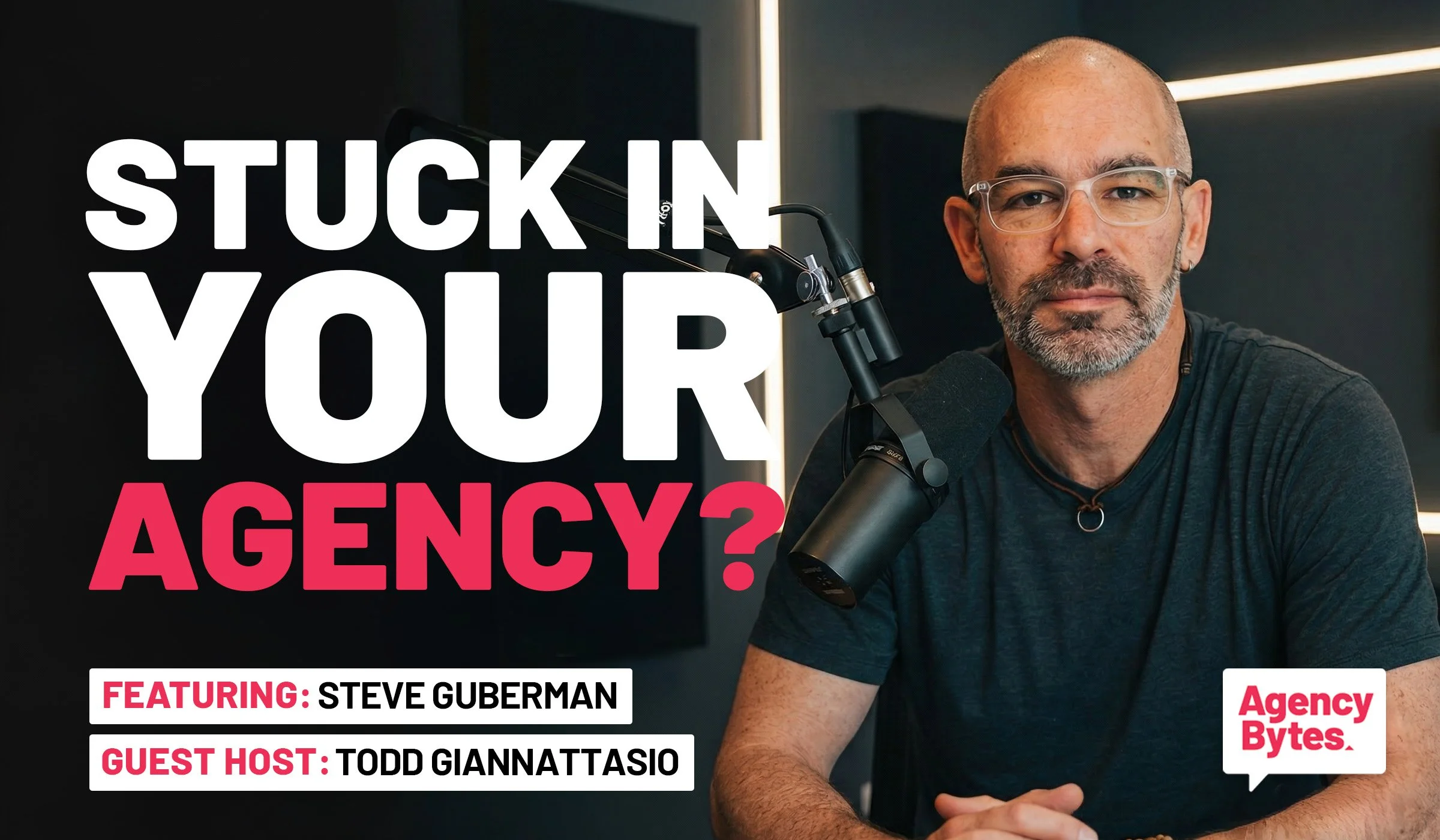
Featuring Guest Host: Todd Giannattasio, Tresnic Media
In episode 150, I flipped the mic. To kick off Season 4, I handed the host chair to my friend Todd Giannattasio of Tresnic Media — a returning guest from episode 10, and the guy who helped me name Agency Outsight in the first place.
This one's more personal than most. Todd walks me through my journey from screw-off art kid to graphic designer to accidental agency owner, the acquisition that should have been the first of many, selling my agency, and the grief that ultimately reshaped how I think about purpose, work, and what a business is really for. We get into the asset mindset, programmatic M&A as a growth lever, why most founders pay themselves last (and shouldn't), and the copycat goals that keep agency owners chasing someone else's dream.
If you've ever wondered what's actually on the other side of an exit — or whether you're building a business or just a really demanding job — this is the conversation.
Key Bytes
• Most agency founders accidentally build a job, not an asset — and the difference shows up the day you try to sell.
• Programmatic M&A unlocks exponential growth that organic effort simply can't match.
• Buying talent is faster, safer, and more predictable than hiring it.
• You don't need a truckload of cash to acquire — SBA loans, earnouts, and seller financing make deals possible at almost any size.
• Paying yourself last isn't noble — it's a habit that quietly devalues the business you built.
• Copycat revenue goals pull founders into chasing numbers that mean nothing to their actual life.
• Grief, burnout, and life events have a way of forcing the clarity most founders avoid.
• Creative empathy — not tactics — is still the most underrated edge agency owners have.
Chapters
00:00 Flipping the mic: why Todd is interviewing me
02:47 From screw-off art kid to graphic designer
05:30 Starting the agency with ego and no business plan
08:25 The acquisition I should have repeated four times
11:00 Selling the agency and what came after
14:30 Grief, COVID, and finding purpose in the garden
17:10 Launching Agency Outsight and pricing it on instinct
21:40 The asset mindset: building enterprise value
26:00 Programmatic M&A as the real growth lever
30:15 Why founders pay themselves last (and shouldn't)
33:00 Copycat goals and chasing someone else's dream
36:00 Rapid-fire questions and closing thoughts
Steve Guberman is the founder of Agency Outsight and the host of Agency Bytes, the podcast for agency owners who want real conversations about building, growing, and eventually selling the business they've worked so hard to create. A former agency founder who successfully exited his own firm, Steve now coaches creative, marketing, and digital leaders through the challenges of growth, positioning, and the complex decisions that come with scaling or selling an agency. As both a coach and M&A advisor, he helps owners see what truly drives long-term value — financially and personally — and through Agency Bytes, he brings that same lens to every conversation, pulling honest stories and hard-won lessons from the agency world's most respected leaders.
Todd Giannattasio is the founder of Tresnic Media, where he helps brands grow online through systems built on what he calls Helpful and Humanized marketing — a combination of fundamental principles and modern strategy that's earned him features in Entrepreneur, Forbes, and Huffington Post. A veteran marketer with more than two decades in digital communications, Todd has worked with brands ranging from Universal Records and BASF to growing startups and small businesses, giving him a rare perspective on what actually moves the needle at every stage of growth. Certified through DigitalMarketer, HubSpot, and the Jordan Belfort Straight Line Sales and Persuasion System, he's also a sought-after speaker at top events for entrepreneurs and innovators across the country — and a longtime friend of the show, returning to Agency Bytes to flip the mic and interview Steve for this Season 4 kickoff.
-
Todd Giannattasio (00:01.907)
I don't know if you start right away or roll into it. I was just gonna say, just to reiterate from your email, we'll hit on your journey as an entrepreneur, big life events that impacted the journey and what you're doing now with the AM &A stuff.
Steve Guberman (00:03.948)
Nah, you were gonna say something.
Steve Guberman (00:18.114)
Yeah, and anything else that comes up, man, follow your lead.
Todd Giannattasio (00:19.569)
Yeah, that'll be like the core stuff we try and like navigate through and then wherever it goes, goes.
Steve Guberman (00:25.228)
Yeah, and try and keep it to 25, 30 minutes. And however you want to wrap it up, you wrap it up.
Todd Giannattasio (00:31.219)
All right, let's do it. Yep.
Steve Guberman (00:32.814)
Cool. Ready?
Welcome to Agency Bites. I'm your host, Steve Guberman, from Agency Outsite, where I coach agency owners to build the business of their dreams. shit. Hang on. Where'd my thing go?
Hang on, start again.
Steve Guberman (00:56.75)
All right, take two.
Welcome to Agency Bites. I'm your host, Steve Guberman from Agency Outside, where I help agency owners build the business of their dreams. This week on Agency Bites, I'm joined by my friend, Todd Giontacio from Tresnik Media. Todd's a dear friend, returning guest from episode 10, you might remember. And Todd was instrumental in helping me develop both the confidence to launch Agency Outside, as well as the name itself, which we've talked about in the throwback episode 10. But I didn't invite Todd on.
again for me to interview him. Instead we're flipping the mic around and Todd's gonna interview me. This is my Jay-Z reintroduction episode and it's Todd's game and he's in charge. So Todd, turn it over to you my friend.
Todd Giannattasio (01:33.203)
You
Todd Giannattasio (01:40.403)
Well, thank you guys very much for listening to the show. Today I have the amazing Steve Guberman, who is the founder of Agency Outsight, where he helps agency owners build the business of their dreams with clarity, purpose, and profit. A former agency founder himself who successfully exited his own firm, which I can't wait to talk about that journey in this episode, he's now guiding creatives, marketers, and digital leaders through growth, positioning, and the complex decisions that come with scaling or selling an agency. I love...
talking about the acquisition and selling side of things that Steve has become a real expert in. You guys are going to love what he's talking about if you own an agency. So make sure you're staying through all the way for all the details on that and his, his insights through experience and further with helping people more recently with it. As the host of the agency bites podcast, Steve shares real stories and lessons from top agency leaders. In this episode, he is that top agency leader, which he will humbly accept whether he likes it or not right now.
and we will be getting into how he helps others grow with more intention. So Steve, welcome to the show, my friend. Congratulations on getting this far. seriously, like what is pop podcasts? I think last like on average less than 12 episodes, and, die off. So I think if we were to look at the stats, you are in the top 0.1 % of podcasters at this point, but, I really got to acknowledge you being so consistent with this, channel and.
Steve Guberman (02:47.278)
Thanks for having me.
Todd Giannattasio (03:07.876)
and just bringing all the genius to the world that you do. So first I wanna just acknowledge you and show my gratitude for what you're bringing to the agency ecosystem. Just with all this free content and expert stuff that you have shared on your platform for agency owners and now what you do on the coaching side, helping them individually in the small groups and now where you're even helping with on the &A side, which I think is freaking awesome. And I have some personal questions that we...
message on Facebook about and I'm going to share that publicly today so that people can get more into your brain in a real life little mini consulting q &a at the end. how did you get started in this whole agency world? Take us on the quick journey of Gooberman.
Steve Guberman (03:49.518)
Man, that's a good throwback question. appreciate your time. of all, it's weird having spotlight on me. I'm usually like, you know, I'll be the guy at the barbecue on the grill, so I'm not like in the spotlight. I, oh yeah, hide out at the barbecue. But what's funny is, so I mean, I grew up as an artist and sculpting and painting and anything. So,
Todd Giannattasio (04:00.466)
That's a nice little trick for introverts. I like that.
Steve Guberman (04:15.969)
That took me out of like academia and in high school I was a total screw off and like barely graduated. And so like, was not college track in any way, but eventually I got my shit together and found a graphic design course at a community college. And I never even knew what graphic design was. and so I took this course and they were like, yeah, graphic design is like, look around you. Everything somebody designed it. And literally like it was somebody took a veil off my face and I was like, holy shit.
posters and ads and all, like, I don't think I ever noticed it before, book covers. And that just lit me on fire, man. And was like, I can take this thing that I used to be passionate about art and, learn about design. And so I went to design school and became a designer and worked for a few, I worked in house at Panasonic, worked for a few small agencies. And then I realized nobody knows how to run a business. These guys all suck and I can do it better. And, big apologies to my former, you know,
bosses at those agencies because I had no idea how hard they had it until I thought I could do it better. And I think most most agencies start with like the ego of I can do it better or I'm a better fill in the blank. And I had no clue how to run a business. I come from an entrepreneurial, entrepreneurial family background. My parents both ran their own businesses. So I was like, how hard could it be? Mom and dad can do it. I can do it. And so I launched my agency and it was
The hardest thing I think I had experienced to that time, you know, up to that point. And yeah, I don't know. Fast forward. I, you know, I grew the business. did an acquisition in like the earlier part of the business to think a year, two or three. And then I ended up selling the business in year 10, spent five years with the acquiring firm. And then I launched agency outside in early COVID. Yeah.
Todd Giannattasio (06:07.92)
Yeah. That's awesome, man. And I mean, I think that's a classic story of, you know, and mine isn't too dissimilar of like, started as the expert technician, right? And you were in graphic design, I was in, you know, websites and digital communications. And then it was like, I could do this better. You know, I was in corporate, which we found out later, actually, we maybe even worked together back in that day and didn't even realize it. But
Steve Guberman (06:33.528)
Yeah.
Todd Giannattasio (06:36.326)
you know, we would have these vendors come in to do these like little mini projects and they were making so much more money than I was on these little projects. And I'm like, this would take me like two days to do. Why am I working here for like, you know, what they're making my annual salary in a month? And then, and I think so many of us agency owners start with like having the skill and then being like, you know, I can do this better. Let me start a business. And it's like, wait, graphic design and owning a business are two totally separate skill sets, right?
Steve Guberman (07:03.362)
When I read the E-Myth the first time, I was like, shit, that was me. Like, I wanted to make the pies. I wanted to be the plumber. I wanted to do the craft. I didn't realize I was gonna also have to run a business or get con- like, it was just a lot of surprises.
Todd Giannattasio (07:06.564)
Yeah, Yup. Yeah.
Todd Giannattasio (07:14.202)
Yeah. Yeah, yeah, man. But you know, just kind of like you took that experience and that turned into now what you're doing and bringing to the world. And it was like, you started off like, Whoa, this design stuff is cool. I can like help make better posters and better book covers and better, you know, design stuff. And then you brought those skills to companies and it was like, I could do this. I could do this business thing better. And then you went through and you got all the bumps, bruises, know, blood, sweat and tears and successfully
exited through there. Now it's like, hey, let me bring all of that now to the agency owners so that they don't have to have that same amount of stress and struggle that you can help them, you know, get through faster, easier, you know, hey, it's all going to be stressful, there's going to be bumps and bruises along the way. But if we can lessen that and mitigate the risk by having great outsites, right, like that's where agency outsites is so awesome. And I think for agency owners, particularly, it's like
Steve Guberman (08:05.688)
There you go.
Todd Giannattasio (08:11.056)
You know, we, can't read the label from inside the bottle, but at the same time, we think we know everything about how to run the business. Right. So like, talk to me about like the inspiration that really drove you into starting agency outside and like the mission that you, you are on with this company.
Steve Guberman (08:28.44)
Yeah. So I'll take you back to January of 2020. The world was still alive. We had not experienced COVID yet. I left, I left the agency that bought mine. I was there for five years and I learned so much in that five years. And in the 10 years that I ran my agency, I'd gotten three or four master's degrees in marketing and agency operations and biz dev and all of that. And I thought to myself, I'm going to leave the agency side. I'm going go to the brand side.
Todd Giannattasio (08:36.22)
Little safe place.
Steve Guberman (08:57.87)
And I'm spend the next 20 years on the brand side and I'll retire out as a CMO at some big company. And I got a job at an organization that was extremely, I was sold a really good bill of goods, crazy salary, good benefits, autonomy or so I thought. And then I get in there and it's one of the most toxic organizations I've ever stepped into. And it was extremely micromanaged.
Todd Giannattasio (09:22.546)
Just to clarify, this was on the brand side as a business, not as, yeah.
Steve Guberman (09:26.446)
Yep. Yep. Yep. I was brought in as like VP of branding or I don't remember what the title was. Um, and it was the most micromanaged organization I've ever been involved in. And I was, so I was introduced to EOS there. Um, the book traction was given to every employee. The CEO was a huge evangelist for it. Um, and so they believed in some really good principles and I learned a lot there, but it was.
Todd Giannattasio (09:50.672)
Which those are like green flags early on, you know, on the surface.
Steve Guberman (09:54.223)
Oh, I was, I was eating it up hook line and sinker. And plus it was like a 10 minute commute. So why not? Uh, I, I, I, I stayed there until August of that year. So during that time, uh, I started in January in February, six weeks later, my daughter died by suicide. Uh, I took a few months off of work, maybe, I don't know, a month or two off of work.
Todd Giannattasio (09:57.893)
Yeah.
Steve Guberman (10:20.994)
And when I was able to get back into it, I was never able to fully reengage emotionally. I was just, it was just grief fog, brain fog. don't know. couldn't fully engage. And so to the CEO's credit, he was like, listen, take as much time as you need. When you are able to commit, I need you to commit though. can't have you part time. And so I tried it. tried and it didn't work out. And you know, we parted ways pretty amicably. and, and then COVID set in before, before I left.
And then COVID set in and I was just kind of like wandering through my garden, like, what am I going to do next? And I didn't need to work right away, but I knew that I needed to find a purpose. Right? So part of the grief journey is there's got to be something that drives you to like reground and like recommit to society. Uh, that was my process at least. And also I like, I'm a purpose driven person. want to, uh, I want to help people. want to be of service.
I want to make some kind of an impact and I can't give me a billion dollars. I'm not just going to sit around and eat bonbons. Like I'm always going to need a something. And so I started.
Todd Giannattasio (11:26.694)
I'd like to see the garden that you would build though if you did have that billion dollars.
Steve Guberman (11:31.001)
Dude, imagine that, man. Ashley would be pumped. So I dug into gardening that year big time. It was very grounding for me, pun intended. But like being one with earth and seeing things grow from like tiny seed and like that whole process was very like rejuvenating for me. But then, you know, I started talking to agency owners about like, what was going on with their business through the onset of COVID.
Todd Giannattasio (11:34.662)
Hehehehe
Steve Guberman (11:56.267)
Was there a way that I could be of support? And so I started doing like small projects for agency friends, consultancy, whatever you want to call it. I didn't want to be a fractional because if you remember the world at that time, everybody became a fractional something. and so it, you know, I spoke to you, I spoke to Darren, I spoke to Joel bear, and, and there was one other person, Lou from BCS three of the four of you said, you got to talk to Kelly Campbell.
Todd Giannattasio (12:23.73)
Yep. Yep.
Steve Guberman (12:23.882)
She, maybe you did also, don't, but at least three, maybe four of you said in the same week, you got to talk to Kelly. She does what you kind of should be doing. And, and then you and I talked more and it was like, yeah, I can do this agency coaching thing. And the funny thing is I had an agency coach. had a few agency coaches. I knew agency and it just didn't even dawn on me. Like, why wouldn't I just do this thing that I knew made such an impact? So the launch of this was, I don't know what to charge for it.
I don't know what the full like program structure looks like, but I know that I know how to run a business. I know how to see around the corner. I know that I want to be of service and I want to help people. And, and that's, and so one of my first clients was George Costello. he actually, when he launched his agency, I was one of his first clients. He did like a flash animation for me. So was like, we went in full circle, had no clue what to charge him.
Todd Giannattasio (13:14.012)
Ha
Steve Guberman (13:18.798)
I it was whatever it was, was, you know, a fraction of what I'm charging nowadays, fast forward six years. but I found that there was certainty in the market. There was a need for what I knew how to deliver. And I built a platform and a foundation and a program that will take agency owners and leaders in agencies through discovery and into this insightful process that uncovers like what their goals and challenges are. And, yeah, it's been.
coming up on six years and it's one of the most gratifying things I've ever done. I've said a million times, I wish I had done this sooner, but I wouldn't have been ready for it sooner. Like I just, absolutely love what I get to do. And it balances the amount of time I want to work and the amount of time I want to be in the garden or fishing or whatever. And you know, the, the grief process also opened me up to like, life can't just be chained to a desk. Like there has to be a purpose.
and it can't just be all work and it's got to be like, I've got to take care of me and like nurture my spirit and do the things that bring me joy and life's too friggin short not to, you know, and life's too short to work with with or for shitty people also. so that was like the reason why I left that organization also.
Todd Giannattasio (14:30.704)
Yeah, totally man. I mean, obviously your situation kind of took you to the extreme side of things forced into finding more purpose and more intentionally and being grounded. And like you said, not being chained to the desk, but how many agency owners that come to you or that you even see in your whole purview that have not been pushed to the extreme where it needed to be a sledgehammer into the face, but how many of them are
chained to the desk and don't even realize it and how do you help them kind of first see it and then break out of that so that they feel more purpose and fulfilled in their work.
Steve Guberman (15:03.086)
Yeah.
Steve Guberman (15:09.994)
Most are, don't even, even if they realize it, great. If they don't realize it, like it's, hey, you shouldn't be working 80 hours a week. really? I thought that was the job I signed up for. Right. So we launched this thing and it becomes this ball and chain as opposed to this like asset in this thing that can give us freedom in life. It, you know, it takes a lot of like massive impact to realize that like some sort of like nuclear blast or whatever. you know, I'm working with so many really, really smart and creative people who are committed to building this thing.
But they don't understand, you know, again, reference to EMIF, the difference between working in and working on the business. They don't understand, you know, time blocking or prioritizing things or delegating things or like what their core job should be or that they should even have a job description that says, here's where I start and stop. And everything else gets delegated out and how to read, you know, cashflow or P and L statements, like all these things to give them the freedom to say, this is an asset that I've built that can
carry me through life, support my family, give me something post retirement, like all these different things as opposed to, yeah, I work a job and I'm tied to the desk 80 hours a week and nights and weekends. And I'm not going to attribute my agency to why my first divorce is not still going on. But I know we both sat on the couch with our laptops nights and weekends. Like when the kids went to bed, we were on our laptops. It's no way to fricking live. You know what I mean?
Todd Giannattasio (16:34.32)
Yeah. Yeah.
Steve Guberman (16:35.95)
So there's got to be a start and stop in our work, even if we love the hell out of it and balance in life. And I'm a big proponent of like we talked about before we hit record, like these goals that people adopt, right? And I call them copycat goals. Like if they're not your goals, that means something to you and your family and then your team, why the hell are you chasing seven figures, eight figures, whatever the hell the numbers are that are not true to you? You know, cause some idiot on social media said, this is a cool number. it's...
It's you're chasing somebody else's dream for you.
Todd Giannattasio (17:07.92)
Yeah, man. I mean, you said a key word there that I wanna bring to the forefront for agency owners listening here to think about, and you said asset, right? So can you kind of put a quick definition and description on like what you mean by asset as your business? And then I wanna lean into something you skimmed very quickly over where you owned your agency for only two years and then you acquired another agency, I'm assuming, but like, I wanna hear.
How is the business an asset? What does that mean exactly for the owner? And then talk about that growth through acquisition.
Steve Guberman (17:41.059)
Yeah, cool. So an agency has an asset, like while you're running the business, it can be something that really feeds and funds a lifestyle. can be something that really feeds and funds other people, like your employees lifestyle. like you can run a lot of things through the business with gray areas and, and allow it to fund, trips and like the way that you live your life. But as an asset, when you take all that other stuff away,
What you're building has value and, you know, can it be something that you can either hold onto and step away from and earn money out of by letting somebody else run it for you? Or can you sell it? and for whether it's life changing money or like a life changing direction in life. you know, one of the things that I look back on, on running my agency and then selling it was in a, this will point to the acquisition that I did.
I wish I had realized that that acquisition could have been an unlock for an enterprise value beyond what I thought it could have been. So a friend came to me who had a small agency. I think my shop was, I think I had maybe two employees at the time. So we were like well under a million dollars, maybe a half a million in revenue. don't remember. And she said, I'm burnt out. I've got a bunch of cool clients. They would dovetail nicely into yours. Do you want them? And you got to hire my employee and.
The revenue from this book of business will cover that employee and then some, and I just want, me 20 % for the next two years on what these clients bring over. So it was a relationship I had. didn't need to go knock on the door. didn't seek her out. She sought me out. I think she might've spoken to a few other agency people like me, and ultimately she chose me. It was the easiest thing to do. It infused a ton of cash into the business. It brought me a new employee who was game-changing for what the kind of work we were doing.
Uh, she was my first designer before that. had a developer and intern, and I think I was like the lead designer and we used freelancers. Um, so I had my first, like full-time designer for first full-time developer. Um, and that really like gave us a huge bump in the trajectory of the business. If I realized then what I know now, I would have done two, three, four of those a year. Right. Because then when I sold my business.
Todd Giannattasio (20:00.657)
Yeah.
Steve Guberman (20:03.158)
Selling my business, checked all the boxes that I wanted us to check at that time, but it wasn't life changing money. wasn't like I could go sit on the beach for the rest of my life. Right. But right. The option is there, or I can go build something else so I can play money or invest or like all these different things. And so building enterprise value through programmatic and A that's like, that's my new thing. I am hooked on that.
Todd Giannattasio (20:09.168)
Right.
Not that you would, but having the option. Right.
Todd Giannattasio (20:18.704)
Yeah. Yep. Yeah.
Steve Guberman (20:29.07)
Been working with some really talented people on the M &A side in the agency space, helping agency founders. It dovetails so nicely into my coaching that when I can help a founder get out of the day to day, build an operationalized business, it gives them the bandwidth to like focus on doing acquisitions to grow the shit out of the business. The other thing that so many founders like us chase is
Organic growth is exciting 10, 15 % a year. Yeah, I can show 20 % bump. But if you can do 100, 200, 300 % growth in a year, what else, what else is on your calendar this week that's going to put millions of dollars in the bank for you? Like exactly. Nailed it.
Todd Giannattasio (21:11.986)
you're stepping over dollars to pick up pennies, right? I mean, that's what you're doing in those situations. And once you switch the understanding like, exponential growth is possible here. And I'm looking at this incremental growth of 10, 15, well, killing it at 20. It's like, oh, there's a whole nother world of people who don't get out of bed for 10 % because they're thinking 100, 200, 300 % growth, right? And you that you mentioned about the employee thing and
Steve Guberman (21:33.751)
Exactly. Yeah.
Todd Giannattasio (21:41.073)
You know, you and I both know over our decades in this industry that agency owners also often commiserate over like, can never find good talent. And when I do, I have to train them and yada yada. What does it mean to acquire talent in that situation? Like for you, said, you know, like you, you, buy this, existing employee who you don't have to train or anything. They're, they're up to speed. know how to, you know, they know everything that works. You can trust them because they came from this situation. So.
Steve Guberman (21:52.578)
Mm-hmm.
Todd Giannattasio (22:10.662)
You know, what does it mean from a hiring and growing your team standpoint when you can acquire an agency?
Steve Guberman (22:16.942)
It's a secret unlock, man. Like, so, you know, the, the kind of rule of thumb is by an agency that's about a third of your size. So if I'm 10 people, I want to buy an agency. That's three-ish, four-ish people. But doing this kind of like, so I knew the person I was hiring. knew the person that ran the business. He was an existing relationship. had networked a bunch. partnered on work together. So it was kind of a no-brainer, but cultural fit in doing like this upfront due diligence and making sure that.
What this agency integration is going to look like is vital to make sure that, all right, do I have room for this talent? Do I have bandwidth for this talent? Are they going to merge with, with my agency really well? Are the teams going to play well and nicely together? so yeah, I mean, buying talent hell of lot easier than hiring talent. You can really get an understanding. This person has been there three years, five years. Like you can get a real understanding of how they operate, how they think, what their value is, what they bring to the table.
I interviewed this person, they look great on paper. I think I'll hire them. And how many interviewees like just show up real well in an interview and they show up for work and they suck, right? So it's a huge unlock. And buying talent is one of maybe four five reasons why you can do an acquisition. You can buy a book of business, you can buy EBITDA, you can break into a new vertical, you can buy talent. How many founders are like, man, I hate doing sales. Go buy somebody who loves doing sales and just doesn't want to be an owner anymore.
Like it's no money out of your pocket to say, come work for me. I'll buy your business. We'll bring your employees over. Bring your book of business owner over. And now you're not, you're not an owner anymore. I will make sure you get paid.
Todd Giannattasio (23:53.565)
All right, now Steve, know there's gonna be a lot of agency owners, especially the ones who are new to this concept of acquiring another agency, but Steve, I can't afford that. I don't have the money to buy another agency.
Steve Guberman (24:04.43)
First of all, I'm going to sidebar and say this sounds too scripted. It is not. This is just Todd and I riffing. This is curiosity. This is Todd's a smart dude. This is not a paid media advertisement by agency outside for agency outside. Yeah, but that's a great freaking question. most agency owners that I coach like I don't have a million dollars in the bank or I don't want to ruin my cash savings or anything like that. There's so many creative ways to structure a deal like my deal.
Todd Giannattasio (24:09.538)
Hahaha!
Todd Giannattasio (24:15.122)
There's no script here. I'm taking live notes and this is what came up.
Steve Guberman (24:33.71)
When I sold my business, they gave me some cash upfront and the rest was an earn at over two years. And so that meant the performance of the clients I brought over paid me for the next two years on top of my salary. So they had very little cash out of pocket. I've worked on other deals that have been structured where there's an SBA loan. SBA 7A loan is super easy to get. You're personally backing it, but that means that like the S the government is funding you to do this acquisition. And by the way, you can borrow more than just the acquisition money.
And you've got a cash infusion into your business that can give you a cushion. The seller can loan you that money from future proceeds of the business that you're buying. So a lot of really creative ways to do it. It's not like here's a truckload of money, go away. It's like, here's a percentage upfront. The rest is paid for by the clients that you transfer over or, know, paid over time, things like that. So, yeah, sure. If you are making a hundred grand, 200 grand, like it's tougher to do.
But if a business, I'm working with a founder now, he's about 350 in revenue and he's looking to make his first acquisition and he will probably not need much cash out of pocket. The most like cash out of pocket is for like lawyers and like, you know, certain aspects of it like that, due diligence, CFO work, things like that. But you can buy a business and have it pay for itself pretty easily if it's a good business.
Todd Giannattasio (25:58.567)
You know, you touch on a big thing here that I want to, and I don't know the answer to this on your end. So I'm curious, you know, what you're going to say here and how you help. like, think money mindset and finances is a big, big, big thing for, for entrepreneurs, especially us, you know, call it quote, accidental entrepreneurs, where you have this skillset and then you decide that it evolves into a business. Right. And then, you know, you didn't take MBA classes where you understand how like P and L's should look and how much money you need to make. And it's like, well, if I could just cover.
Steve Guberman (26:04.867)
Mm-hmm.
Steve Guberman (26:09.88)
Yeah.
Todd Giannattasio (26:28.006)
you know, cover my my old salary, it should be fine. It's like, well, to pay yourself that salary, you have to make triple that money, right? And so do you see and then there's also the like, the incremental verse exponential, like the mindset of people who are like just trying to pay myself a normal salary, quote unquote, versus a I'm a business owner entrepreneur who should be building enterprise value. So, you know, is that something you work with your clients on?
that money mindset and understanding that like whole structure and opening them up to what's really more possible.
Steve Guberman (26:54.904)
So, yeah.
Steve Guberman (27:01.582)
Yeah, I mean, I don't typically get too much into the weeds of their money, but I do want to talk to them about like how to think about the business of the money of the business, right? If that makes sense. Like, so for every dollar that you bring in, like 30 % of that should be profit for every employee you bring in, you should be triple billing them out. So if an employee costs you totally a hundred grand, you should be billing them out for up to 300, two to 300 grand, like that kind of thing. So we do the.
We do a lot, I almost said do do, we do a lot of work around like what the structure of the numbers of the business are, but I don't really get into like their personal financial mindset. And I don't know, maybe that's a gap that I'm missing. Most of the founders.
Todd Giannattasio (27:43.9)
Yeah.
Todd Giannattasio (27:47.303)
Well, think even there's there's even a and to my, know, I wish I had you. What year is it? I don't know. 15 years ago, right? Because that was, you know, a bit of my story of skill set. Get more clients, got got more clients, hired someone to help me out, you know, and just kind of, you know, learn through the school of hard knocks. And I ended up and we're both in New Jersey, which rent and office space and salaries in New Jersey are much more expensive than other places around the country. And we're competing against New York City salaries for talent.
And so, you know, I ended up with number one, a job, seven jobs, really, you know, six full-time employees with New Jersey salaries and a New Jersey office and rent and monthly costs with that. And I never thought back then, like, you know, when I think about like, you know, what was your, you know, month, what was your highest month or highest year? Like, dude, I'm embarrassed, but vulnerable to say now like,
I don't even remember what my high month was, right? Like that's the thing now where you talk to business owners and you talk about that kind of thing and your numbers. I'm like, dude, I don't even remember what it was. And I just was like, we do stuff, people pay us and like I'm hitting payroll every two weeks and like, but then I ended up getting burnt out because one mentally I'm like, I really would get messed up with the, well, if I'm paying them a hundred grand and I'm charging 300 grand, I like,
there was something, I had a personal issue with that, right? Like, yeah, I was, but not enough. And it was just like whatever was left over at the end of the month, right? Like this is, know, especially in the first half of this phase of the business, but you know, just sitting down and being like, hey, you're running a business. This is what it's gonna cost you. Make sure you're charging triple, like, you know, and that kind of stuff. And I spent too many years not making enough money for myself.
Steve Guberman (29:16.428)
Were you paying yourself?
Todd Giannattasio (29:41.363)
where I should have been and like we probably should have had two and a half or three employees, not six, right? And you know, the office thing, especially back then it wasn't remote world like it is today. So, but that kind of money, just like setting the standard for yourself of like, hey, make sure you're hitting these standard numbers because you're a graphic designer who now owns a business. So you maybe haven't sat down to think about this in the black and white way that you should be.
Steve Guberman (30:07.672)
Well, so that's a big thing that like, I mentioned it before, and as far as like the money mindset part. So what, what are you running a business for? How much money do you want to be making? How much do you need to support your family? And then build the business around that. Like, why am I, there was plenty of times I didn't pay myself. Right. Most founders, they fall in the sword and be like, well, shit, cash is tight. Pipeline is tight. I will take the cut. Granted, that's an exception. The rule is.
Pay yourself first, right? I was on a call with about a three and a half, four million dollar agency yesterday and we're digging into the P &L and so their salary, labor, benefits was like a million and quarter last year. Like, are you guys in there? Oh, no, no, no. Ours is all at the bottom line net. I'm like, no, no, no. You need to put yourself on salary and make sure that there's a line item there for you. You are not whatever's left over. You are the priority.
Todd Giannattasio (30:56.428)
Yeah.
Steve Guberman (31:05.804)
The founders take all the risk. The founders, you know, if something goes wrong, it's all on them. If something goes right, they throw that at their team, right? So why are you running a business and taking all this risk if you're not prioritizing paying yourself and making sure that your family is taken care of? And again, that also goes back to like the asset that you're building is like, there's this thing that supports me and my family. Why wouldn't you prioritize yourself? know? So yeah, it is tough.
Todd Giannattasio (31:21.788)
Yeah.
Steve Guberman (31:35.375)
The money conversations are tough. How much to charge? Why do you charge so much, especially now in, know, AI is infiltrating everywhere. And, you know, I was on call with a client earlier, there's a software dev shop and like, they just found out how to deliver work 40, 50 % cheaper and want to pass some of that savings over to their clients. like, yeah, I don't know that you need to do that, but you're good people and you can. Yeah, the pricing structure, we'll dig into that next year.
Todd Giannattasio (31:58.065)
Yeah, man, that's a whole nother episode we could unpack, right? Like, yeah. Yeah. All right. Well, for our loyal listeners, you know that it is time and let's see if Steve came prepared for my favorite part of the episodes, the rapid fire questions here.
Steve Guberman (32:05.324)
Yeah. Yeah.
Steve Guberman (32:18.68)
There is no preparing for rapid fire.
Todd Giannattasio (32:20.828)
Beverage preference, coffee, tea, something else? All right. All right. What's one of your favorite easy productivity habits?
Steve Guberman (32:23.256)
Coffee.
Steve Guberman (32:31.48)
Time blocking, time blocking and then respecting that time. So I put time on my calendar for my CRM work, for bookkeeping, for like the things that I need to get done. And then I respect the time that I put on there.
Todd Giannattasio (32:44.558)
Yeah, I think time blocking is easier than respecting the time you blocked. So it's not just writing it down, but actually sticking to it, right? What's a recent book recommendation? I know you're on a real kick right now with a whole new world of books you've tapped into.
Steve Guberman (32:51.128)
Yeah. Yeah.
Steve Guberman (33:04.686)
Dude, I just became a reader in September. We're recording this mid-March. I've been reading books about spirituality and business my whole career. I rarely finish them. In September, my fiance handed me a book by a guy named Mitch Albom. I've now read seven of his 15 books. My goal for this year is to read all of his books. So I'm a big fan of his. And then I also just dug into, oh, this guy, Peter Heller.
more just adventure novel work. So yeah, it's weird to be able to recommend a book or an author because I've never been a reader. Like, sure, I'll say getting things done and the E-Myth and all these like, you know, built to sell and all these business books. We've all read them. They're all out there. I don't know. The fact that I didn't finish them almost always. Right. I get the audio book every now and again. Profit first and calm the chaos and all these books.
Todd Giannattasio (33:45.968)
Yeah.
Todd Giannattasio (33:50.673)
Yeah.
Steve Guberman (34:02.39)
I get the gist, you understand the framework and then you move on. I don't know something about digging into fiction in this past bunch of months has been really invigorating. And I've got a daily habit of it now every morning with my coffee. I read at least a few pages. Yeah.
Todd Giannattasio (34:15.226)
I love that. I'm going to tie this into another question I have on the list here, which is a go-to way to reset your creative brain. But I'm curious, how does stepping outside of the business books and the business content world and getting into fiction stuff that's like unrelated, semi unrelated, like how has that affected your business thinking and your business work?
Steve Guberman (34:38.156)
I believe that one of the greatest tools we have in our industry, but probably it touches a lot of industry is creative empathy. And especially like in the creative design, advertising, software space that's vital to connect with clients. This has really opened me up to different levels of that, like empathy and understanding people. Not that you can't do that through business books, but I don't think it's the same. I think that's more like tactical and linear, and this is just kind of more like ethereal.
so, so in that way, but for me, like go for a walk, get in the garden, go sit in a river and go fishing. Like those are like my true resets. I also have a daily meditation habit that keeps me grounded and is vital to like just my peace of mind and ability to connect with other people. But yeah, these different kinds of books have really opened me up to, I'm giving a talk, in Florida next month about like the human side of relationships and,
Todd Giannattasio (35:15.622)
Yeah.
Steve Guberman (35:36.064)
nothing to do with AI or robots. it's all about like that empathetic connection that we make with our clients.
Todd Giannattasio (35:41.478)
Yeah, yeah, that's great. What's a favorite recent purchase under $100?
Steve Guberman (35:47.691)
Under a hundred dollars. Who spends under a hundred dollars on anything anymore? I don't, well, I'll say it was a gift, but this is pretty dope. I'm pretty excited to get this put onto my truck. so it's a sign that it goes on the back. says grateful. Yeah. So that was under, that was a gift, but yeah.
Todd Giannattasio (35:51.09)
Hahaha
Todd Giannattasio (36:06.738)
Love it. Perfect. That's great. As an agency owner on your agency journey, what was a belief that turned out to be super wrong as an agency owner?
Steve Guberman (36:20.076)
Hmm. I think it what I said earlier is I got to make sure everybody gets paid before me and I would take that sacrifice. And I think that that became, I think there are exceptions to that rule, but that for me became the rule where I wasn't budgeted for and I didn't prioritize my impact on the business in a positive way. And so that was a huge like a habit that I fell into and really not a good one.
Todd Giannattasio (36:47.492)
Yeah, so if there's one billboard piece of advice, right, like one bold statement that you can give agency owners today, what does that bold statement say?
Steve Guberman (36:58.178)
Go out of your way and just help somebody be of service in some kind of way. I think it's never, you can never go wrong just doing something for somebody else and being of service. Don't charge for it. Just be of help.
Todd Giannattasio (37:10.534)
Love it, that's awesome, man. Well, thank you so much for guesting on your own show. Seriously, it's an honor. I'm super grateful that you asked me to do this with you and I'm really proud of you for putting this out there for so long and turning it into the amazing resource it is for agency owners. So people who are watching and listening and they're an agency owner and something really struck a chord, where can they go next to get more from Steve Gooberman and hire you and work with you?
Steve Guberman (37:36.916)
agencyoutside.com or agency coach on LinkedIn.
Todd Giannattasio (37:41.053)
All right, awesome, I love it. Steve, thank you for being here today. Everybody, thanks for following along. And if you could, for me, do Steve the huge favor if you've made it through this episode and this far, shoot Steve a message over on LinkedIn and just tell him like he's doing a great job with this show and give him a little positive reinforcement and gratitude and acknowledgement for this, because it's freaking awesome what you're doing.
Steve Guberman (38:01.912)
Todd, I am super grateful for you. Thank you, my friend, my brother in this thing that we do. Thanks for your time. I hit the stop button when I want to, so I get to say thank you to you and how grateful I am for you for taking the time out of your day to do this and being just a cheerleader this whole way, Todd's an awesome dude, creative, brilliant digital marketing brain. Tap into it, Tresnick Media. Appreciate you, my brother.
Todd Giannattasio (38:10.039)
Hehehehehe
Todd Giannattasio (38:26.234)
Yeah, thank you, sir. Thanks, guys. Make sure you're subscribed and see you on the next episode or you'll see Steve on the next episode.
Steve Guberman (38:33.177)
Thanks man.