
Ep 152 – Michael Perry, Tavern – Why Relationships — Not Design — Actually Grow Your Agency
Listen & subscribe on the platform of your choice
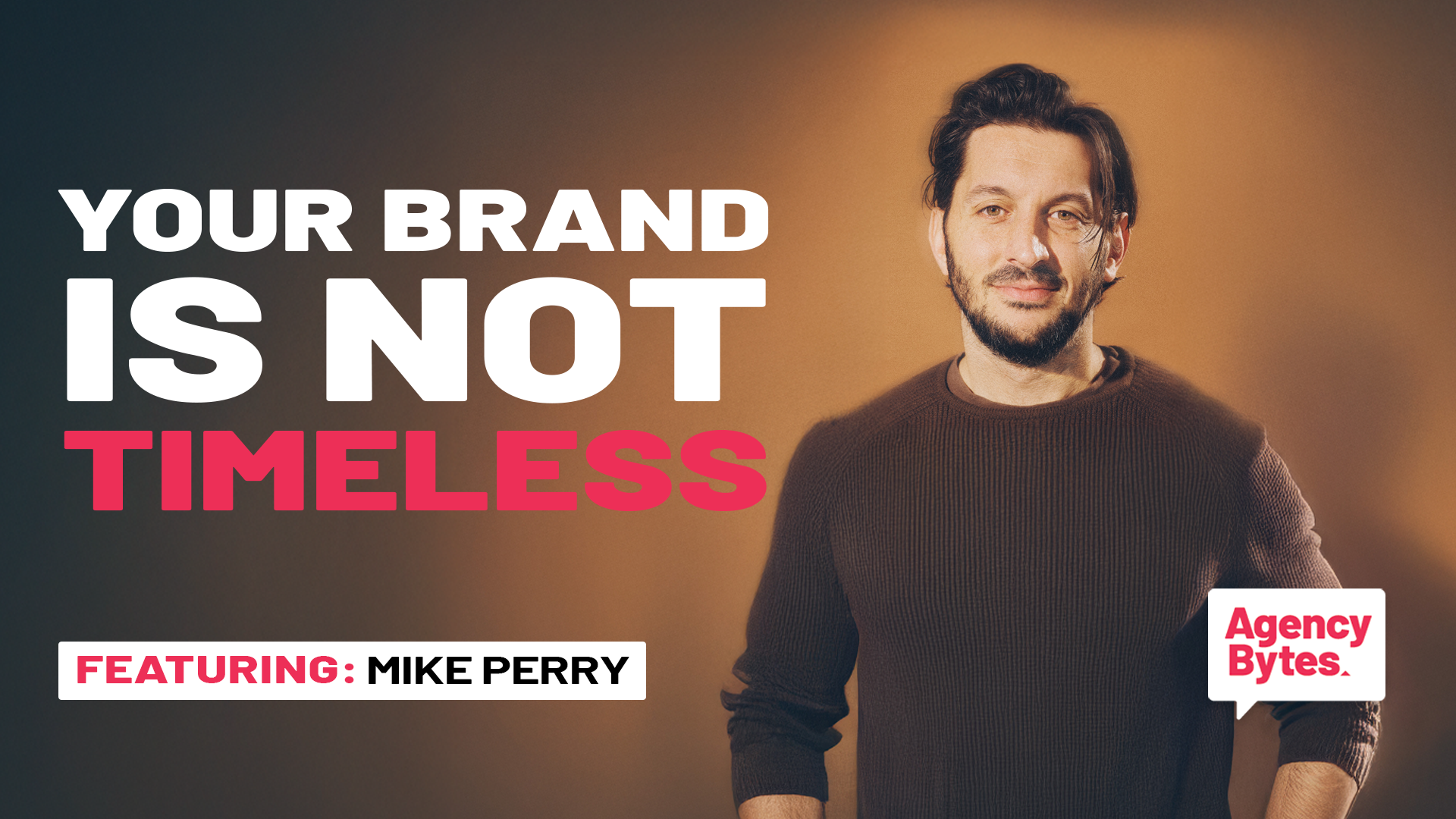
Featuring: Michael Perry, Tavern
In episode 152, I sit down with Mike Perry, founder and Chief Creative Officer of Tavern, a Brooklyn-based creative shop building brands in food, beverage, hospitality, and sports.
We get into the philosophy that drives everything Tavern does — what Mike calls "modern heritage," the practice of mining a brand's past for its real equity and modernizing it for today's consumer without falling into retro, nostalgia, or flash-in-the-pan rebrands. He shares why he's writing a how-to book on it, how Tavern embeds with clients like a fractional chief creative officer, and the story behind HyperBlast, the high-octane drink brand he's launching as his own client.
For agency owners, this one is a clinic on real niching — Mike argues expertise isn't your portfolio, it's whether you actually care about the category your clients live in. We also land on the thing he wishes he'd leaned into earlier: this is a relationship business, full stop, and the deepest relationships make the best work.
Key Bytes
• Real niching isn't about your portfolio — it's whether you genuinely care about the category your clients live in.
• Modern heritage means mining a brand's past for its equity and modernizing it for today, not slapping a retro filter on it.
• Timelessness is impossible to fully achieve and fragile to keep, which is exactly why brand guardianship matters.
• The founder who launched the agency to design should still be moving pixels — leadership and hands-on craft aren't mutually exclusive.
• Being your own client removes the convincing, the stakeholders, and the sell — every answer is just yes.
• Internal practice work stops being a luxury when you funnel it into real brand-building that levels up the whole team.
• The biggest fallacy of Mike's career: that "nobody's drinking" — the numbers tell a very different story.
• This is a relationship business — the deepest, longest client relationships are the ones that produce the best work.
Chapters
00:00 Welcome and introducing Mike Perry and Tavern
00:47 Failing fast: the agencies Mike tried to start too early
02:06 Big agency vs. small agency and the 40-person sweet spot
03:46 Tavern's trajectory and the client roster
06:27 Why deep category expertise is really empathy
09:01 Staying hands-on as a founder and CCO
12:54 What "modern heritage" actually means
16:59 Writing the book and killing the gatekeeping
23:22 Launching HyperBlast and becoming his own client
32:16 The freedom and discipline of self-client work
35:51 Rapid fire and closing thoughts
Mike Perry is founder and chief creative officer of Tavern, a Brooklyn-based global creative agency crafting timeless brands across food, beverage, hospitality, and beyond.
With more than 15 years at the forefront of brand building, Mike’s earned a reputation as a certified creative powerhouse. His career includes leadership roles at top global studios such as Stranger & Stranger, Design Bridge, JKR, and Quaker City Mercantile, as well as media giants NBC Sports and TikTok. He is the creative mind behind some of the industry’s most recognizable rebrands for clients including Burger King, Budweiser, and Diageo.
Driven by Tavern’s Modern Heritage philosophy, Mike blends legacy and innovation to create dynamic brands that flex with the lightning-fast pace of culture. In a world of trend-chasing, Tavern focuses on what lasts: commercially powerful, future-ready brands and ambitious experiences that resonate at every touchpoint.
Tavern is behind the rebrand and restaurant design that reignited the American steakhouse Sizzler, as well as the custom-built bar for Beam Suntory’s Old Overholt. Other collaborators include Chick-fil-A, Old Grand-Dad, and New York City FC.
Contact Mike at their agency website or @tavern.agency on the socials.
-
Steve Guberman (00:03.266)
Welcome to Agency Bites. I'm your host, Steve Guberman from Agency Outsite, where I coach agency owners to build the business of their dreams. This week on the show, my guest is Mike Perry. He's a founder and chief creative officer of Tavern Agency. They're Brooklyn based creative shop building brands in food, beverage, hospitality, and beyond. Mike spent more than 15 years at the intersection of legacy and culture with stints at some of the most respected studios in the world and some of the big name brands. Some of you've definitely seen whether you know it or not.
At Tavern, his guiding philosophy is what he calls modern heritage, the idea that the best brands aren't trend chasers, they're built to last. And that's what we're gonna talk about today. So Mike, thanks for joining me.
Mike Perry (00:44.972)
Yeah, thanks so much for having me.
Steve Guberman (00:47.17)
Yeah. Give the backstory on Tavern. You're probably like a designer and thought he could do it better than everybody else and said, I'm out of here. Yeah.
Mike Perry (00:53.134)
That's it. Yeah, I was a designer that thought that probably way too early. I feel like every job I had, I tried to start an agency. I quit and started an agency and it failed fucking miserably immediately. And it wasn't until, I think it was about over a decade worth of working at big and small agencies that you really learn and see
Steve Guberman (01:10.212)
You
Mike Perry (01:22.166)
what's right, what's wrong and take, you know, the taverns, ultimately a collection of all of those thoughts and beliefs and practices and processes all combined into one that I do think we do it better than everyone else.
Steve Guberman (01:35.692)
Yeah. Hell yeah, you do. You guys are rocking. And I left it out of the bio because it wasn't in there, but recently on the GD USA people to watch. Wait, wait, I got it right here. I'm sticking this all over people to watch 63rd annual edition. There you go. If you don't subscribe to GD USA, it's we were joking before I hit record free magazine. Why the heck not? So that's that's a pretty sweet honor. So big agencies, small agencies. Did you feel like you thrived better in one or the other or like different?
cultures.
Mike Perry (02:06.958)
I believe. Yeah, I mean, no, I never fit into any of them. At least like my me feeling like I fit into them. Because it was always you know, smaller agencies like weren't thinking big enough or weren't working on big enough. Clients or projects or you know, categories even mediums, literally all of it. And then the bigger agencies is the same problem, but different, right? Like it was like, yeah, we're working on Budweiser.
and burger hang, but at the same time we can't do the small cool niche stuff, whether it be for those big brands or for the smaller ones. So like, I, never really made sense. And I, after working at all different sizes of like literally two people up to 200 people, um, I think there's a sweet spot. think that sweet spots probably around like 40, uh, at any one given agency. That's, that's really, you know, what are
our like stopping point will be about the 40 50 mark. It's just at every agency that I've been at whether they were most of the time is smaller and they always like grew much larger before I left and around that like 30 to 50 person mark it just felt so right. You were so connected. so like ingrained in the client still everyone was there was clicks within the studio but like everyone's still hung out together. It just I don't know for me it was just felt like the right the right fit. So no I like
Steve Guberman (03:19.416)
Mm-hmm.
Mike Perry (03:33.912)
There's nothing that feels right, but there's a lot to learn from both of them, right? Because the smaller ones do really niche, unique, fun stuff really well, and the big ones do really big, large enterprise work really well. I just want to do both. I think you need both, especially nowadays.
Steve Guberman (03:46.884)
Yeah, you need to mix it up for sure. So 15 years in, what's kind of the trajectory been for Tavern since you launched it?
Mike Perry (03:58.03)
So we're on year four right now. When we started, was just me and a collection of freelancers. And then we kind of slowly grew. at 12 now, plus freelance here and there. But it was small to begin with. Our first two clients, actually, it was Flying Embers, where we were doing a lot of their advertising work, working really closely with the founding team and some marketers there. And then Sizzler.
which is a huge one to have as our second client, but an old Barwazer client of mine actually moved there. He's now the CEO of it. And we kind of, they went through some bankruptcies. They were starting from ground zero. We were there, we were there kind of early days to help them from a design perspective, but also kind of in the mix is like a chief creative officer role, you know, within there so that we can guide their, their creative and marketing teams and really help, you know,
Steve Guberman (04:30.914)
Yeah.
Steve Guberman (04:51.661)
Mm-hmm.
Mike Perry (04:56.416)
underneath the hood, which is what we like to do in a lot of clients. But it was kind of perfect because that is that mix of like, it's a mass brand, the awareness is off the charts of it. It's really big. But at the same time, it's, you know, 80 mom and pop shops at the end of the day, because it is still kind of small and bankrupt, you know, brand that hasn't been loved for decades, literally decades. So
It was kind of the sweet spot. So that's really where we started. And ever since we've been working on brands like, you know, Beams and Tori is a big client of ours doing a lot of strategy and tequila work strategy work for their tequila brands. Small Batch, obviously, a lot of their bourbons that is kind of most of our website, it feels like at this point. Galo, we do a lot of their innovation work, specifically for cans of brands like Waterbird, which just launched Fisher's Island lemonade.
and some completely new to world ones that are, they will be out. They're out on shelves now. Coming soon. And then as well as like quick service, like Sizzler and Chick-fil-A, we work with their internal teams a lot, working on like brand standards and really like championing design internally there, not so much external facing stuff. So a lot of like,
Steve Guberman (05:56.932)
Coming soon to a shelf near you.
Steve Guberman (06:11.384)
You
Mike Perry (06:14.38)
All over the shop, it really focused on the food, bed, hospitality. And then of course, sports is the cherry on top with a lot of the work we do. New York City Football Club being one of the main ones where we do a lot of their brand activation stuff. it's all over.
Steve Guberman (06:27.555)
So that's like an outlier. Yeah, all over, but that's an outlier from food and Bev. What was the food and Bev like niching from, I know you were at JKR and a couple other shops. Like where did you feed into the food and Bev space?
Mike Perry (06:40.586)
Yeah. So the sports, sports makes sense. If you, if you think about it hard enough, it makes sense. Food, food, Bev, hospitality and sports, all things are great. Tavern has to offer ultimately, the sports, I'll get to the food and bed. I started my career at NBC sports. So I was doing major properties like tour de France, one 50 MLS. when I was first kind of really kicking off, premier league, when it came to the States on Saturdays, like on
Steve Guberman (06:46.593)
there's a dovetail there, yeah.
Mike Perry (07:09.912)
broadcast on Saturdays. Formula One, no one even knew Americans like didn't give a shit or really know what Formula One was. And we did the initial season launch for that. So like really cool like sports stuff. And then I hard pivoted I went to this place called Quaker City mercantile led Hendrix gin, did some sailor Jerry work some Narragansett work pills, narco like a lot of booze there and that kind of pushed me into the into the food and bed space. But yeah, most of my background is spirits and beer.
and QSR fast food. And so it only made sense. then a little bit of sports. So it only made sense. It's really the reason why we niche down though is because I truly believe that you need to be an extreme hyper expert on the category. Not from a design perspective, not from a marketing perspective, but truly from a, like, you give a fuck so much about that specific category and those products. And that's what our entire team is comprised of. We just happen to be.
Steve Guberman (08:03.01)
Yes.
Mike Perry (08:09.164)
great designers and strategists on top of it.
Steve Guberman (08:12.995)
I'm pause you there because I can't say that enough without turning blue in the face when I say it. So you describe it slightly differently than I do, but it's the same thing. If you don't have the empathy to be able to fully understand what the people in your category that you serve are going through, what they're experiencing from the markets, from their bosses, from every aspect of what the hell they do, you can't claim expertise. I don't care what your portfolio says. And you nailed that, man. You absolutely have to know, from not a design standpoint, sure, that helps.
book helps, but from knowing where they are emotionally and that connection, it's vital. So yeah, I'm so glad you said that, Yeah. So sports, food, Bev, it all fits into a tavern and you are tavern. So it works. Yeah. Talk, talk about.
Mike Perry (08:48.174)
Yeah, absolutely.
Mike Perry (08:56.94)
But yeah, and we take on some of the but you know, it's mostly that's the bulk of it.
Steve Guberman (09:01.239)
Yeah. Talk about like your role founder, chief creative officer, how much of your, your kind of day to day, are you able to like get into the design aspect of what you love doing?
Mike Perry (09:13.152)
It depends on the week, but a lot, a lot more because, that's what I wanted to do when starting this. It's like, yes, we want to be big in might, but not necessarily big in like, you need a 50 person team coming to every meeting. So I'm heavily involved in literally every project. This new kind of offering that isn't so public facing actually that we've been.
Steve Guberman (09:14.723)
Mm-hmm.
Mike Perry (09:35.628)
We do on a lot of our, our, on our clients. And we're really trying to pitch more is I'm essentially your chief creative officer that sits in on your meetings. And I'm a part of it. That's what we did for Sizzler early days. And that's why I think it led to such great results because we truly lived in literally under the hood inside the business. so not a ton of, you know, hands on design necessarily, but a lot of design thinking and a lot of like acting as an ECD or CCO or whatever you want to call it.
within the individual brands. I still definitely get to work a little early, stay a little late and make some fun stuff. I work on like behind me our collaboration with Fatshia Bruto Spirits. It's our holiday gift we do every year. So I typically spend...
Not, I don't design all of it. The team really helps out on a lot of bits, but I designed the bulk of it. just so I can keep my finger on the pulse a little bit. And I think to be a really good designer, think you need to be more creative director or whatever you want to call it design leader. You still need to be moving some pixels around here and there. You gotta, you gotta put a pen to paper every now and then. So yes, working close to the team, but I also like
do some hard work. I'm hesitant to say this. I feel like you're not supposed to be doing that. But I just don't believe that. I think you need to just, whether it's for yourself or for getting the idea on paper, there's a level of just hands-on tactility that should happen still, no matter how big the clients are and how big your team is.
Steve Guberman (11:14.285)
Well, that's the whole point of launching a business is this is what I love doing. And then, and this was my story, I launched an agency, found myself running teams and doing biz dev and writing proposals and never designing. I'm like, this is garbage. Why am I doing this? So the fact that you're able to, whether it's causing imbalance or not, the fact that like, all right, one of my priorities is, priorities is I want to stay engaged with every client or I want the client to know that I'm engaged or I want to move pixels around. Like the fact that you're able to make that happen is really cool because a lot of founders can't figure that out.
Now the other side is all right, if it's creating imbalance and whatever, then like some shit's got to move. But that's why you launched the business because you're a designer at heart and you want to be in the weeds of it.
Mike Perry (11:42.871)
Yeah.
Mike Perry (11:52.94)
Yeah, it's easy because I have a great account strategy and operations team on top of it. So, you know, it's.
Steve Guberman (11:58.276)
Yeah. Yeah. So they clear the way and they take things off your plate that you allow you to do the work that you want to do. You know, when when you talk about from an operations standpoint, like, you know, the US models, like the right people in the right seats and everybody's rowing the same direction, right? If the, if the seats that you've developed on this team of 12, give or take all are doing the things that they love doing, they're really good at it. It should be humming in, in like in chorus, right? Same thing with you.
Mike Perry (12:04.878)
Yeah, absolutely.
Steve Guberman (12:26.007)
There's no reason that the founder shouldn't be part of that. We all do the things that we love and we're really good at and competent, et cetera. The owner should also be able to do the thing that they love doing. Otherwise Mondays are like dreadful. Why the hell would you want to do it? You know what I mean? Yeah. you mentioned, pre record, you've got a product coming out. You've got a book coming out. The book is based off of like your core values of modern heritage.
Mike Perry (12:35.534)
Yeah, absolutely.
Mike Perry (12:40.483)
Yeah, totally.
Steve Guberman (12:54.423)
Let's talk about modern heritage first and kind of like what that means to you as a culture standpoint.
Mike Perry (12:58.976)
Yeah, it's really, it's our design philosophy. It's our branding philosophy and everything we do. They're, you know, in this sea of trendiness and everyone trying to do something new and feeling like they need to go all over the place. I think it's even more important today. So any brand, you know, what we believe is, is you need to look to the past, take everything that's really great from your past, all of your equity, all of your heritage.
But modernize it for the current consumer, but also for the future consumer. So it's, it's not retro. It's not nostalgia. It's not new, stalgia. I hate all those fucking terms. They're like horrible. It's not a reissue. If you're just doing reissues, like it's, you're not moving the needle. It's just a flash in the pan. So it's very much like taking learning and understanding where you came from so that you can progress into the future. I also think like, you know, it's, it's gotten some flack more recently because
Steve Guberman (13:36.195)
Mm-hmm.
Mike Perry (13:55.682)
people are jumping on this bandwagon and being like, this is the XYZ is modern heritage, without totally calling out any, any contemporary brands relaunching these days, but like you've seen them. It, it's not about that. It's, it's really what I, what I think is, it's, it's a true, the, the philosophy really, really works because it's, it's searching for timelessness and building, building a timeless brand. So if you are able to distill it down and actually do the practice of modern heritage correctly, you're not doing some
flashy, massive cracker barrel rebrand because that's not, you know, you're not taken into consideration the heritage and you're just going to modern on it, right? It's kind of this nice like tension scale that balances you. So I think it's really, it is really important for all brands to be working in this type of way, whether you're 10 years old or 150 years old. Obviously it's, it's a little bit more interesting when the, when the brands are super old, but it's really just like protecting who you are and who you've always been.
And scrapping what is and isn't working and, really championing what is, it's being distinctive. It's being, you know, strong with your equities at the end of the day. and yeah, what, what we want out of that ultimately is timelessness is, and it's like that impossible thing that you, timelessness is the thing with timelessness that I love so much is like, you, can't achieve it. It'll probably ha and if you do, it'll probably happen long after you're gone. Right? Like think of anything that's truly timeline.
But at the same time, even if you do achieve that status, it's so fragile. You could lose that at any point because it could just then be old and dated and whatever. it is this constant retooling and reimagining while keeping consistent for all your consumers. A great example of this, which I always reference to is the Maya principle. It's the most advanced yet acceptable. And that's what I really believe everyone should be doing with their brands.
Not these overhauls, not these like things for fucking press and Instagram to go blow up on. It's people need to start protecting their brands a lot more. And it's just been decades of not doing that, especially with, you know, social and the Internet and everything allowing us to kind of just trash it all up.
Steve Guberman (16:05.848)
coverage.
Steve Guberman (16:12.227)
Yeah. I mean, we've seen so many brands do it and do it poorly. I don't want to call them on the mats, but I will say, I think when Mustang launched the Mach-E, they tried to call it modern heritage. And I'm like, no, it doesn't even look like a Mustang. It doesn't represent it at all. And you've electrified it. So no, that doesn't work. But who do you think does it well?
Mike Perry (16:26.412)
Exactly.
Mike Perry (16:32.264)
scissor of course. trying to think of consent. Who does it well?
Steve Guberman (16:34.027)
Of course, obviously,
Mike Perry (16:42.092)
You stumped me there. I don't know. Yeah. The book, because I can't educate people enough. trying, I'm literally trying in every type of way to educate anyone who will listen to me, mostly marketers on why I think this is so important. it gets, it's, it's modern heritage, but it also gets down to like brand guardianship too. That's kind of like the long tail of all of it. And so
Steve Guberman (16:43.959)
we'll come back to it. Where is why a book?
Steve Guberman (16:59.48)
Mm-hmm.
Mike Perry (17:09.228)
You know, I talk about it as much as possible. We work with clients, you know, and really pitch, pitch and force them into that way of thinking. That's, that's great. And, know, they all are on board either previously we're working with us or, know, we've converted them, but I want to make something where I can actually send it to some of these people. They could read it. It's, it's a book, but it's a book made by a designer. So there's 300 pages, but most of them are pictures and it's really easy before and after.
Steve Guberman (17:32.876)
You
Mike Perry (17:34.51)
on why you can see and why, how it works. And it's literally a how to, I think that's the problem. There's like, you know, the book too is there's so much gatekeeping in this industry of, it's our proprietary process. You should come hire us. Fuck that all ships rise with tide vibes on this. Like it's a literal three step how to process of how you can protect your brand and how you can take your old dated brand that's lost its way.
and truly dig deep into the heritage and modernize it for a current consumer. So it's a how-to book. It's, I guess, partly how-to, partly.
my last ditch effort to try and get people to save people to save these markets.
Steve Guberman (18:20.323)
Well, no, I mean, I'm sure there'll be other efforts because this will, this will stick people. It'll hit certain people, but there'll be certain people that it won't hit and you'll find other ways down the road, whether it's you become a college professor or whatever that, however that plays out. Um, but I mean, there's, there's tons of people that will put this stuff. The fact that you're putting into like a manifesto three-step book is beautiful. A lot of people will do blog posts and LinkedIn posts and crap like that. And so this is something tangible. You're a tangible shot, you know, a shop of tangibility, which is awesome. Um,
Mike Perry (18:29.198)
Absolutely.
Steve Guberman (18:49.537)
Was there like any kind of process for you in writing the book as far as like a lot of authors will say, yeah, that was really cathartic or I absolutely hated it or something in between.
Mike Perry (19:00.558)
I liked it. I know has ever asked me about the actual process of it. I like set out where I was like, we need to put pen to paper here because we have it in a bunch of decks. We preach it all the time. We do do blog posts and press articles or whatever, but it's not simple enough. And I set up to write it. Um, and I was like bouncing some stuff back and forth with my strategist on it. And we just, it just got so in the, in the weeds. was so messy and so many words, which is like,
not what we even do for our clients, right? Like we're, we're simplifiers at the end of the day as brand designers. so it was a fucking mess. And then I was looking back over some stuff and I gave a presentation at how design live a couple of years ago where it was essentially this book. It w you know, the, if you really like looked at the formatting of the long presentation, it broke it down into three steps. And I was like, that's it. Like, let's just do the three steps that we
It is our process. like it's in it's kind in our scope of works to the it was all there. We were just overcomplicating it, which is classic and that they're all brands and marketers do anyway, right? Like so we're we're the problem. And so kind of taking a bit from literally like our scopes plus a presentation using that as the full framework and even the photos from the presentation because it was a it was all before and after it was just a different, know, as a vertical format versus like a spreads.
So using that and then building upon it and using other case studies and stuff like that. So it was a weird process. I mean, I've also never written a book and I'm not, you know, I'm a designer. I write copy, but that's, that's the extent of writing, right? Anything over a sentence, like look out, you know.
Steve Guberman (20:36.79)
same.
Yeah. But also like this isn't the great novel. This is this is a how to guide. So it's less about character development and story arc or whatever. You know what mean? So yeah. And I ask that selfishly because I toy with the idea of a book. You know, is there a book in here and is it a how to is it like a manifesto? Is it like an inspiration thing? And I don't know. So I'm always curious, like what prompts people to do it? I see your motivation. I love the motivation you want to know. This will shift so many.
Mike Perry (20:48.238)
100%.
Steve Guberman (21:08.451)
brands and industries and service providers and all, you know, and I also love the mindset of like when everybody wins, everybody wins, you know, so it's not a thing. want to keep trapped in. Yeah.
Mike Perry (21:19.31)
Totally. Yeah. And I think like the physical element of it obviously helps from like a Tavern promotional point of view. But what I do want is like, I want it sitting on all the marketers desks so that they're constantly reminded. Like the physical thing, even if it's never cracked open, the Modern Heritage really big on the cover, like will remind you to kind of stick to the practice, stick to the vision, right? Like it's just a tangible reminder, hopefully.
Steve Guberman (21:44.683)
Yeah. Yeah. And listen, you can use it for biz dev. know a lot of agency owners that have written books, send it out to potential clients and, you know, open a door that way. So there's that. So talk about.
Mike Perry (21:48.558)
Sure,
Mike Perry (21:54.582)
Absolutely. I don't feel like, sorry, real quick, just on that, like, yes, it is part of biz dev for sure. But at the end of the day, like we were picky about who we work with. want to work with people, you we really care about their category. Like I was saying earlier, we want them to really care about their category and really understand and care about design. And like, yeah, some big brands are cool names and stuff, but don't necessarily have that love or care or appreciation from their marketing teams.
Steve Guberman (22:11.095)
Mm-hmm.
Mike Perry (22:22.328)
Frankly, we don't want to work with them. We do want to work with people who are interested in even flicking through a book like that and really aligned to our vision. And that's what we do. A lot of our clients are. They're very much bought in on this philosophy, which is cool because then you're just already in lockstep as we're developing and building the brand. You know they're going to protect it too. This is brand protection. It's really the crux of it all. It's easy to do the work. It's hard to protect it and keep it going.
Steve Guberman (22:42.061)
Yeah. Yeah, no, I love that.
Steve Guberman (22:50.595)
Absolutely. But what's really interesting is you're four years in and you're able to be selective. Most agencies strive for that beyond four years. in the beginning, it's like, I'll do whatever work I can for anybody and everybody and whatever you need. I'll paint the wall or do your dishes. But you've gotten to a point, know, and build some cache around the work that you've done and the niche that you own that you can be selective and say, if you're not on this plane, then we don't want to work together. And that's very cool. Something to be proud of.
Mike Perry (23:18.018)
Yeah. Yeah, totally. Yeah, it's great. That's it's nice.
Steve Guberman (23:22.561)
Yeah. Talk about the product launch. This is exciting news.
Mike Perry (23:26.892)
Yeah. So, the initial, you know, going all the way back, going all the way back to all my failed ventures of, of agency. always wanted to. Sure. I like, yeah. I always want, I always wanted something of a Tavern, right? So like we always, the dream was always like, we'll, get a bar. There'll be a bar in the front studio on the back and the bar will be an actual bar that's operating.
Steve Guberman (23:35.765)
Lessons learned, we'll call them that.
Mike Perry (23:55.564)
We're going to do, we still pie in the sky, but like just go, go on this journey with me. Well, while the studio on the back of the bar will be functioning, we'll launch, we'll not only work on clients, we'll launch our own brands as well. So we'll launch client. did a lot of new worlds alcohol stuff too. So we'll launch client brands throughout through the tavern, the literal tavern in the front. We'll launch our own brands. And then we'll also use it as a testing ground of like this, like
actual real life testing so that you're not going to like, you know, across the river to do some weird product testing that ultimately fails and you have to bastardize your design because someone didn't like it in testing that day. like we'll do real world testing or we'll rent it out, whatever. But like, so it actually functions as a, as a real tavern. And again, like the deep expertise, like kind of running a tavern at the same time. So that was always the goal, but really it was like,
That was a product of like, want to launch our own brands. do it so much. Yes, a lot of modern heritage brands, but at the same time, we do a ton of noodle world in many categories, but mostly alcohol. So we're creating all these brands from scratch all of the time for our clients. And it's like, why not launch our own at this point, right? Like we're always confined by whatever their product project brief is. Of course we push them and we develop it, but like,
There's categories and things that some brands won't play in. You know, some, some mass brands don't want to put caffeine anywhere near the pack. And we highlight that caffeine and alcohol, which is what I'm getting into the product, which is, hyper blast. We created this brand called hyper blast. is basically your contemporary version of four Loco. So, you know, at high alcohol is back. Everyone says, I haven't pitched this.
You're boots on the ground pitch here, but, um, Hi alcohol. No Gen Z isn't drinking, which is the biggest fucking fallacy of our, my entire career. Uh, Gen Z doesn't drink alcohols in the shitter. No, no one wants to buy alcohol anymore. It's just not true. I can tell you the specifics on how Nielsen reports and why that's not true, but whatever that I just also use your head. The generation that created a Borg, which if you're not deep on tick tock,
Mike Perry (26:19.82)
with with the Gen Z. It's called a blackout rage gallon where they it's basically jungle juice, you know what we know of jungle trap cans, but they do it in a gallon like a milk gallon, and they make their own and then they put funny names on it like iceborg and things like that. This generation created that so they leveled up our jungle juice party drink. But they don't drink anymore. Gen Z doesn't drink blah blah blah.
Steve Guberman (26:21.539)
I have no idea what that is.
Steve Guberman (26:27.999)
yeah.
Mike Perry (26:48.312)
okay, sure. So if you if you do look kind of to the details of the category and what's selling for last year to two years so far, I mean, RTDs are on a fucking tear. They're the highest growing category. Cutwater is like the third largest spirit brand in the US as of last quarter. Insane, just insane numbers on RTDs. And most of these RTDs Cutwater, Buzzballs, Beatbox,
I'm missing some but all the big ones that you get in the C store, they're all like, you know, 10 to 12 % alcohol. So super high octane volumes lower, but alcohol is up. like, again, no one's drinking drinking numbers are down but like, but alcohol volumes up, right? And all of these beatbox buzz balls, all these things are really weird versions of shit we had 20 years ago, right? Like, and I don't know exactly the analogs to what like buzz ball is, but it's like a gross
some of them are milk based, know, cream. Yeah, yeah, they are like, like a white Russiany kind of thing. Milk based alcohol where like, this is not new, like Kaluwa, guess would be the comp, but like, yeah, it's like not new. It's just slightly different in modernized, if you will. So what's, what's missing out of this category and it's for Loco. It's for Loco original recipe, which fucked you up.
Steve Guberman (27:51.298)
Yeah.
Steve Guberman (27:57.732)
Yeah, I was thinking Kaluah, yeah.
Mike Perry (28:13.664)
one can of that would just destroy you. And it's funny, there's like all these memes online for a while now where younger kids are just like longing for like the Indie Sleaze aesthetic, which was, and longing for literally for Loco Original Recipe and being like, I never had it. And so it's like, why, yeah, why doesn't that exist? There's very legal reasons you can't inject alcohol into caffeine or caffeine.
Steve Guberman (28:27.309)
Yeah.
Mike Perry (28:42.942)
into alcohol product. banned that in like 2010 or something. But there is a weird loophole, which is if caffeine is naturally occurring, also no one wants for local original recipe to be very clear. know consumers have changed these kids drink is an insane amount of caffeine and alcohol that is not okay for anyone. So it should be very clear there. But there is some version of that to where like it's working, right? So
and, iced tea and hard, hard ice teas and hard lemonades are on the rip the last couple of summers. They're from an RTD perspective, they're crushing it. And there's a reason there's naturally occurring caffeine within the teas. So we sought out to do what is the four Loco like the modern heritage version of four Loco. And that's from a liquid perspective. so we developed this liquid with Jai who is Jai, which is this company, and Greenpoint and they do a lot of liquid dev stuff. They were awesome.
We developed the liquid, we're using herbamate, so that's your caffeine strike. That goes directly to some other comps in different countries. Czech mate is this big drink in Brazil. It's like massive RTD in Brazil that's absolutely crushing. from a market perspective, it's going to make sense. People are gonna want it. People are quasi familiar with it and it's interesting. It also produces caffeine. So we have 75 grams.
of caffeine, it roughly a cup of coffee plus 12 % alcohol. It's 16, 16 ounces. it's lightly carbonated and it's sweetened with monk fruit. So it's fully all natural. And the, the, the lead skew is charred mango, of course. So, then from a brand perspective, we really wanted to build a really deep, rich brand world and create something that
has existed, like feels as though it's existed and you've almost found it in the back of a liquor store and decided to put it on shelf, but it's been stuck there since like 1984. And so we created, it's basically this fictional world that is like 80s, 90s jet ski culture. And it's like full high octane chaos. And really everything's inspired by, I mean, you can tell, but like taking the brand from doing a lot of,
Steve Guberman (30:41.09)
Yeah
Steve Guberman (30:59.394)
Yeah.
Mike Perry (31:02.05)
having your own brand, is really cool. You get to do so many things that are non-traditional and a little bit. I don't know. Some marketers would say stupid, but ultimately expand your brand universe. like on the, on the back here, sorry, I might be upside down. on the back here, we have tons of different random brands, logos, almost like this is a jet ski and we have all of our sponsor stickers on there. So these are all individual brands that we've created for different products that
would be for our team rider. And we're actually going to make the product. like, g-rips is the grip company for your jet ski. we got, we made a helmet that you'll see on the internet somewhere. So physically making like this fictional brand world come to life in a way that, you know, just taking it a step further than just, we made this product that I, that I stand by that I think is really strong and I think will crush it and market, but taking it a step further and really building a universe around it.
Steve Guberman (31:36.962)
fun.
Mike Perry (31:57.388)
Again, I worked on hundreds of jeans. like, I think they're the kings of brand universes. Sailor Jerry was also one of those vacation is a contemporary version. Like that's what brands need to be doing, whether it's in real life or online, it doesn't matter. It's like fully building out not just brand worlds anymore, universes from.
Steve Guberman (32:16.439)
Yeah. Whole ecosystem of everything. Yeah. So two questions on it. How does it feel to be your own client as far as building something for you? And then like, how do you treat yourselves differently as a client? Cause so many agencies say we're going to do this thing, but then client work gets in the way.
Mike Perry (32:33.55)
client work has definitely gotten in the way of this. Client work is always prioritized. but we kind of set aside time. We, set aside time from a design team perspective. I'm really close to my design team still obviously, cause we're so small, but we set aside a ton of time just for practice and, and, and play ultimately developing new skillsets. And we've used this as that, right? Is so like, there's a, there's a bunch of video work that we're still working on for this, which is shot.
Steve Guberman (32:37.827)
Okay. Yep.
Mike Perry (33:03.63)
It's all animated. Some of the team learned some new kind of like blender tricks and doing 3D stuff. Other members of the team are super obsessed with like old VHS and CRTV work. And so that's all been combined and we use this just as our testing playing ground ultimately. So, and they were just editing it right before this call. Actually, it's just sick. Like all this crazy stuff that we're doing with VHSs and CRTVs is making it look like so good and so perfectly like destroyed in eighties.
That translates into client work ultimately. we're using, so instead of, you know, using what we typically would do just like random practice, which we I've talked about many times before, but like we do a lot. We used to do a lot of, we've just applied it to this now, which is cool. And then being our own client, if fucking rules, cause like all ants, all the answer is always yes. Like we don't, it's less convincing. So you have, so it's actually way easier to do.
It's not really getting in the way of a lot of things because we don't have to make, we don't have to get people on board. We don't have to like bring all stakeholders involved. We don't have to sell anyone on anything. We've decided on it as a team. I kind of, the vision is set and go, and you just keep building on top of it, which is really rad. So it's, it's cool. It's definitely a fun practice playground for like.
that will lead to better client work, but also, you know, a great way to show like, Hey, we know how to even develop liquid. Like, you know, that's, so hard to communicate. That was really why we started this from the beginning was proving to clients like, Hey, we know the entire, we know soup to nuts here. Like, and we we've done that deep work, but it's you, you go to our website and it's like, yeah, it's a bunch of beautiful design visuals and packages, but like,
Do you know that we understand like, like we made those decisions because we understood the mash bill, the historical mash bill of old granddad, like, those, the decisions were made based upon that. Like that you can't, no matter whether people are going to read what you write or not, it can't convey that. It's like, it does go deep into liquid development and strategy on all of these projects, which makes it a reason why you can make those design choices. So this is kind of our way of being like, we know how to do it. and then some on top of that.
Steve Guberman (35:03.075)
Hmm.
Steve Guberman (35:23.779)
sick. I love it, man. Yeah, I love it. think doing your own work is a way like you said, pushes the envelope allows you to you say go just learn something without practical application and a project to define it, then you're spinning wheels. So brings the team together. Plus shit, you're gonna have your own drink to put on market. And that's sweet. I love it. Alright, cool. I want to wrap up with a couple of random rapid fire questions that I'm gonna make up on the fly. The first is
Mike Perry (35:40.898)
That's the best.
Steve Guberman (35:51.639)
What is something that you are, these are, I've recycled them, something that you're binging a book, a podcast, a show that you just can't get enough of.
Mike Perry (36:00.682)
let's go book and it's full and it's business specific. I I'm obsessed with Blair ends right now. Who's like the wind, wind without pitching guy. I read that way too late in my career, but he has a book on, pricing creativity that costs a hundred dollars for the ebook. It's fucking insane. is ungodly worth it. Yeah, absolutely. So the four conversations, is that the new one? Yeah, all of them are worth it. Spend a hundred dollars, any creative.
Steve Guberman (36:17.507)
It's worth it. It's worth every penny. His new book is also worth it. Yeah.
Yeah.
Mike Perry (36:29.674)
agency owner or just creative trying to sell it's it's it's gospel at this point.
Steve Guberman (36:35.615)
And it shows that like you can have a creative mind and still build business into it. And you kind of need to do that. love that. Give me a couple of designers that inspire the hell out of your career.
Mike Perry (36:53.39)
This is a hard this you really make me these are not rapid fire by any means. I'm gonna go old. Let's up Dita Rams obviously I is one of one of my favorites. I who I always forget this guy's fucking name the guy who created Maya the Maya principal Robert low he may be he's an architect. Art Chantry is one of my like college heroes the
Steve Guberman (36:54.718)
Hahaha
Steve Guberman (37:15.235)
I have to look them up.
Mm-hmm.
Mike Perry (37:24.142)
This shouldn't be so hard. I'm trying to think of like the old heads.
Steve Guberman (37:30.467)
It's funny because I don't add in, you know, not knowing you too well. I'm like, all right, this guy's style is like Draplin style or, you know, um, yeah, everybody does the books somewhere back there. Everybody's got it. So, uh, all right. And then finally, what is just an invaluable.
Mike Perry (37:36.523)
I droplet.
Yeah, yeah. Sorry, I'm curious what you were going to say. Drap them. What else? What other areas do you bunk?
Steve Guberman (37:50.339)
Lincoln Design
Mike Perry (37:53.613)
moments.
Steve Guberman (37:56.932)
Paul is share like the early like pentagram folks, Michael Beirut.
Mike Perry (38:03.822)
Yeah, they're all the fucking best. Yeah. I don't know why I'm just blanking on graphic designers. Paula Scherer, like, I went to Tyler's School of Art, which no one knows about, but Paula Scherer, that's like her alma mater. So everyone's like, Oh, yeah, okay. Yeah, familiar. Now, so
Steve Guberman (38:06.615)
Yeah.
Steve Guberman (38:17.111)
No, we know it because Mike Perry went there. Yeah. Final rapid fire. What is an invaluable piece of business advice that you wish you knew earlier?
Mike Perry (38:19.586)
There you go. One day.
Mike Perry (38:29.838)
relationships that this business has nothing to do with design, category expertise, anything. It is a purely relationship business. And I feel like I've heard that at every job I ever worked at. And I was like, but we're to be really fucking great designers. And that's all that matters. And really at the end of the day, it is the relationships. I, not that I ever treated them poorly, but like,
It is the one thing that I wish just like in the back of my mind, I was always like deepening the way that I currently do because the relationship, yes, it's great because then you have a client and they pay you money. But having a deep, mean, all this is safe to say for every single client of ours. How we are so deep in a relationship for so long that it makes the work so much fucking better. It's.
It's ungodly better. It truly is. It's wild. much having a deep, long lasting relationship of trust for both parties is really like pushes the creative forward. It makes such great work. mean, literally every single client on our website, I've personally known and had a good relationship for well over five years, way previous to Tavern, if not longer. And the longer they are, the bigger and better the work is. New York City Football Club.
Sizzler, Beam Suntory, Gala, literally all of them, it's crazy.
Steve Guberman (39:57.859)
Love it. Yeah. Relationships are everything. Mike, I am grateful for the start of this relationship and your time today and all that you've shared with whoever's listening. So thank you for being here.
Mike Perry (40:07.084)
Yeah, so much. Thank you so much for having me. I appreciate it.
Steve Guberman (40:10.638)
You got it!