
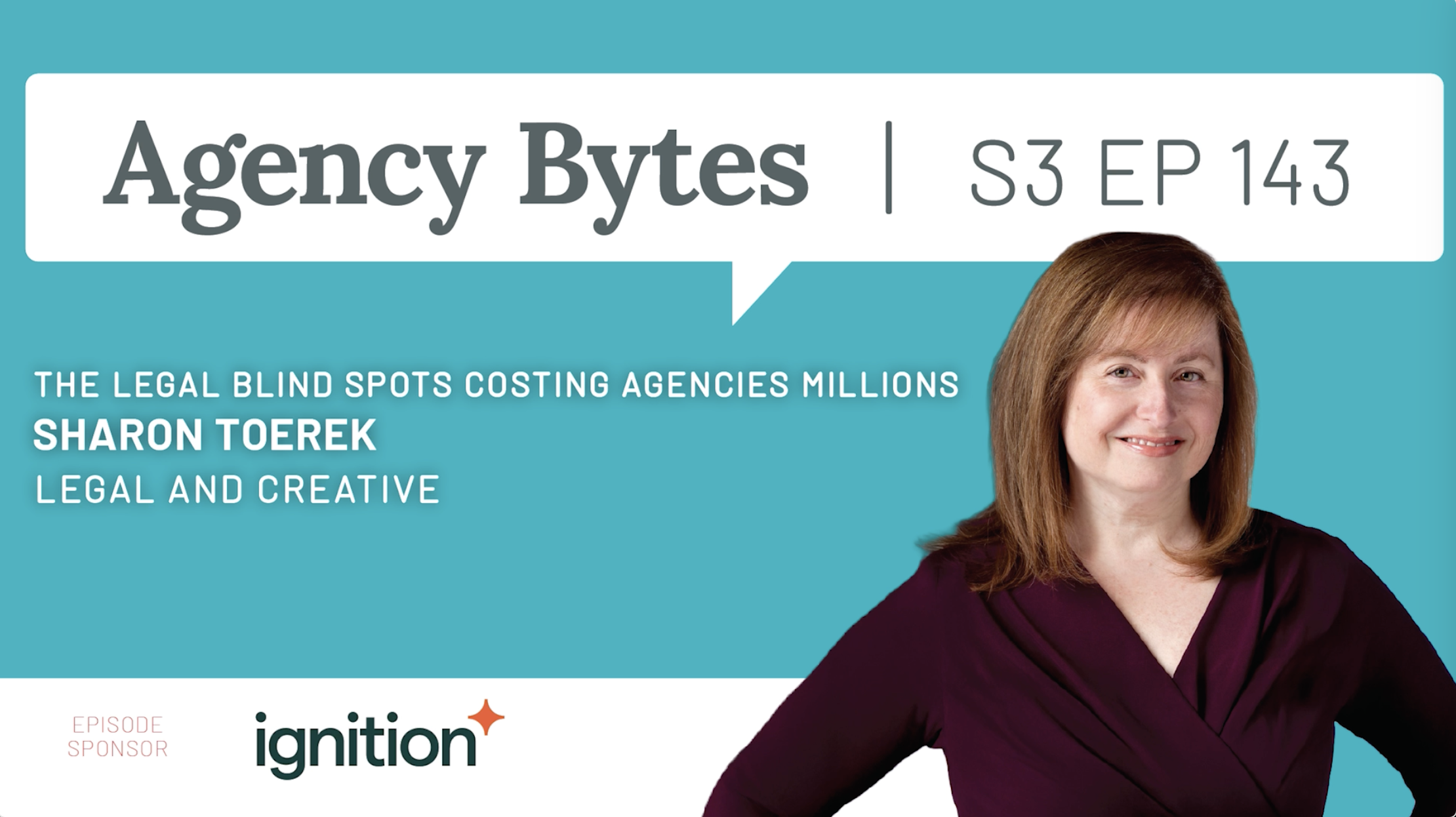
Ep 143 – Sharon Toerek, Legal and Creative – The Legal Blind Spots Costing Agencies Millions
Agency Bytes is proud to partner with Ignition.
START YOUR FREE 14 DAY TRIAL
ignitionapp.info/agencybytes-trial
Use Code OUTSIGHT25 to save 50% off!
Listen & subscribe on the platform of your choice
Featuring: Sharon Toerek, Legal and Creative
In episode 143, I dig into one of the most underestimated risks in agency ownership: the legal blind spots that quietly cost agencies millions over time.
From contracts and scope creep to client disputes, IP ownership, and liability exposure, we unpack where agencies unknowingly put themselves at risk — and why most don’t realize it until it’s too late.
This conversation is a must-listen for agency owners who want to protect what they’ve built, reduce unnecessary exposure, and stop treating legal as an afterthought instead of a growth safeguard.
Key Bytes
• Most agencies don’t realize their biggest legal risks until a problem hits
• Poor contracts quietly drain profit long before lawsuits happen
• Scope creep is as much a legal issue as it is a pricing issue
• IP ownership mistakes can create long-term client and valuation problems
• Proactive legal structure is a growth advantage, not a cost centerChapters
00:00 Why legal blind spots are so common in agencies
04:15 The contracts agencies rely on (and why they fall short)
10:20 Scope creep as a legal and financial issue
18:05 IP ownership mistakes that come back years later
26:40 Client disputes: where agencies expose themselves
34:10 Risk vs. fear: what actually matters legally
42:00 Simple fixes agency owners can make now
50:10 How legal hygiene protects valuation and exit
56:30 Final thoughts & wrap-up
Sharon Toerek is Founder of Toerek Law (doing business in the agency world as Legal + Creative), where she focuses her national law practice on helping advertising, marketing, communications, and creative agencies protect their assets and turn their ideas into revenue.
Sharon provides proactive, strategic counsel to communications, marketing, advertising, digital, and creative agencies on legal and business issues they face continually in their work, including:
• agency-client relationships, including agency service contracts
• agency-freelancer and agency strategic alliance relationship management
• trademark and copyright protection, enforcement, and licensing
• influencer marketing negotiations and content marketing legal compliance• advertising regulatory compliance
• AI policy and risk management for agencies
Sharon is an approved participant on the 4A's Legal Consultants Panel and a member of the 4A’s Expert Network. She has also served as President of the American Ad Federation (AAF) Cleveland and has been elected to AAF Cleveland’s Hall of Fame.
In addition to her Firm’s work representing U.S. independent agencies, Sharon
• Created the Legal + Creative Agency Protection System, a comprehensive legal education and legal toolkit for marketing, ad and creative services agencies
• Created and hosted over 300 episodes of the agency-focused podcast The Innovative Agency, a podcast about innovation and trends in the marketing agency world
• Presents sessions on agency-critical legal topics to independent agency networks, to private agency audiences, and at industry conferences, including INBOUND, Content Marketing World, MAICON, the Build a Better Agency Summit, Own It Summit, Mirren New York, and PRSA Counselors Academy.
-
Steve / Agency Outsight (00:02.508)
Welcome to Agency Bites. I'm your host, Steve Guberman from Agency Outsite, where I coach agency owners to build the business of their dreams. This week, I'm joined by someone who has protected more agencies from legal and operational chaos than most owners even realize. Sharon Torek is the founder of Torek Law, better known as Legal and Creative, where she helps agencies safeguard their ideas, strengthen client and freelancer relationships, stay compliant, and actually monetize their intellectual property. She's one of the industry's go-to legal minds.
a trusted advisor through the 4 A's and the creator of the Legal and Creative Agency Protection System. She's also the host of the Innovative Agency, with over 300 episodes digging into what's changing in our world and how owners can stay ahead. If you've ever wondered how to avoid legal landmines or stop leaving money on the table, Sharon is the person you want in your corner. Sharon, welcome to the show.
Sharon L Toerek (00:52.44)
Thanks for having me, Steve. It's great to be here.
Steve / Agency Outsight (00:56.578)
Legal is not something that's super, is often seen as super sexy, but man, is it like required in our industry. so I'm glad to spend some time digging into kind of some of the things that most agencies are probably overlooking. I know when I had my agency, I overlooked a lot of things and thought, man, this doesn't apply. It'll never come up for me. And so I kind of want to dig into some of that stuff. But yeah, so you've been running your law firm.
in the creative agency for a while. Give kind of your backstory and how you landed in the creative space with legal.
Sharon L Toerek (01:29.91)
Yeah, it isn't sexy in the minds of a lot of agency owners, but hopefully we can nudge it a little closer in that direction by the time we're done with our conversation over the next few minutes. So I'm an IP lawyer by training, and that means I started my career out protecting brands, protecting original creative work via trademark and copyright avenues. And over time, that really morphed into
a marketing and then an agency focused area of discipline. And what I loved about the ability to serve agencies was the entrepreneurship that we got exposed to, the creativity that we got a front row seat to see every single day. And that's still, you know, hands down, one of the best parts about owning a law firm that serves agencies is the creativity that
we get to see in all ways, both her strategy and art and all of it. So it eventually evolved from an IP practice to a marketing focused practice and then narrowed down, I'm a strong believer in niches, narrowed down to independent agencies. And so we helped them with IP, we helped them with.
Contract development and negotiation, we help them with marketing regulation compliance. And then increasingly over the last couple of years, layered over that AI, risk management, and there's a lot of &A and activity in the agency world right now. So we put together those deals here and there. It's not our most frequently requested area of work, but it's definitely upticked a lot over the last 18 months or so.
Steve / Agency Outsight (03:06.818)
Mm-hmm.
Steve / Agency Outsight (03:18.69)
We're gonna get into that, because I'm madly in love with &A stuff these days, and it's where I'm leaning into, and guiding a lot of clients through, but I'm curious, thinking back through getting, from IP, the idea of how do I trademark my ideas, how do I trademark the software I'm building, the products I'm building, again, from a sexiness of legal standpoint, what are you seeing agencies getting themselves into the most trouble?
Sharon L Toerek (03:22.446)
Sorry.
Steve / Agency Outsight (03:46.368)
with legally these days or like avoiding that is getting them into the most trouble these days.
Sharon L Toerek (03:51.501)
Right. Well, so, yeah, let's talk about that, but let's first talk about the sexiness thing, because I think the sexy opportunity, if you will, that most agencies are missing out on is the opportunity to look at the legal affairs of their agency overall as a profit center, not a cost. And intellectual property creation, protection, monetization is one of the best ways to
Steve / Agency Outsight (04:07.158)
Mm-hmm.
Sharon L Toerek (04:19.082)
monetize the work that you do in your agency every day, not just the client fee for service work, but harvesting all that intelligence that you create, all that secret sauce that you are the creators of into new and additional revenue streams. So we're talking about additional income for the agency in addition to the IP you're creating on a customized basis for your clients. And then since we're going to talk &A in a few minutes,
It is a key driver of valuation over time so that when you are ready to exit as an agency owner, you have either more options because you can either sell the IP or keep the IP, sell the agency business or keep it. So the economic opportunities for agencies are vastly overlooked. so it's kind of a personal soapbox of mine to make sure that agencies understand how to leverage it.
for money and also how to protect it along the way so they're not getting themselves in jeopardy or their clients in jeopardy or creating, you know, rifts in the client relationships along the way.
Steve / Agency Outsight (05:29.857)
So turning legal into a profit center, monetizing the IP, give some examples of things that you've uncovered for clients that they're building. didn't realize, hey, I could be, I mean, are we talking SaaS products or are we talking, I've built this once, I can sell it over and over again as like a productized service. Give some examples to shake the ideas free for listeners.
Sharon L Toerek (05:51.439)
All of the above, and I guess some of the examples that come top of mind, a lot of them emerged through the pandemic when agencies had some of their main spigots of revenue completely shut off or at least vastly reduced. so agencies that had a specific area of expertise became teachers or educators. So they developed training curriculum and they monetized and licensed that.
Steve / Agency Outsight (05:53.494)
Okay.
Sharon L Toerek (06:21.354)
or they developed sort of a methodology that they were able to socialize with other marketing service firms for income or revenue sharing opportunities. One of my favorite examples is so analog that it's almost analog enough to be evergreen, if you know what I mean. It is an agency that had a specific specialty serving
utilities, believe it or not, and they had such a vast content library of newsletter content, white paper content. They were able to license it to your point a minute ago to multiple clients or users in multiple non-competing markets for recurring streams of revenue. So I like to get agencies thinking about what's your unique area of expertise and what's the unique audience that you deliver it to.
And there usually are additional opportunities based on standardization, pattern matching that can be turned into intellectual property that can be licensed for income. And then I'll give listeners just a quick way of thinking about your intellectual property as an agency. The rubric we use is a triangle and it is brand at one point. That's your, the names and other things you use to identify who sells what you're selling.
It's the content that could be software, could be marketing copy, it could be research, it could be strategy. And then the third point of the triangle is your transactions. So that's how you actually make money with the intellectual property, whether it's licensing it out, selling it out right. It also refers to protecting your transactions into the agency because sometimes you use third parties to help you create some of this stuff.
Steve / Agency Outsight (08:14.913)
So the idea is, all right, we've built something. We know that there's recurring value here. How do we turn this into a product or a service and protect it from other people swiping it, but also from, I guess, keeping it, I guess, insulated from the rest of the business. Like, what are some of the legal parameters that you walk them through? like from the realization of, we have something here, right? Like, that's the first realization.
Sharon L Toerek (08:42.126)
All right.
Right. The first place to start is do we have something? The second place that any agency owner's mind is going to go to is does it present a financial or an economic opportunity for the firm? That's where we need to be thinking broadly about is it actually a revenue generating opportunity or is it a value increasing opportunity for the agency itself? It could be both, but it's definitely usually one or the other.
And so if it falls in the brand, I mean, the legal mechanisms for thinking about protecting some of this stuff, and it's easier to do this if you do it along the way rather than thinking about having to attack it all at one time and the investment of time and other resources that that takes. But be considering, do you have original go-to brands to your client market or to whomever's buying what it is that you have to offer?
If you do, then you've got to be thinking about trademark protection for all of those things, whether it's brand names, product names. I can't tell you how many agencies I've seen who use the same name in different markets. It's pretty common in this industry actually. So your brand protection is one, you know, the one point of the triangle and one part of your IP portfolio that if you keep up with it, it's not overwhelming and it adds value to your business overall.
The content is usually protectable either as a trade secret, meaning it's valuable to you so long as you keep the secret sauce secret within your agency and there are systems and processes for doing that. Or it's something that is probably the subject to either copyright or patent protection. Usually copyright, you don't see a lot of patentability in most IP that agencies create, but there are some exceptions to that, especially as you mentioned in the SaaS and software space.
Sharon L Toerek (10:39.48)
that's copyright and trade secrets for the content. And then there's transactions. This is where you protect your money-making opportunities. Carefully written client agreements that make sure you hold back the rights to the things that the agency wants to use on multiple occasions, either for multiple clients or to monetize separately, or in actual licensing arrangements you make to put this out into the world, separate and apart from any client work that you do.
And then I always like to make sure we remind agencies that you don't own the rights to anything that you've paid for, that a third party has created for you. Those are your 1099 contractors, your freelancers, unless you have an agreement of writing with them that says so. That's the way the copyright law works in the United States. again, transactions in, transactions out.
So that's kind of your quick start guide to how you should be thinking along the way when you're creating this. The business assessment is really one that you have to make as the owner of your agency. It's just something that we're seeing enough potential demand for because I'll be the first to say that I'm a realist about IP as much as I love it. If it's not going to be a needle mover for your agency,
It's probably not the most significant thing on your radar in terms of legal issues that you need to be paying attention to or ways to protect and preserve value in the agency using legal mechanisms.
Steve / Agency Outsight (12:13.451)
So, right, you unpacked a lot there and I have a lot of questions, but that last part is very important and I don't want to miss that either as far as like what are some of those legal protections? And you touched on like if I build something as an agency for my client who owns it, if I build something for my client and I use 1099 verse W2 talent, who owns what part of it? How do I protect that kind of stuff? You clarified the difference between trademark, copyright and patent and kind of what that process.
Sharon L Toerek (12:17.196)
Yeah.
Steve / Agency Outsight (12:43.497)
looks like for you to advise them. So let's talk about like that health, the legal health of a business, of an agency and some of those like protections that they just have in place. again, when I had my agency, we had a contract. I think I got it from the AIGA website. I had a friend who was a lawyer look at it and maybe that lasted five years and there were so many holes in it when I finally like grew up a little bit and had somebody look at it for the different instances. What are some of these like legal health?
things that agencies need to kind of look at and look at regularly.
Sharon L Toerek (13:16.078)
Right, it's a great question. And as the industry is changing at a quicker pace than it ever has, the health check you should do should be more frequent. I would say that first of all. So where it all begins, as far as I'm concerned, after all these years of working with agencies, is a healthy library of contracts. have what we consider at my firm to be core agreements that every agency.
should have in place and should maintain as current and should be refreshing as the industry and the work changes. That is your agency's services agreement, whether you use an MSA or whether you call it something else. Doesn't matter to me so much what you call it, but it does matter that it covers essential things like intellectual property ownership and transfer. When that transfer occurs, what will transfer, what will not transfer,
you know, and drifting away from this knee-jerk assumption that it's all work for hire for the client's benefit anyway, so why do we need to be worrying about this? The truth is, it's not all work for hire. There are many things you should be thinking about holding back. And now with AI being so predominant over all of our workflows, there are things that you may deliver to the...
client from the agency that are not ownable by anybody because they are machine created. And so it's addressing IP in your client services agreement. It's of course addressing liability limits and identifications, things that the agency is not going to be responsible for, things that the client is required to review, do, and provide. And there are a host of other things. But the bottom line is that is your most essential contract as an agency.
you ought to be looking at it no less frequently than annually based on the amount of change that's happening and the pace of that change. The second critical agreement is, and this is where I see agencies fall down every single day, is your independent contractor agreement. It is easy to assume because these relationships feel informal or because the work gets done quickly that a quick email to your favorite freelancer or a
Steve / Agency Outsight (15:23.617)
Mm-hmm.
Sharon L Toerek (15:36.483)
you know, a quick one pager is going to cover everything that you need it to cover when you're working with 1099 talent. some of the documents I've seen in this regard are just scary in terms of the way they position the agency and owning the rights to the work and being able to fulfill their commitments to their clients in those contracts. So.
If you're using, if your bench consists of lot of freelancers in 1099, and I have never met an agency whose bench does not consist of these folks, you need a good solid independent contractor agreement. That's pillar number two, as far as I'm concerned.
Steve / Agency Outsight (16:17.729)
And I'll just jump in and throw out that more agencies are leaning more on 1099 than W2s. That ratio of in-house versus out-house is shifting drastically. Like I know $6 million agencies that have two or three W2 employees. And so yeah, it's got to be protected in scale.
Sharon L Toerek (16:35.19)
Yeah, we can have a whole conversation about the risk around that, but yes. So you need an agreement that addresses so many of these critical issues, not only so that you are in integrity and protected in your relationship with the contractor, but so that there's a waterfall between what you're promising the client as an agency and what you're able to deliver that the contractor has provided or participated in. So that is critical.
We've seen a definite uptick and I think this is somewhat related to the &A frequency that we're seeing occur, but of agency to agency collaborations and strategic partnerships. so having adequate contracts to address those relationships is super important. Who's gonna own the client relationships? Who's gonna own the IP that's created? What kind of competition restrictions are gonna exist between the agencies, if any?
There are a lot of other side issues as well, but that is a critical pillar agreement for agencies that collaborate with other agencies to serve common clients or to refer business back and forth to each other. And most agencies that I know, they either have their go-to shops with certain disciplines or they're commonly serving a client either because the client has demanded it or because they have complimentary but not competing skill sets, whatever it might be.
So those are all critical, money saving, risk reducing, bottom line affecting legal starting points for every independent agency.
Steve / Agency Outsight (18:13.715)
as it relates to like the MSA style scope of work kind of contracts, what are some of the most commonly things that you see missing when a client comes to you like, here's our bulletproof, know, SOW or whatever. And you're like, my gosh, I can't believe you're missing. Like what are the top two or three things that you don't see?
Sharon L Toerek (18:33.986)
right. They don't flesh out the appropriate protocols and timings for the transfer of the rights to the work. That will be the first one. The second one is there's an inadequate amount of attention paid. and by the way, the IP stuff includes your ability to use samples of the work for your publicity purposes, which is a display right, which is an intellectual property right, which is not always called out adequately.
Steve / Agency Outsight (18:56.822)
Yes.
Sharon L Toerek (19:03.66)
and what you're going to regret not having addressed if you want to do a case study for your next pitch or show some samples of the work. So IP, of course, liability limits and identification is important. Fair competition rules. I don't know how this is going to shake out with the way the talent market is moving over the next year to two, but I can tell you that there's a reason why.
we make sure our clients have fair competition rules in the client agreement about talent poaching and in their agreements with contractors and other agencies about client poaching. So fair competition rules are very important. And then over the last two years, we've added specific language to client agreements regarding data privacy compliance, regarding AI use.
acknowledgement and responsibility so that everybody's on the same page about that. And then I would wrap it up by saying, I don't think agencies use the opportunity at the beginning of the relationship well enough to document the client's responsibilities in the relationship. If the client's giving you information and data, they need to be responsible for that, not the agency.
If the client's giving you product information or claims that are going to make it into the deliverables, that should be their legal responsibility. If you're a branding agency and you are recommending a brand to the client, and it's up to the client to vet that brand and make sure that it passes legal scrutiny before they're giving you the green light to launch it out into the world.
So making sure that the clients are agreeing that they're going to approve work, they're going to give you the information you need, that information is going to be accurate, true, all of that. Something I don't think, I think agencies are so excited at the beginning of the relationship that they're more focused on what do we have to do? What are we supposed to be committing to? And maybe not as much about what the client's responsibility in the relationship needs to be.
Steve / Agency Outsight (21:19.861)
Yeah, the onboarding is all about, we've got this new prize client. How do we make sure we don't lose it as opposed to owning responsibility, delegating responsibility, and setting the tone for how the relationship is going to play out, even down to communication preferences and things like that. That's not legally binding, certainly, correct me if I'm wrong, but certainly understanding who's responsible for getting this content reviewed by attorneys or trademarked or, yeah.
Sharon L Toerek (21:45.871)
100 % and don't you think I mean from my perspective representing agencies and yours having owned one you never have more leverage than you're gonna have when you're negotiating that contract you're never gonna have more leverage and so don't treat it as a fire drill to just be rushed through I know you're excited because you've just won the business and this is the only thing
Steve / Agency Outsight (22:00.258)
That's it.
Sharon L Toerek (22:13.602)
that's putting a roadblock between you and that retainer coming in or that spigot starting to turn on. I get it. I'm a business owner too and we want to keep that revenue flowing, but you will never have more leverage legally or otherwise than you have before that agreement's signed. so be an advocate for yourself. And if you need help doing so, then get the help that you need to advocate for the agency's positions on these issues.
Steve / Agency Outsight (22:41.547)
So true, you can't go back and be like, you know, we forgot this in our contract. Can you now sign it? No, it's not gonna happen. You're pretty much beat. All right, so two topics I'm really stoked to talk about and I don't wanna like burn through a ton of time, but AI, obviously we can't blink and not think of AI or see it everywhere. It's in everything we do. Agencies, I don't wanna say they're at the forefront of it, because I think it's touching all industries, but I do think agencies are being impacted. It's the industry I play in. So from my perspective, massively.
Sharon L Toerek (22:45.517)
Yeah.
Steve / Agency Outsight (23:11.489)
both integrating in their workflows, using it to develop ideas, content, hopefully not production-ready content. What are some of the protections that they need to put into place so that they can keep doing this and not have liability against them, I guess, for using AI?
Sharon L Toerek (23:29.006)
Right. There are a few quick things. I'm going to give you a quick punch list, if you're an agency owner or a leader out there, of things from a risk management, a legal perspective to think about. First of all, and this is much about a business conversation as there's a legal conversation, you need to be having crucial conversations with your clients, your vendors, your contractors, and your employees about
What are the rules of the road about how we're going to use AI? What platforms? What use cases? What policies does the client have that we need to be aware of so that we're not breaching those policies? So you need to have crucial conversations with all the relevant parties about AI to make sure everyone's on the same page regarding your risk tolerance and any rules or policies that need to be considered. So that's number one. Number two.
be familiar with the platform's terms and conditions. The cliff notes on that, the spoiler alert is these platforms are all happy to have you own the rights to any output, and they're not going to protect you if that output breaches somebody else's intellectual property rights. So just know that going in, but read the terms and conditions of the platforms that your agency use most frequently so that you are...
conversation about them and can explain them to your client, you know, in layperson's terms if you're ever asked to do that. That's number two. Number three, have written policies, both a client-facing policy around how the agency thinks about and uses AI, and there's multiple components of that, but have an internal policy. And these should be living, breathing, and constantly changing documents because AI is going to look and feel different six to nine months from now than it feels today, of course, if not sooner than that. So...
policies around how you use it, what you use, what your use cases are, what the human guardrails need to be around any work that goes out the agency's doors, either to a client or even worse, out into the world without a client having seen it first. So that's policy making. And then I think that number five is making sure that your contracts, as we said earlier, so we don't need to belabor it, but
Sharon L Toerek (25:45.571)
Your contracts should all be addressing AI. Your client contracts, your employment agreement. If you don't have a written policy, you should have an addendum in your employment agreement about it. Certainly your independent contractor agreement. If your contractor's using AI and not telling you about it, so you're not therefore disclosing it to your clients, that's a problem for the agency. So you need to be addressing it in those agreements and in your vendor agreements. So those are your five quick
start steps towards avoiding risk and sort of thinking about how you manage the risk. And they're all living breathing tactics, things that you need to revisit on a regular basis. And if you set the foundation of this, it doesn't have to feel so onerous, right? It doesn't have to feel like it's taking over all the bandwidth that you think you're saving by using these tools in the first place, because that's a common
An understandable pushback is, if we have to do all of this compliance stuff, you're so far ahead of your clients as an agency when it comes to AI adoption. I have not seen a use case yet where the agency isn't farther along than the client is. So be a leader and take the breath that you need to take to put these steps in place to reduce your risks.
Steve / Agency Outsight (26:54.891)
Hopefully.
Steve / Agency Outsight (27:07.765)
And you said something that's so valuable that I'm constantly preaching is educate your clients. Don't just, you know, deliver work and not explain how you developed it or where it came from or why you're using AI or how AI played a part in this or that. You talked about terms and conditions. It just reminded me of the South Park episode about terms and conditions. It's. It's absolutely hilarious. Look it up, but.
Sharon L Toerek (27:28.18)
see it but I can only imagine.
I will.
Steve / Agency Outsight (27:32.449)
Trying to understand these terms and conditions is impossible and so when if you can from an account management and education standpoint Be the forefront there for your clients. Here's here's what it means. Here's why we're doing this not that Here's why you can't just replace us with AI like that kind of a thing It goes a really long way
Sharon L Toerek (27:49.443)
Yeah. And your marketing counterparts at your clients, especially if your clients are enterprises, they need your intervention so that they can get this successfully run up the flagpole with their IT and their legal teams. And so the more fluid and conversant you are and the more you've thought about these things ahead of time from a risk management step, the faster you're going to get to getting the work done and getting paid for it because you're going to be...
locking some of those roadblocks out of the way more efficiently.
Steve / Agency Outsight (28:20.801)
Agreed, yeah. So AI is not going anywhere. It's shifting massively, super fast. I've seen a lot of founders panic sell their agencies this year because of the AI tsunami that's coming at them. They don't want to adapt again. They've already been through the downturns of economy. They've already been through the 08 recession. They've reinvented themselves 20 times and they're like, yeah, here's one more, I'm done. So panic selling is going on.
which is an upside for the acquiring agency, but a downside for the sellers and you're doing some transaction work yourselves. Can you talk about what you're seeing in, coming into early 26, like what you're seeing in the agency &A market and some of the, I guess, pitfalls that we're seeing in the transactions?
Sharon L Toerek (28:56.142)
Yeah.
Sharon L Toerek (29:07.83)
Right. I think that we're seeing a much larger frequency of the smaller transactions than we would have seen, you know, five years ago. I agree that the tsunami that AI feels like right now is driving a lot of the activity, a lot of the interest. I haven't seen any outright, I have to be honest, panic.
I am the part of the selling owners. I have seen fatigue. I have seen, you know, it's it has been a great run, but we're not up for version 3.0, 10.0, whatever it is, what this industry is going to look like for us to continue to win. So let's take some of our chips off the table now. And so we've seen strategic third party buyers for sure, where
They can fold in either there's an interest in the client roster or there's an interest in the talent roster. And it's creating all kinds of opportunities for efficiencies and for doubling down in a market you're already interested in serving by folding another agency in. So, you know, I choose to look at it in a balanced fashion. I think the increase in volume is as, as you say, I think AI has something to do with it.
Steve / Agency Outsight (30:15.073)
Mm-hmm.
Sharon L Toerek (30:33.902)
whether the lift is actually heavy or just the perception of the lift is heavy. I also think that those agencies that made it through with the skin of their teeth through the pandemic, they were just getting righted again. They had one really strong year and then the trade winds economically along with the technology.
of AI advancing upon them has just felt like more than they want to continue to balance. so we've seen some internal transactions with leadership teams buying the agency from the owner. We've seen third party transactions. And then there are new and novel approaches, both on the P.E. side, equity coming in and buying up and rolling up shops. And also many holding companies, if you will.
They're not true holding companies, but they are collectives or aggregators, if you will, of agencies with different specialties that complement and can do better together than either any of them can do individually. So that's what I'm seeing out in the marketplace. And some interesting innovation, I think, could come out from under this where agency owners
with smaller books or smaller firms who may have thought that their only option a couple of years ago was just to close, know, shut the lights out. And they may have more options now than they thought that they did. And I think that that is a reason for optimism. So I think that there's lots of ways to look at the situation. And if you're an owner that's at that stage of your career in owning an agency,
I think there's more possibility for you out there than there even was a few years ago. And I don't think that's a bad thing. I just think that there's a lot more players out there to sort through. So that, you know, that's a challenge, but that's why you have advisors that like, like Steve to help you come in and figure out what makes sense for you.
Steve / Agency Outsight (32:40.149)
Yeah, I agree. think there's a lot of optimistic movement going on. There's not, know, the panic that I'm seeing, the panic selling is like the intent. Like you said, I'm burnt out, I'm fried, I've been through, you know, economic downturn, pandemic, God knows what other kick in the face, like I'm done. What do I do with this thing, right? So literally three agency owner friends that I'm working with now are like, how do I divest this agency?
Sharon L Toerek (32:52.46)
Yeah.
Sharon L Toerek (32:56.696)
Yeah.
Steve / Agency Outsight (33:06.273)
You know, and so there's options, but there's really like creative and exciting opportunities, which I love being a part of. I think it's really cool from a legal standpoint, thinking about kind of, you know, doing an acquisition or even on the other side of doing the divestiture. Like what are some of the pitfalls that you've seen that have like killed a deal, whether they've gone in too hot or like some of those things that you've seen of like, oh, I can't believe that killed it.
Sharon L Toerek (33:32.451)
just did a workshop about this recently about how to prepare and what to be thinking about and the things that either cost the seller and sometimes the buyer more money or adversely impact the valuation, which is the name of the game when you're trying to exit. and coincidentally, these are the same things that you should be thinking about to keep your agency strong anyway, whether you plan on selling it or not.
But the first of them is not adequately accounting for auditing and protecting the intellectual property that you're creating along the way. Because if you want to use it as a value sweetener, you need to demonstrate value. And one of ways you do that is by securing it as you create it and properly monetizing it with license arrangements, things like that. So that's the first thing. The second thing is looking at your auditing, your client contracts.
to see whether or not they are assignable because an agency or an owner who wants to buy your agency is not going to be interested in a book of business that has easy out clauses and all the client agreements or proof somehow that the client is in it to win it with you and will go with the new owners. So audit your client agreements. That's the second thing. Audit your IP, audit your client agreements.
And then the third thing I'll mention just quickly, and this tends to be not a deal killer, but a deal delayer and therefore a cost increaser, is you don't have your act together just in terms of corporate affairs. You don't have corporate agreements between co-owners. You don't have the necessary bylaws or operating agreements. Nobody's sure whether you're a corporation in good standing anymore.
Nobody knows where any of the IP registration proof is. So just having your corporate ducks in a row internally, your legal foundation internally in place, I've seen that add weeks to a close date and that's not happy news for anybody involved in the transaction. So I would say those are the top three things to be thinking about. If you want to position yourself.
Sharon L Toerek (35:55.799)
And the longer your horizon between now and when you think you might be ready to do that, the easier and less expensive these things are to clean up along the way. and like I said, those happen to be a lot of the same things it takes to just be a good, strong, solid agency anyhow. But if you're looking at the dollars and cents of it and the calendar days and months of it, then those are definite difference makers in my experience.
Steve / Agency Outsight (36:22.593)
Thank you, I'm so glad you said all that. And you said some really key points. One is, the longer you delay it, the more expensive it gets. The more money you're at a possibility to lose. Second thing that you said that I absolutely love is, you've got all your ducks in a row and you're just running your business as if it could sell, it's just a good running business. And that's what you should have. Legally protected, good client protection, good strong pipeline, strong processes, all of these things.
Sharon L Toerek (36:30.766)
100%.
Steve / Agency Outsight (36:52.637)
sure, you're ready to sell if that opportunity comes along, but you've got a really good, healthy agency. And that's what I've been preaching for years, build it as if you wanna sell it, and then find the opportunity to say no, because man, that feels really good. You know? Yeah.
Sharon L Toerek (37:06.862)
100%. I agree. And, you know, one of the saddest things for us to see when we're advising an agency through this process is the deal stop in its tracks because you've got a really weak agreement with the client or you don't have agreements at all in writing with clients because you've been handshake business with them for the last five, 10.
It's great to have a longstanding relationship, but those legacy relationships tend to be linked to the founding owner of the agency. And if you don't have the contract to back up the revenue, then that's not going to be a very strong selling point for you to a potential buyer. So these things have dollars and cents consequences, and you can knock those things out of the way proactively if you are careful along the way about...
doing these things, which is why I consider legal affairs to be a profit-making tool for any agency.
Steve / Agency Outsight (38:10.101)
Yeah, yeah, absolutely true. Invest now, invest early in what you need to be healthy and protected and add multipliers to what your exit could look like and to the profit that you're experiencing now. Man, you are an absolute chasm of knowledge. And frankly, these are all topics that I freaking get just stupid excited about. So I'm grateful for the opportunity to kind of get out of here. That's on your business card. I know it.
Sharon L Toerek (38:33.55)
called a chasm of knowledge before that. It's not, but I might report them or I might create a digital version and maybe I'll put it in my LinkedIn profile chasm of knowledge. love it.
Steve / Agency Outsight (38:39.135)
Hahaha!
Steve / Agency Outsight (38:45.153)
Perfect, yeah. All right, let's wrap up with a couple real quick rapid fire questions. Sharon, this has been awesome. So the first is, what's a small daily habit that makes your work life noticeably better?
Sharon L Toerek (38:59.19)
A small daily, man, this is going to sound so analog and retro. am, I'm a paper and pen girl and my process involves as many digital tools as I use. A, my favorite notebooks are those five by seven. It's a Spanish company. I actually have one right in front of me. I'm going to click cheat and look at the name. No, it is a Mikkel Rius. I use these, I use these notebooks and I make
Steve / Agency Outsight (39:19.585)
Is it the Moleskines?
Sharon L Toerek (39:28.622)
I have four quadrants of admin, marketing, legal, which is client production work, and then sales. And I make those, that's how I organize myself every day, every week. And so that's a daily habit, a weekly habit that has never failed me. And I just, I think I process information and retain it more strongly with pen and paper. Yeah.
Steve / Agency Outsight (39:55.318)
I'm the same way and the endorphin rush I get with crossing something off my list is way better than like clicking a mouse to check it off. It doesn't even compare so.
Sharon L Toerek (39:59.298)
yeah!
You got to put something on your list just so that you can check it off either if you've it, even if you didn't, you want the proof that you did it.
Steve / Agency Outsight (40:08.927)
I do that all the time. do something and I'm like, it wasn't on my list. Like even my weekend list. I didn't have feed the birds on there. I'm adding it and crossing it off. yeah. What about...
Sharon L Toerek (40:12.046)
Yep.
Sharon L Toerek (40:17.442)
Yep. I travel a lot. I make packing lists. I don't need to write down what I'm going to pack anymore, but I do it anyway.
Steve / Agency Outsight (40:21.813)
Yep. All right, if you could instantly master any skill outside of your profession for fun, for business, for whatever, what would it be?
Sharon L Toerek (40:35.086)
I would like to learn how to build a custom GPT. I have practiced a little bit, but I would like to be fluent in building one myself so that I know what it feels like to go through the process.
Steve / Agency Outsight (40:55.071)
I can introduce you to a few people that can walk you through it. Yeah. And then finally, what's other than any AI app, what's one app that you love that most people would never expect that you use regularly?
Sharon L Toerek (40:57.965)
Okay.
Sharon L Toerek (41:07.214)
What is one app that I use regularly?
Sharon L Toerek (41:13.098)
I don't know. I don't think I'm that unique when it comes to, let me think about this really quickly. I love the app that supports the project management software that we use at the firm. It's a law firm specific, but they have a mobile app that's pretty slick. And so I rely on that extremely heavily for our financial dashboarding, our calendaring, all of it. It's kind of a fingertip thing.
I guess I would say that one. then personally, I was a fan of the Noom app for a long time. It was like a nutrition and dieting app. That one, yeah.
Steve / Agency Outsight (41:53.506)
Okay, yep. Awesome. I'm a big fan of Merlin. It's the birding app and it pulls from Cornell University's database. So we'll be out in the kitchen or in the yard and we'll hear a bird and I'll fire up the Merlin app and you'll be like, oh, that's a whatever. Tough man. So yeah, big bird nerds, but Merlin's a cool app for that. Anyway, Sharon, I am super grateful for your time, all the experience that you shared with us.
Sharon L Toerek (42:09.794)
Yeah.
Sharon L Toerek (42:14.166)
Awesome.
Steve / Agency Outsight (42:20.181)
Folks check out Sharon, she's at legalandcreative.com. Got the podcast there, tons of information, webinars, workshops, all of it. Sharon, thank you so much for joining me today.
Sharon L Toerek (42:31.96)
Thanks for having me, Steve. It's been a great time together.