
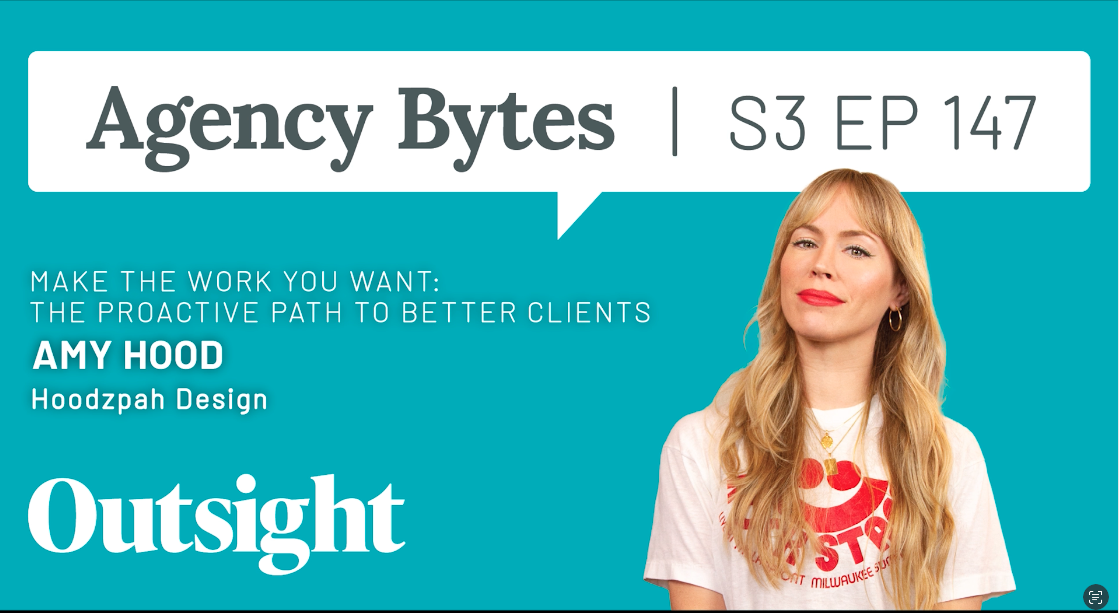
Ep 147 – Amy Hood, Hoodzpah Design – Make the Work You Want: The Proactive Path to Better Clients
Listen & subscribe on the platform of your choice
Featuring: Amy Hood, Hoodzpah Design
In episode 147, I sit down with Amy Hood, designer and co-founder of Hoodzpah Design, the Southern California brand identity studio behind work for Disney, Nike, Netflix, Target, and the Lakers. Amy and her twin sister Jen built Hoodzpah out of necessity after realizing they were “unhireable on paper,” and turned it into a nimble, right-sized studio that’s intentionally stayed small to protect speed, momentum, and creative quality.
We talk about why “make the work you want to get” is still the most reliable path to better clients, how relationships compound when you lead with curiosity (not strategy), and why creatives have to treat marketing as part of the job if they want opportunities to find them.
Amy also shares the story behind Hoodspa’s Adobe MAX banner plane stunt (“No more broke creatives”), what they learned from taking a big marketing swing, and how they’re shifting from service work into products like their updated book Freelance, and Business, and Stuff and the Fort font subscription app.
Key Bytes
• Making the work you want to get is still the fastest way to change the caliber of clients you attract.
• Staying small on purpose can be a growth strategy — speed and momentum beat bureaucracy.
• If you don’t share your work, people can’t refer you because there’s no proof you exist.
• Spectacle marketing works when it’s aligned, intentional, and captures attention in a sea of noise.
• Diversifying income through products creates longevity — especially when your body can’t grind forever.Chapters
00:00 Welcome + who Amy Hood is
01:05 Hoodzpah’s origin: “unhireable on paper” to studio owners
02:59 Twin partnership: dividing roles and avoiding scorekeeping
08:41 Staying small on purpose (and why bigger can be slower)
11:18 Landing better clients by making the work you want
18:03 Dream clients + putting your hat in the ring
21:00 Adobe MAX banner plane: “No more broke creatives”
28:40 From service to product: book, fonts, and Fort app
31:48 Font licensing fear and why clients are gun-shy
38:44 Rapid fire: resets, creative myths, and boundaries
Amy Hood is a designer and co-founder of Hoodzpah, Inc, a brand identity studio in Southern California that has worked with companies like Disney, 20th Century, Nike, The Lakers, Target, and Netflix. Amy's logo and identity work centers around custom lettering solutions. She is the font designer behind Palm Canyon Drive, Beale, and Beverly Drive. When she's not stress-watching Laker games, Amy can be found at the beach, plein-air doodling, and practicing her Smashball backhand. She co-authored the book “Freelance, and Business, and Stuff: A Guide for Creatives” (and its related online course) with her sister Jennifer, based on the Professional Practices class they taught at Laguna College of Art & Design.
Contact Amy, grab their book, or fonts all on the Hoodzpah website, Instagram, or YouTube channels.
-
Steve Guberman (00:01.292)
Welcome to Agency Bites. I'm your host, Steve Guberman from Agency Outside, where I hope help agency. There I go. Screwing up. Take two. Welcome to Agency Bites. I'm your host, Steve Guberman from Agency Outside, where I help agency owners build the business of their dreams. This week on Agency Bites, I am thrilled to be joined by Amy Hood. She is a designer and co-founder of Hoodspa, a brand identity studio based in Southern California that's worked with brands like Disney, Nike, Netflix, Target, and the Lakers.
She's the co-author of Freelance and Business and Stuff, a practical guide for creatives. And when she's not designing, you'll probably find her stress watching Lakers games or sketching at the beach. Amy, it is so great to have you on the show. Thanks for joining me today.
Amy Hood (00:43.324)
thanks, Steve. Yeah, I was it was fun chatting with you last year, just about a few things going on. I was like, yeah, let's let's do a pot about it. That'd be fun. It truly feels like ages ago.
Steve Guberman (00:51.764)
Awesome yeah last year seems like ages ago already. So talk about Hootspa you and your sister what's kind of the backstory how'd you launch it like what's been the trajectory for you.
Amy Hood (01:05.707)
Yeah, okay. Elevator pitch, short, sweet. Yeah, we basically, we were artists our whole life, but we didn't go to traditional college. I was an art major at a community college, which I always say is every parent's waking nightmare to try to be a fine artist or community college. And I was five years into a two-year program and I was like, I have to get out of here, but I was paying for my own school. And one of my coffee shop clients...
got me a job as an intern at his graphic design magazine, which was really just a coupon clipper. But I learned everything through mentorship. And when that business folded, because the magazine industry just was taking a dive, print was dying in a real meaningful way. Jen and I, who both worked at this magazine, we literally were unhireable on paper. We only had crappy ads and no school experience. And I don't even think our resumes were even
getting looked at. They were just getting immediately put in the trash because we just weren't hireable. But I think we knew we always had like the skills and that sort of thing. We just hadn't had the opportunity. So we started our own studio and that was like 15 years ago in 2011. And it was purely out of necessity because we could not get hired and Southern California living is extremely expensive and rent had to be paid. But it's kind of funny how when you do something out of necessity and you're like, just until I get the next job. And then that thing becomes the thing. And you're like, I actually really love.
Steve Guberman (02:13.816)
Wow.
Amy Hood (02:29.528)
working for myself and building this thing. And I can't imagine working for anyone else now. It's kind of crazy.
Steve Guberman (02:35.394)
Well, you're unemployable now. You can't work for anybody else. Yeah. Yeah.
Amy Hood (02:36.988)
Truly. Steve, I think about that all the time. I'm like, I sing to myself in the office, my office. If I had to work with other people, it would just never work. I need my singing time while I'm working. It's part of the process. No, no, you can't sing out loud.
Steve Guberman (02:50.776)
Yeah, most jobs don't allow for that these days. Yeah. So what's like the divide of roles and responsibilities between you and your sister?
Amy Hood (02:59.424)
Yeah, it's become a lot clearer over the years. We used to think, we do all the same things. We're good at all the same things. And I think when you're young, you just want to be good at everything and you're really competitive. But now I'm like, no, Jen is absolutely the business mastermind as far as like, you know, quoting, making sure, you know, contracts and everything like that and the way that we organize our projects and position ourselves. Jen is the mastermind when it comes to that sort of thing. And then I handle all of the marketing side. So promoting all of our fonts and all of our books and all that kind of stuff.
and making sure we're getting the workout. And then we both kind of equally tackle the brand identity work. And then recently we've been getting into type design. I say recently, but it was like 2015. yeah, but also blink of an eye. But yeah, we've both been getting into that. I kind of started us off, but Jen, we've always kind of had that skill for lettering. But yeah, the creativity is kind of equally split, although Jen's just...
Steve Guberman (03:39.64)
Also a blink of an eye.
Amy Hood (03:53.814)
she's really good at the strategy side. So I pretty much run everything by Jen to just brainstorm together. And then we kind of divide and conquer and we kind of art director our individual clients and then come back together for creative direction kind of riffing together. But yeah, that's kind of how we divide it. And the older I get, the more value I see in just focusing on what you're good at and just outsourcing the rest. Like you don't have to do everything. And that's something that when you start your own thing, I'm sure you knew from running your studio.
That's a hard thing to get rid of. It's like, I can just do it. It's like, I don't need to do it. Like somebody else could do it better and faster.
Steve Guberman (04:27.598)
Yeah, that's a mindset shift that like a lot of people get, like I say late, but they get it when they get it. But yeah, it's like, what am I really good at? What do I want to do? And frankly, why do you own a business if you can't just do the things you love doing and let somebody else do the things? I don't want to do bookkeeping anymore. I don't want to do like all this menial stuff or I don't want to production design or what, like whatever that thing is, delegate it out. Let somebody who's far better than us do it and stick at the things you love doing. Absolutely.
Amy Hood (04:41.867)
Yes!
Amy Hood (04:53.59)
You're so right. like you started the business so you could have freedom and then you keep bogging yourself down with the things that you hate because you just usually it starts out you can't afford to like sub someone or you don't think you can. And then by the time you can you think well I could do it faster and then I can save a couple bucks. It's like for what for what for you know it's not worth it.
Steve Guberman (05:08.696)
Yeah, no.
And there's the, the, again, the mindset of like, let me let somebody else do this other stuff and I can focus on the top level of the thousand dollar an hour things. So yeah.
Amy Hood (05:16.874)
Yeah. that's so it. That's such a huge shift in your mindset. Like when you're when you start small and you're trying to grow. I think that was the hardest part for us was just getting out of that kind of like scarcity mindset or like saving every penny or just being being a little bit miserly with our with our budgets. You know, it's like, no, we want this to be awesome. We've kind of been able to shoestring ourselves for now. But like
like we have the money now, let's actually do the things that we've always wanted to do and start proving that we can handle this next level of marketing and client management and all that kind of stuff.
Steve Guberman (05:52.238)
I've never, I've coached a lot of husband and wife teams. I've never coached a sibling team and I'm curious, my siblings and I are super close, but like we also would beat the crap out of each other growing up. Like how do you guys operate as a team? you like, are there, are there sticking points that you guys like, you know, loggerheads against or are you symbiotic on everything? Like what's the vibe in an operational world?
Amy Hood (06:04.193)
Yeah.
Amy Hood (06:14.742)
That's so funny. Every time I talk to someone who was like, if I had to work with my sibling, I'd murder them. And it's so funny, but I think it's probably similar because we're twins and we grew up together and we're so used to just having to get along. My mom was pretty strict on us getting along. I think it's more like a married couple, actually. It's like, it's a little bit more. It's not so much like I'm my own person and like we would come to brawls. It's more like a respect, but an annoyance, like a seething annoyance when you disagree, you know?
But yeah, it can be really difficult. think honestly, I am thankful that at the end of the day, we know that we love each other and we have each other's backs because that's the thing when you partner with people that are not family or even just friends, you always kind of wonder. At some point, it comes to a stage where you feel like someone's taking more. And it can be really difficult to know, are they thinking about me too? Are we all considering the bigger picture and everyone as a whole or do I need to like...
watch out for myself here and that can be really difficult when you're picking partners. So I find it easier, but I feel for people who have defined partners, you know, all I can say is always get a partnership agreement just so everyone clearly knows their roles upfront. That's the best thing you can do because then there's mutual respect and like guidelines. I think the hardest part is when it's too wishy washy and then people inevitably feel like taken advantage of because it's just not clearly stated.
Steve Guberman (07:29.667)
Yes.
Steve Guberman (07:42.136)
Yeah. And also like when you take that energy from a marriage into a business partnership, hopefully you're not keeping score in the marriage. So you're also not keeping score in the business. And maybe that's the mindset you guys have.
Amy Hood (07:50.688)
Yes. That's so true. That's interesting. Yeah. I think, I don't know if this is like a Southern thing or again, a twin thing, but we always grew up where it's like you help and you pick up. Like if someone cooks, someone does the dishes. If grandma's outside raking the leaves, you go out and help her pick sticks. it's like we grew up in a very like, you just help. You look at what everyone's doing and you see how you can help. And because of that, think we were always looking for that in our team members too. It's like.
Like you said, don't keep score. Literally just jump in. How can I help? Are you busy? What can I take off your plate? When you're running a small studio and you're doing these big projects, like you have to have that mindset. It can't just be like, that's not my role. It's like, we're not a big enough agency for everyone to have like clear set, you know, very, very tight roles. You know, it's like, you kind of just need to jump in when, when you need, when people need help.
Steve Guberman (08:41.196)
Yeah. And so you guys are, we'd say around five people now, full time, five and a half. Yeah.
Amy Hood (08:44.044)
Yeah, we're like five and a half. So we have, yeah, we have some part-time help and, but yeah, fully fledged like little design studio that could, I'm always amazed at the caliber of projects that we can tackle and working with bigger teams. And I'm sure you felt this when you had your studio, but like the bigger the team does not mean like the faster or the more you can get done. In fact, it actually is so much slower because there's so many people.
Steve Guberman (08:57.038)
Mm-hmm. Sure.
Amy Hood (09:12.674)
that have to say, yes, there's so many approvals, there's so much red tape. And so I still, I don't wanna grow too big, even if we could, that's the last thing I wanna do. Like I really love how nimble and quick, and our clients really love how nimble and quick we can be.
Steve Guberman (09:27.598)
Yeah, stay true to that. know, you we were, felt right sized around five or six as well. And we, we won an agency record contract that doubled us. And at 12, we were, it just, was too much at that point. And, um, and then we lost that AOR and those roles were contingent upon that contract. So having to lay people off stunk, um, but knowing, knowing we operate at the best size at five and a half, like staying true to that.
Amy Hood (09:38.967)
Yeah.
Amy Hood (09:48.248)
That's the worst. Yeah.
Steve Guberman (09:53.174)
I had a web developer who used to say, can't throw more women out of pregnancy and speed it up. It's still going to take nine months. And I was like, that, yeah, I get that analogy here. Yeah.
Amy Hood (10:00.407)
That is so good because that is funny. That's like people think a bigger team means it can go faster. It's like, no, that just muddies it. It's just like having too many stakeholders. Like, you you want everyone to have a say, but there's a way to like organize it to where it's like, okay, everyone gets to be in on the discovery phase where we're ideating and it's very broad and everyone can like lend ideas and we can all riff. But once it comes to actual like creative decision-making, who are the two to three people?
that get the say, the final say, because after that it just becomes not only designed by committee, which is a bummer, because everyone's trying to be pleased, but it also just takes forever. And then you kind of lose that magic momentum, which I think small studios really, I think that's one of the benefits of working with a small studio is the momentum and even just having delegated point persons where it's like, at the end of the day, these two people get to make the decision so that things can move forward.
Steve Guberman (10:54.67)
Yeah, absolutely. Love that. What, so thinking about the trajectory of Hoodspa starting out as like doing print design ads that you couldn't even use in your portfolio. Now you're working with like massive brands. You're a huge Laker fans. Talk about like what, how you were able to jump into some of the bigger brands in order to like get some of that work that's like life changing for you.
Amy Hood (11:17.91)
I think it's like the worst kept secret now, which is like making the work that you want to get, like doing passion projects, like being proactive. But at the time, I mean, it was so old school back in the day when we started, like, you know, there were like networking meetups that we went to once and everybody in the room was like 40 plus and they were just so rude to us. Kind of like, you're going to steal my business. You're trying to eat my piece of the pie. was very us versus them. It was very old school mentality. And there really wasn't much community.
And so we just felt like we kept trying to get inroads the classic ways of like interview, try to get a job at the cool agencies, but we just couldn't, we didn't have, and rightfully so, we did not have the work to show for it. And so I think for the longest time, we've just realized like, if we wanna get somewhere, we have to make our own opportunities. Like we just have to do the things to show that we can do them and take the time and eat the cost, not in an insane way that's going to like make me lose my house or something.
Steve Guberman (11:48.014)
Hmm.
Amy Hood (12:15.084)
But you know what I mean, just like being proactive in your own life instead of waiting for the perfect opportunity. And I still think that's true today, even though it's like very common knowledge. It's like, you really have to, you really have to show what you can do and show passion.
Like I think when students come out of school, they're always like, oh, like I'm interviewing and it's really hard and how do I stand out? I'm like, do something that you're just passionate about. Like I have all the projects memorized that all of you all do for all your classes. Like I can see it in the portfolio. And I know even if you don't say it, that it was for school. You know, it's like, if you can dream up your own project and the passion comes through and it was just for you, like that will always be a benefit and that will always sell you. So that's totally what we did. were.
obsessed with the Lakers, obsessed with just like California culture. There's a lot of like surf and skate brands that we figured we could probably work with that would be a good fit for our style. And so we just started like sharing our process, sharing our work, making work, emailing, emailing people that we admired and just being like, Hey, I really love what you're doing. And this was a weird one. But I remember back when it was like blog spot, I used to a blog and I would just do write-ups. It was like early podcasting, like what you're doing, just do write-ups on people I admired and like.
Steve Guberman (13:13.752)
Mm-hmm.
Amy Hood (13:26.264)
post their work, share their work. And then they would inevitably be like, hey, thanks for like sharing my work. And it would create a connection, you know? And I don't think I was intentionally doing that at the time. I just was like excited to see what was out there, because I hadn't gone to design school. And those connections, it starts to build, you know? if you just, even just with Twitter back in the day, do you remember old Twitter, old design Twitter, how like, it was incredible. Like, yes.
Steve Guberman (13:51.112)
The Twitter was amazing. And even like the Tumblers and stuff that you guys were doing, you know, things like that. Absolutely. Yeah.
Amy Hood (13:57.25)
Like I made so many friends that were just mutuals that then I met in real life. were, and we took it offline. We'd be like, let's go get coffee. Let's like hang out. Let's, we're both going to this conference. Let's meet up. And like those people helped me build my business. Like we worked together. We send each other work. We did projects together and like we grew up together as businesses. And I, I don't think we could have done it without that because it's amazing what your friends will do. And it's amazing what you will do, but it's like, you can bring your friends along for the ride. So it's like my friend, Jeff Ipchin locally.
He was working at the Anaheim Ducks, which is the hockey team around here. And of course, the beloved Disney franchise. And we got to do a little project with him and he knew we were Lakers fans. And he went to school with the Lakers senior designer, Jay Diaz. And he was like, I could like, you know, introduce you guys, you guys could get lunch. And we got to go tour the Lakers facility and like meet the whole design team, which led to a project. And you just truly don't know like where the connections are going to come from. And if you try to be too...
Steve Guberman (14:47.885)
Wow.
Amy Hood (14:54.87)
conniving about it, you'll do it wrong. Just literally go out and meet people, have good conversations, and be curious. That's the main way we've built our business. And treating every project like it's the Nike, like it's the Lakers. Because those small projects for us that we took on where we were like, this budget isn't great, but I can see something here. There's an exciting...
like the vibe is right, the product is right, they're gonna take it across the finish line because they have history of like getting it done. have always like clients will come to us and they'll inevitably list four projects that were all small, all small budgets, but the creativity was like chef's kiss. So it's like, sometimes you just gotta like know like this is gonna be a good one and you just take it and it doesn't matter that the budget isn't good.
Steve Guberman (15:25.474)
Mm-hmm.
Steve Guberman (15:40.46)
Yeah, take risk. Be curious. Do passion projects. I see the same studio or student work also. And it's been that way for 20 years. You design the same exact. It's nonsense. But yeah, you got to take a risk and it's a calculated risk. And often those like smaller budget projects are in exchange for you can have ultimate creative freedom stick within our brand guidelines. But we were looking for you to just really push the envelope, kick it out of the park for us, that kind of thing. And it pays off.
Amy Hood (15:47.989)
Yeah.
Amy Hood (16:06.88)
Yeah, totally. I love how Mike Smith talks about it. He was talking about like, work with businesses that are in a disruptor situation, which that's like a very tech phrase, but you can think about it in any way, which is like a small business needs to make a splash and they need to be a little bit more edgy than maybe a big company that has way more liability. And I think people think like, I'll do the cool projects when I work for the big companies, but they have so much liability. They're waiting to see someone else smaller do it successfully.
So, you I loved how he phrased that because he was like, we like to work with clients who are willing to take those creative risks. And I was like, that's it. That's such a great short description of like the businesses that we love to work with. then inevitably, like that will get around if you if you're proactive about sharing your work and submitting and trying to get press like it will it will make the rounds. And art directors are always looking for creatives, like doing exciting things.
Steve Guberman (16:58.926)
Yeah, I think, you know, knowing the DNA of who you want to work with, whether it's like we work with conservative brands who want to, you know, toe the line or we want to break through brands who want to really just break out and do disruptive things. You know, think about like Dollar Shave Club when they came into the marketplace, disrupted the entire market. They're not tech at all. And the CEO did this insane ad. He just walked through the facility. And so, yeah, they're out there. And then it's matter of attracting it, doing the great work like you guys are doing.
Amy Hood (17:14.178)
Totally.
Amy Hood (17:19.734)
Those ads, yeah.
Amy Hood (17:27.864)
Yeah, and then I think also like I can't tell you how many friends I have that are like the best designer I know better than anybody and don't share their work because they don't have the time or they just they like cringe at the thought of like having to talk about themselves or they just like get in their head about like describing what they did and I'm like hire someone do whatever you have to do because it's like I want to refer you but there's no proof that you exist
Steve Guberman (17:53.678)
Hahaha
What about are there still brands that you're like, this is a dream client. We got to get in there someday. Anything that's on your radar you want to put out into the ether.
Amy Hood (18:03.21)
Absolutely, I say it all the time. But like, we would love to and I think we would be amazing at helping a NBA team or like an NHL team like rebrand, like keeping the history of what makes it special. Like that is our sweet spot. Keeping the history and the legacy of what makes the thing special, maintaining that, but like bringing a new spirit and a new fresh take on things. Like that would be a dream project for us. And we got to do kind of like a tasting of it for
the Sacramento Kings and a couple of other teams, they have this thing every year called the California Classic, which is like Lakers, Kings, Warriors, Spurs. And I think the Suns always have this like pre-season summer league series and it's every year. And we got to brand that and it was so fun. And we got to work with Ryan over at the Sacramento Kings and
It was a really nice little touch into like, okay, this is what we can expect for the process. So it's like a little bit lower stakes. It's not like the big main thing, but I'm like, okay, we're starting to kind of get our foot in the door to like make this dream a reality, you know? And I'm like, now I just need to like reach out and I have a lot of connections and just be like, Hey, when the day comes that you all want to rebrand or refresh, just know like our hat is in the ring and we will give you 110%. Cause I think you have to kind of, you have to kind of put it out there. You have to be like, you have to.
you have to want it and you have to make it clear. I don't think a lot of people kind of go after and are proactive about those kinds of things. And it's so awkward to figure out how to word that email, but I'm like, if I don't, I'll regret it for the rest of my life.
Steve Guberman (19:33.934)
Absolutely, you've got to be proactive about saying what you want to get out of a relationship, what you want to bring to the table, otherwise they're not going to think of it. Like sure, they might be like, wow, Hootspur does awesome work, but we have to go with whatever, know, this brand or, know, Alan Peters or blah, blah. know, so yeah, absolutely. I think you've got to say it and put it out there and be direct about it. Yeah. Yeah.
Amy Hood (19:45.387)
Yeah.
Amy Hood (19:53.238)
Totally. And you can be cool about it. It can be short and sweet. And in fact, the shorter the sweeter, better. So that, you know, if they're not interested, it's like an easy thing, but literally just reminding them like, hey, if this comes up, especially because in our line of work, like branding is so like when someone undertakes a brand refresh, like that's like every five to seven years, maybe 10 years, like it's not frequent. So it's like, you have to remind them that you're there, especially when like there's all these amazing studios now, like there's more options than ever. So it's like.
just reminding them that you're there and you're a good option, you know, and that you would treat this with the utmost respect and care and that sort of thing is, I don't know. So that's kind of like our goal is like, it would be amazing to do some sort of project like that. And I think that would be right up our alley. We're like true fans of sports and in general. So yeah.
Steve Guberman (20:40.815)
you mean you have to do your own marketing? That's insane to remind people who you are and that you exist and what you do. Like what? That's crazy.
Amy Hood (20:46.752)
I know. It's the hardest part about being a creative and it's like the biggest thing we talk about in our book and our courses for sure.
Steve Guberman (20:50.85)
Yeah. Yeah.
So let's talk about marketing. You made a huge splash at Adobe Max. Talk about your spectacle marketing event that you guys took up.
Amy Hood (21:03.2)
my gosh, that was so fun. When you jumped in the DMs and were like, I love this. was like, this is exactly the response that we were hoping for. And I was so glad to be getting those DMs because it was such a big swing. And I was like, either this is going to go over really well, or it's going to be a total dud and a flop. And it was a waste of the marketing budget. But it's like, we had to try. But basically we, I'm so glad that you thought so, but we, we were, we had been working for like two to three years, rewriting our book, freelance and business and stuff, which the first edition was like a huge hit.
Steve Guberman (21:13.731)
Yeah.
Steve Guberman (21:21.73)
think it was great.
Amy Hood (21:33.004)
We've sold over like, you know, 25,000 copies, think something insane. And we were, we were rewriting it just to be, we had learned even more about working with like bigger clients, the unsaid things, the soft skills, you know, those kinds of things, and just updating for, you know, the new era that we live in. And we were like, we really have to like make a splash and really like let people know it's here. It's, it's like the age of the freelancer in the small studio. Like people are getting laid off. They need, they need to be able to have these skills while they're finding their next thing or.
maybe just starting their new thing that they had always been putting off. So we were like, we really want to make a splash. What if when everyone, all these 15,000 people that are going to be communing in LA for Adobe Max that are all our target demographic, what if we flew a banner plane promoting this book over Adobe Max? And not on the nose, but like kind of a like, wait, what is that? And like, I want to find out more. So we, we, riffed a lot. were like in tech starts with friends, like riffing, doing mockups, but.
we landed on like no more broke creatives as like our kind of campaign. And then the tagline was, are you a broke creative? And then, and it was like broke creative.biz. And basically that just took people to the site where it was just kind of talking about the book, the course, kind of our own personal story, how we started our business, cause we got laid off and just kind of like addressing kind of the interesting times that we're in.
which is that a lot of people are having to freelance right now that didn't want to, you know, or that are not prepared, but are needing to make ends meet. And that this is like a great tool to get you started with just like the tactical basics of how to run a smart business and hopefully also grow one that you're like proud of and you know, but just bare bones starting it and then also growing and thriving. And it was, it was amazing. I've never, I've never had to, you know, to hire a banner plane. So just finding one.
Steve Guberman (22:54.53)
Mm-hmm.
Steve Guberman (23:15.491)
Yeah.
Amy Hood (23:23.852)
getting quotes, guessing how much it would be and being like, okay, it's not as bad as I thought, but it's pricey. just like all the planning and everything was like fascinating. And I sharpened my negotiating skills. I will say we negotiated it down. We made it happen. And I was like really, it was like probably the biggest marketing thing we've ever done. And it was quite fun having everyone just like building the suspense. Like it's coming, look up. Like we had all these fun little like cryptic posts.
Steve Guberman (23:48.717)
Yeah.
Amy Hood (23:52.792)
We shared it with a couple of friends so that they could kind of like whisper around maybe like teasers, you know, around Adobe Max. And our friend, Andrew Hockrattle was like big in the community over there at Adobe and he helped us kind of like spread some rumors. yeah, it was...
Steve Guberman (24:06.37)
Yeah. He's a good person for that. He's a rumor miller. Yeah. Yeah.
Amy Hood (24:10.208)
Isn't he the best? my gosh, he's so funny. I love him so much. And it was amazing, but it literally, almost flopped. everyone, we were like, okay, everyone will be out and about in the city, getting lunch and like walking around and taking a break at noon. And then the plane took off like early because there was Santa Ana winds were blowing so hard that they missed kind of our window. But luckily the, like the last
spot before lunch let out early, I guess. And so everyone happened to be outside just as it was flying over. And I was like, it was such a relief because when if you can't fly that day, they're like, we'll just make it up another day. I'm like, the event is today. Yeah, it has to be today, you know, so it was.
Steve Guberman (24:40.169)
cool.
Steve Guberman (24:48.866)
Yeah, there's no other day.
Steve Guberman (24:52.942)
So big risk, big reward. I love that. I'm curious, so with little expectations, were you able to track metrics, whether it's site visits or QR, there was no QR on it. So yeah, I mean, what kind of metrics were you able to gather from it?
Amy Hood (25:07.458)
Well, we did do Google Analytics obviously on the BrokeCreative.biz, which was great. So that we got a lot of traffic from it. I will say like it wasn't as huge as I thought it would be, but the buzz on social media to me felt good. So it was like, there was a lot of buzz of just like, which is kind of what we wanted was just like awareness of, you know, like it's coming, it's happening. The second edition is finally here. We've been talking about it for two years and it's finally here, you know? And so we had a lot of...
Steve Guberman (25:19.458)
was huge. Yeah.
Steve Guberman (25:31.032)
Yeah. Yeah.
Amy Hood (25:35.264)
And we did get a ton of pre-orders, I will say. So it's like, I need to go back and like fully dig into the details. Cause of course it was right before the Thanksgiving break, right before the holiday break, all that kind of stuff. But I think it was fully a success in that we took a big swing. Everyone was talking about it on social media. We captured it with a photographer. So we've got these ads set up that we're gonna run in the new year. That's kind of riffs on the idea.
And then we're hoping to continue the footage on as like kind of like a larger campaign of no more broke creatives and just like really leaning into that for 2026. So I'm excited to see how it like grows and how we kind of riff on it. And I want to do more in-person activations. I'm still kind of thinking about it, but just like, even just like popping up at AIGA local events and doing something fun there, something a little bit more personal and small, like actual like person to person.
Steve Guberman (26:05.933)
Love it.
Amy Hood (26:27.35)
But we're still kind of riffing on that. We love the idea of spectacle and activations and in person. And I think with all the fatigue of like, just advertising is so ubiquitous now. Like it's everywhere. You can't escape it. It's like, I think that kind of, that kind of marketing is, it feels good right now. It feels like a reprieve.
Steve Guberman (26:46.124)
Yeah, that's what was different about it. mean, yeah, anywhere you go, LA, New York, whatever, there's a million things just in your face. And this was different because it was in the sky. People were looking up. I saw a million people sharing about it. And I just, yeah, I thought it was different. And, you know, I love the idea of doing like gorilla activations and something different and getting a buzz out. Is that something that like you, you would do or have done for clients? Or was this like your first kind of out of the box campaign?
Amy Hood (27:02.988)
Totally.
Amy Hood (27:14.11)
That's such a good question because I think part of the reason we wanted to do it for ourselves is because we kept kind of pitching ideas to clients that they were kind of like, that's interesting. And they liked it, but it felt like too big of a risk. And like we had a couple of things planned that were smaller with a couple of clients, like really funny ad spots. But to be honest, we haven't really gotten into marketing that much for our clients. We mostly stick in the brand identity realm. But when you're when you're launching a new brand, we always try to like.
Steve Guberman (27:24.782)
Yeah.
Steve Guberman (27:36.685)
Okay.
Amy Hood (27:41.548)
talk with the clients about like, what's a big way we can make a splash to announce this rebrand in a fun and exciting way that shows the shift in the mentality, in the vision, in the ethos, in whatever it is, or what we held onto, you know, in this brand refresh. So I think a lot of what we wanted to do was just like treating ourselves like the client, like we had when we started at the agency all those years ago, which is like trying these things for ourselves, seeing what works, seeing what activations are meaningful so that when we do pitch these ideas to clients,
It's not like, oh, well, have you ever done anything like that? It's kind of like we have, we have experienced to fall back on, you know, and in that way, I thought it was really beneficial and just like, you know, knowing what these things cost, being able to like put together like a informed budget for clients. I mean, like it's not actually as much as you think. And it's like a pretty cool, pretty cool moment. So I think that was a lot of the reason that we did it was again, like practicing what you preach, like showing that you can do the thing that you're trying to sell your clients on, you know.
Steve Guberman (28:38.87)
Yeah, yeah, you took the risk on yourself and now you can parlay that into, yeah, we can do this for you as well easily. Yeah. So you took the shift from also like where brand design studio to you've got a font app, you've got a book in its second iteration. What was it like kind of shifting your and your like your and Jen mindset from being brand designers to product designers?
Amy Hood (28:42.719)
Yeah. Totally.
Amy Hood (28:58.569)
Yeah, I think that that's always been innate to us. I don't know why, but like when we were young, like I remember when I was in high school, like I was dating this guy that was on the basketball team and I made a shirt that's like had his name on it and rhinestones and school colors and stuff. And all the, all the people in the school were like, I want one, put like my name on it with the school colors or like I want one for my boyfriend or whatever it was. And I started to truly, I was bedavling t-shirts. was selling them and I would like draw the number. would draw the name and script, you know.
Steve Guberman (29:20.396)
You were the original bedazzler?
Amy Hood (29:28.551)
And like I was always selling something, you know, but it just kind of felt innate. So even when we started our business, like we've never been really, I started trying to sell my art at the San Clemente like craft fair. And it's just like, you know, I was making greeting cards. Like I was always trying to do something. So I think it's just innate to us to sell products, but I think the products that we've really loved recently are the ones that are like practical and useful.
when you have a product that you know is just going to be a help to someone, like it's going to aid their process, it's going to make them faster, it's going to give them peace of mind, whatever that is. Like the marketing becomes so easy because you just know, this is the thing that I wanted, that I made because I needed it. You know? And I think, I think sometimes when you're, when you're, when you have a product that's a little bit more silly that you made for fun, like sometimes you can get in your head about like, does somebody need another thing? Does somebody like, how am going to say this? Do you know what I mean? It's like, you can't think that.
Steve Guberman (30:22.035)
Yeah.
Amy Hood (30:24.587)
way because you made it for fun and they will enjoy it. But I do think there is something easier about the mentality of like, no, this is actually helpful. This font app that we're doing with our friends, when you go to download fonts, it's like, do they have trial fonts? making sure the client knows that it's trial fonts and just the mess of trying to get fonts on your computer and trying them and all that kind of a hassle.
is like, there's just a lot of studios don't offer it is like, you just can't try out the characters and then inevitably you buy a font that you actually didn't like because a couple of characters are weird, you know? So we were just like, gosh, it'd be great if we could have something that was more like Adobe fonts where they're just on your computer if you sync them and you can try them use them. And so that's what this app is that we're doing with Fort. It's called the Fort app. And it works like a desktop app where you can just turn everything on.
when we deliver new fonts, like when we release a new font, it just comes straight to the app. It's a monthly fee. So you get six new fonts a year and you can use like the whole library and it includes a desktop license. So you just know like, okay, I can use this for any of my clients on desktop. If they want a live file that I can just, they can either also get this app or they can just buy a retail license. You know, it just kind of makes everything a little bit easier. I think, you know, with, I mean, after the whole
Steve Guberman (31:40.814)
Very cool.
Amy Hood (31:48.209)
My fonts shaking down that company on Reddit. Did you see that post? Yeah. It was monotype, I guess, who owns MyFonts. I don't know about everybody out there, but our clients have been extremely gun shy about font licenses now. Pretty much we get branding projects. The first conversation we have in the discovery is like, OK, and what is our font budget or what are we thinking? And they're always like, Google Fonts, Adobe Fonts. They just want to know that the license is clear. They don't want to have to worry about it. They don't want to...
Steve Guberman (31:51.202)
Yeah, I did. It's insane. Yeah. Yeah. I think so. Yeah. Yeah.
Amy Hood (32:15.979)
worry about spending 30, 40, 50 grand a year. And we were just noticing this is a huge problem, not only for creativity of encouraging brands to do something cool, but just they feel like the font licensing is duping them. And that's not a good feeling.
Steve Guberman (32:33.932)
Yeah, mean, others shy of designing their own custom typeface like they're very, it's very limiting because of the legal ramifications. yeah. So.
Amy Hood (32:41.813)
Yeah. And it just felt very predatory. And we had a client come to us and say, yeah, they came and shook us down for this amount. it's hard when maybe it looks like a bigger business on paper, or it's actually not that many designers are using this. It can be really hard to like, there's just a lot of different ways people license fonts. So I think our goal with Fort was just like, how do we make this easy? We just want people to use the fonts and feel comfortable and be able to sell it to their clients.
easily without like much hassle and they can try it and they can use it and they can and people can just use our fonts and make beautiful things like at the end of the day I think that's what we want so so we're hoping that this yeah so we're hoping that this app I know for me I was like another subscription but then the math on it's crazy like for the price of like half of a family like you know our new our new family is probably going to be about like 118 dollars and it's like you can get
Steve Guberman (33:18.092)
Hmm. Yeah. You want to empower them. Yeah.
Amy Hood (33:37.943)
all of our fonts for $99, which is like 400 plus fonts. like, so it's like buy one font family or subscribe to this yearly and get like tons of new fonts every year. So I think the learning curve for us is just like, how do we market that clearly? You know, it's like, this isn't something that is very like Adobe fonts is just free with the program, but how do you explain the value or like convince people that another subscription is worth it? You know, it's like, it's an interesting like new kind of hurdle that we're
that we're learning and trying things on.
Steve Guberman (34:10.446)
It's an exciting new challenge and you guys are a type foundry now as well as a brand studio. so the idea that are there for creatives, they understand like I'm willing to pay for access to really like beautiful typefaces. Whereas people that are like not that enthusiasm and enthused about typefaces. Sure. Adobe fonts is fine. It comes with whatever 10,000 fonts. That's enough, you know, but for the people that want like a truly like bespoke typeface, like subscription, they'll, they'll pay for it. A hundred bucks is nothing.
Amy Hood (34:23.393)
Yeah.
Amy Hood (34:39.187)
Yeah. And I think that's the hot, that's like, you talked about it earlier, but like positioning, it's all about positioning because it's like, if we're trying to, if we're trying to like compete with Adobe fonts, we can't, that's not, that's not the right mentality. It's like, we're not, we're not quantity. We're, like quality and style for like a certain, like a certain demographic of people who have like a, you know, certain skillset or like, you know, whatever. So it's like really kind of figuring out like, how do we, who's our audience? How do we speak to them? How do we
How do we explain this and explain the value and make sure that they understand, like, if you want volume, like, that's what Google Fonts and Adobe Fonts is for. If you want to not have to scroll till your eyes bleed to find a great option, like, this is a good option. And it goes great with Adobe. Like, I still use Adobe Fonts all the time because it's so convenient and we're on there. So it's like, I think it's kind of like, like, this is a great addition to your system to where you know you'll have great fonts that not everyone's using.
and you don't have to just be scrolling on iPhones for, you know, 10 hours, which is my nightmare.
Steve Guberman (35:39.928)
Yeah, it is an absolute nightmare. Is font book still a thing? I don't even know. I remember that desktop app being a thing back in the day.
Amy Hood (35:45.663)
Now, yeah, it's like a lot of those got bought out by like monotype. And but yeah, there used to be more options for like the sinking kind of mentality. So it's interesting kind of like bringing that option back. And we're teaming up with font do to create the app. And they're going to. But anyway, they are just like a really amazing building software for fonts. And they've done a really amazing job. It's so easy to use. I use it all the time. It's so
Steve Guberman (35:49.719)
Okay.
Amy Hood (36:13.685)
It's so easy to just type out things and see what's working. Yeah, it's been really cool. been a total learning curve. You're going to have Jessica Hishon soon, but I've been fascinated watching her build her new product, StudioWorks, just seeing how they're marketing it, seeing how she's diversifying her income, and finding her next thing. Because my wrists hurt. I am very acutely aware that I only have so many years left in this body.
Steve Guberman (36:26.764)
Yeah, Studio Works.
Amy Hood (36:40.011)
to be doing my best work and being really profitable. I'm like, what's a thing where I can continue to be profitable, but I can't go as hard as I used to. It used to be so easy to work long hours and now I'm just like, I'm so tired. They are so a thing of the past.
Steve Guberman (36:54.51)
All-nighters are a thing of the past, but you're absolutely right. Diversifying the income, subscription models, build, once, sell a million times, the books, these are all amazing things that you guys have developed in order to, like I said, diversify income, support more artists, help other people, simplify the process. I love what you guys are doing. I'm such a huge fan and super just excited to see what you guys do next. So yeah, yeah.
Amy Hood (37:14.869)
Yeah.
Amy Hood (37:21.059)
thanks, Steve. Yeah, that's so sweet. Yeah. And I think like even like with you this podcast, I'm sure you feel it. But like, like when like one person writes in and they're just like, wow, this really helped me get my business off the ground. I'm just like that. To me, that is like worth so much more like the rewarding feeling of being like I helped an individual like thrive on their own. It's not like
It's not like some faceless thing. It's like, this really impacted someone's life in a meaningful way in the same way that the people that helped me when I was starting my business. I just remember how hard it was and how feeling like there's so much I don't know and I don't know what I don't know. And having those people that just took the time to give me feedback or give me advice, that was huge. And a lot of people don't have that. So having this book as a reference, I'm just like that.
That is like one of the things that I'm most proud of that we've done and just like it's been so rewarding in a way that I hadn't expected.
Steve Guberman (38:13.848)
Yeah. So such an amazing, powerful resource for literally anybody, but people starting out, people looking to like jump into it. I do think we're seeing kind of a, another push of the freelance era that we saw early in COVID when so many people were laid off and hanging up a shingle. so it's just a brilliant resource for them. Like, yeah, don't step in the same potholes we stepped in. Like, you know, here's a map to walk around them kind of thing. Amy, I have taken up way too much of your time today. I'm super grateful. Let me throw a couple of random rapid fires at you.
Amy Hood (38:24.695)
Yeah.
Amy Hood (38:33.685)
Yeah.
Totally.
Steve Guberman (38:43.704)
to wrap things up. So the first is what's your go-to way to reset your creative brain when you're feeling stuck?
Amy Hood (38:50.047)
Always a walk, always, it always fixes it. Just hearing the wind through the trees, you're like, it's not that deep.
Steve Guberman (38:57.41)
Yeah. Love that. So true. What's something that you believed about being a creative early in your career that turned out to be completely wrong?
Amy Hood (39:07.381)
I remember everyone was like, never share your process, never design live with a client. Like keep all the mirrors and, and you know, curtains up. And I've found that to be not true in a lot of cases, not always. You have to really be like acutely aware of what the client is able to like see and understand and like their imagination capabilities. But I mean, I can't tell you how many times I just get on a call and we just do a live design together and we fix it in five to 15 minutes instead of three weeks of back and forth and then feeling and losing momentum and then feeling like.
wow, they really don't get it. You know, it's like, just get on the call, talk it out.
Steve Guberman (39:42.007)
I love that, couldn't be more true. And then finally, what's one boundary that you've put in place as a studio owner that's had a bigger impact than you expected?
Amy Hood (39:54.503)
I think, you know, growing up in the Instagram era, it felt like, you have to be authentically you and share every part of you and like monetize every part of you. I think we set a boundary pretty early on where it was like, we get to have our personal life. Like we get to have things just for us that aren't for shares and likes and, you know, monetizing our lifestyle or whatever, you know, and it's really hard when you are your business and you started your business with lifestyle branding and sharing every aspect of your process.
But I think like creating that safe space to be like, I don't need to share everything and I don't need to post everything. This can be just for me, little mental snapshot just for me and my family. And that's good. It's like having that separation of like, you don't have to be your business and you also, you don't have to share every piece of your life online. Like there's a freeness to that, that yeah.
Steve Guberman (40:43.586)
Yeah, I love that. It's so true. Like sometimes I'll do a thing and I'm like, yeah, it doesn't need to be posted. Like that's just for us. Like who cares? nobody's going to be like, Hey Steve, you didn't post that you were at the grocery store yesterday or Amy, were you even at the Lakers game? Like, yeah. Yeah. Amy Hood, Hootspur Design, big fan. Folks check out Fort App coming. Is it coming soon? Is it out?
Amy Hood (40:47.735)
That's just for me.
Amy Hood (40:56.479)
Yeah, yeah, exactly.
Amy Hood (41:05.271)
It's here, we're adding new things every month. So yeah, and we're gonna be supporting web fonts soon, soon. So yeah.
Steve Guberman (41:12.034)
subscription model typeface foundry and The second edition of the book is out. So grab it now The links are gonna be in the show notes. Thank you so much so much so much for spending time with me today
Amy Hood (41:25.143)
man, thanks Steve, this was so fun.
Steve Guberman (41:27.66)
Yeah. Appreciate you.