
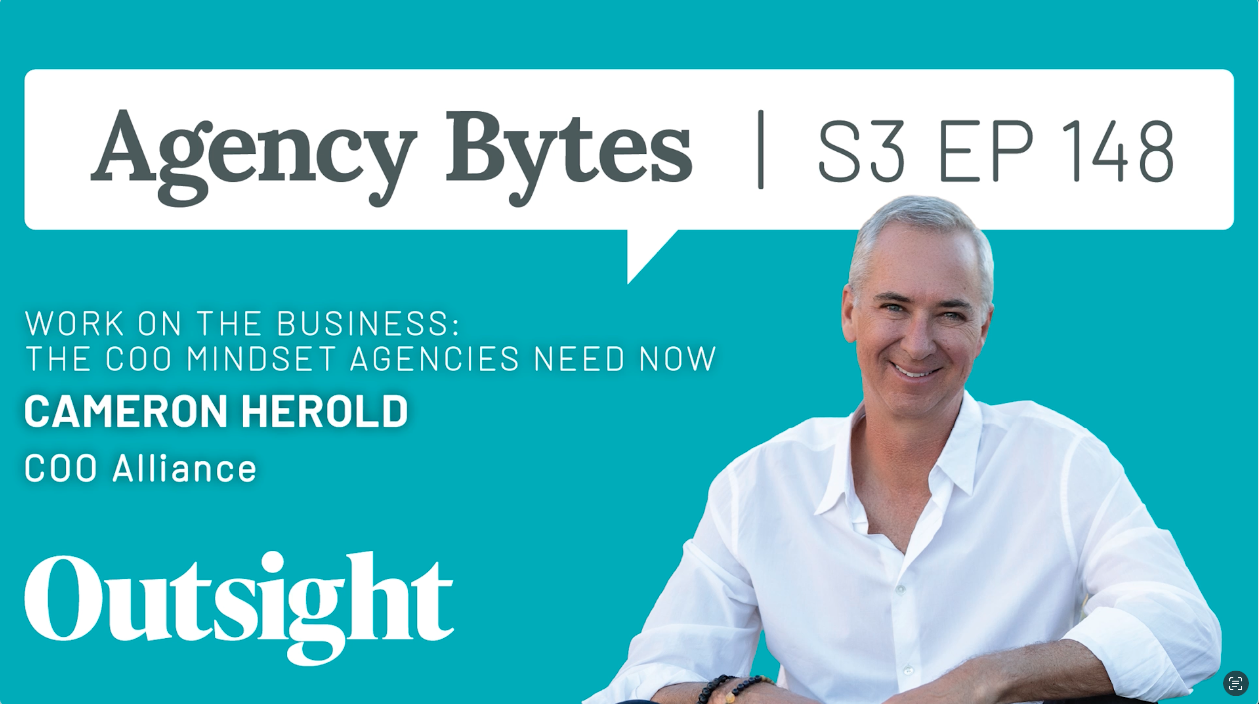
Ep 148 – Cameron Herold, COO Alliance – Work On the Business: The COO Mindset Agencies Need Now
Listen & subscribe on the platform of your choice
Featuring: Cameron Herold, COO Alliance
In episode 148, I sit down with Cameron Herold, founder of COO Alliance and one of the most recognized voices in operational leadership, to talk about the mindset shift agency owners desperately need right now: stepping into the role of CEO and building a true COO mindset inside their business.
Cameron has helped scale companies like 1-800-GOT-JUNK and advised hundreds of growth-stage businesses, and in this conversation, we unpack what it really means to work on the business instead of being trapped inside it. We talk about the operator’s lens, how founders accidentally become bottlenecks, and why operational maturity is often the difference between a lifestyle business and a scalable asset.
If you’re an agency owner who feels stretched thin, stuck in delivery, or unsure how to elevate your leadership team, this one is a masterclass in stepping up and leveling up.
Key Bytes
• The CEO’s job is vision. The COO’s job is execution. Most agency owners are trying to do both — and burning out.
• Operational discipline isn’t about bureaucracy — it’s about freeing the founder from the day-to-day.
• If you’re still the glue holding everything together, you don’t have a scalable business — you have a dependency.
• Working on the business requires intentional systems, delegation maturity, and the courage to step back.
• Strong operators build companies that can grow, sell, or run without the founder in the weeds.Chapters
00:00 Welcome & Cameron’s Scaling Background
04:12 The Difference Between a Founder and a CEO
09:48 Why Most Agencies Don’t Truly Work “On” the Business
16:35 The COO Mindset Explained
23:10 Founders as Bottlenecks
31:42 Building Operational Discipline Without Red Tape
40:18 Hiring & Developing Strong Operators
49:03 Scaling vs. Lifestyle Businesses
57:25 Final Advice for Agency Owners
Cameron Herold is the mastermind behind the exponential growth of hundreds of companies globally. Founder of the COO Alliance and Invest In Your Leaders training. Cameron is known as the "CEO Whisperer" and is also the former COO of 1-800-GOT-JUNK?, where he engineered the company's spectacular growth from $2 million to $106 million in revenue in just six years.
The publisher of Forbes magazine, Rich Karlgaard, stated, "Cameron Herold is the best speaker I've ever heard...he hits grand slams”. Cameron is the host of the Second In Command podcast, author of 6 bestselling books, including The Second In Command, Vivid Vision, Meetings Suck, Free PR, Double Double, and The Miracle Morning for Entrepreneurs.
Cameron is a top-rated international speaker and has been paid to speak in 26 countries and on all 7 continents, including Antarctica in early 2022.
Contact Cameron:
www.cooalliance.com
www.cameronherold.com
https://www.instagram.com/cameron_herold_cooalliance
https://www.facebook.com/COOAlliance/
https://www.linkedin.com/in/cameronherold
https://www.linkedin.com/company/coo-alliance/
https://twitter.com/cooalliance
https://www.youtube.com/@CameronHerold?sub_confirmation=1
https://cooalliance.com/vivid-vision/
-
Steve Guberman (00:01.328)
Welcome to Agency Bites. I'm your host, Steve Guberman from Agency Outsite, where I help agency owners build the business of their dreams. This week on Agency Bites, I am joined by Cameron Harrold. He's widely known as the CEO Whisperer. Cameron helped scale 1-800-GOT-JUNK from 2 million to over 100 million as COO and now leads the COO Alliance, working hands-on with operators and leadership teams inside fast growing businesses. He's a best-selling author.
Host of a second in command and someone who's spent decades helping founders get out of the weeds, build real relationship benches and scale without burning out. Uh, which makes this conversation especially relevant for agency owners. So Cameron, great to have you here. I'm glad you got the memo on uniforms today.
Cameron COO Alliance (00:44.906)
And if anybody's listening and not watching, we're both wearing our plaid flannel shirts today. We both cracked up laughing when we hopped on the call. Steve, good to see you.
Steve Guberman (00:55.174)
Great to see you, my friend. I appreciate the time today. For those that don't know, give kind of beyond what I just intro'd you as kind of what you're up to with COO Alliance and what your journey's been through the entrepreneurial space.
Cameron COO Alliance (00:57.678)
Of
Cameron COO Alliance (01:08.494)
Sure, I grew up in a family of entrepreneurs. My dad groomed my brother, my sister and myself to all be entrepreneurs. And then I joined my first entrepreneurial mastermind 30 years ago. I joined the Entrepreneurs Organization in 1995, was a member of that for a bunch of years, five years. Since then, I've been a member of about six or seven different large entrepreneurial mastermind groups. I was a Genius Network member for nine years. I was in Strategic Coach for seven years.
I've done six baby bathwater events, five mastermind talks, events, et cetera. And so doing all these entrepreneurial events and being in rooms with entrepreneurs, I recognized that there was a huge gap in the market. There were groups for marketers and there were groups for lawyers and there was pretty much trade associations for everything out there, but there was nothing for the second in command. And I had played the COO role for 1-800-GOT-JUNK, but I'd also been in a second command role for a couple of other companies.
I just recognized a need in the marketplace. So about nine years ago, we started an organization called the COO Alliance, which is the largest network of its kind in the world for the second in command. And we have COOs from 17 countries that meet up in person a couple of times a year and then over Zoom. And we just have this large community to support them to help the entrepreneurs make their dreams happen.
Steve Guberman (02:27.28)
What's crazy is, before I don't even know that you were on my radar yet. And so I run mastermind groups for agency owners. And two, three years ago, I was like, there's no, nothing I know of for second and commands. And a lot of it came about through working with founders and them saying, I don't know what to do with this, or I don't know how to direct this person. And when I would talk to second and command and say, Hey, you should join this mastermind group. They would say, you know, I would say, your boss.
Susan recommended you and Joe number two would be like, Susan clearly has no clue that I have no time in my calendar for a mastermind. Like the second and commands were so overworked, but the CEOs apparently didn't have visibility into how overworked they were that they thought, yeah, they can go to a mastermind group. anyway, I just thought it was funny. It never launched. I couldn't get traction with enough second and commands. And so I am grateful that there is such a great resource that you've got.
for second because it's so vital for the growth and success of an agency or any business for that matter.
Cameron COO Alliance (03:32.984)
Well, yeah, there's two parts to that that are important to speak to. One is that I don't, it feels, I'm frustrated for COOs who say they don't have time for a mastermind because what they don't recognize is being in a mastermind, working on their skills and their connections and their confidence is the classic working on the business instead of working in the business. And for a couple of hours a month to work on their skills, they're going to actually amplify their results.
Right. If they would actually remove themselves from the day to day and force them to delegate more, force them to grow their people more, force them to say no and to optimize and automate systems more. But when they, when they're just going there and working hard, they're almost like a fly banging their head on the window and they're going to keep working hard until they get through the window and they all end up dead on the windowsill or they end up getting fired and replaced by somebody else who's a more effective leader. Part two of that though, which is interesting. My COO Alliance started nine years ago.
because I was coaching two CEOs and their COOs and they ran digital marketing agencies. And the one who came up with the idea for the COO Alliance, his name is Zach Morrison. He's now the CEO of an agency called Tenuity. At the time it was called Elite SEM. They had 40 employees, now they have 2200. Zach asked me if I would get the COOs for a bunch of my clients together.
Steve Guberman (04:53.372)
Wow.
Cameron COO Alliance (04:58.134)
I'm like, I don't really know the COOs. goes, well, you're coaching Matt wool from acceleration partners. He's the COO for Bob Glazier. You're coaching, Zach Oberon over at book in a box, which is now called scribe media. goes, why don't you just get us together? I'm like, well, that's interesting. So I did a one page landing page, tossed it up, pushed it out on Facebook. And 26 hours later, I had 10 people fully paid to come to a three day event. And the event became all 10 of them presented.
something they were strong into the group in 15 minute presentations. And on day two, they all presented a problem and the group helped them unstick the problem. And that was it. I didn't even do any training. And at the end of the two and a half days, nine of the 10 wanted to continue meeting and that was the start of the CO Alliance. So I can say thank you to Acceleration Partners, which is a digital agency around performance marketing and then Tenuity.
Because they're there and both of those CEOs are now the CEOs of those companies, but they were the reason for starting the CEO Alliance nine years ago.
Steve Guberman (06:00.228)
Amazing. you, exemplify what I think is super critical is that you were the linchpin of bringing the chemistry together. You didn't need to get on stage and show decks or graphs or charts or do, you know, personality indexes or any of nonsense. It was, let's get the chemistry, let's get the right people in the right room and together we're going to elevate and solve. And I mean, I think that's the magic of it all.
Cameron COO Alliance (06:11.222)
Mm. Mm-mm.
Cameron COO Alliance (06:24.376)
Well, I was just speaking with, with somebody else in the, kind of the industry this morning. And I said that I'm not, I might be the face of the brand and I'm trying to even remove myself from the face of the brand. I really want to bring all these COOs together and have them grow each other. They've got the skillsets, right? And I haven't been running an operational company now for 19 years. I've been running my own business, but I left 1-800-GOT-JUNK 19 years ago. mean, I haven't run teams and you know, integrations and so I ain't got
I would be horrible at trying to train people now.
Steve Guberman (06:56.562)
So talk about what you see in kind of the missteps of putting, well, let me ask before that. One of the biggest things that I see in agencies is founders not putting a number two in place. And I think it's one of the most essential things they can do as they try and get themselves out of the day to day. And so what are some of the things that you can identify that like here's when you're ready to do that, or here's some of the things that you should think about when you're doing, know, starting to put number two in place.
Cameron COO Alliance (07:23.022)
Great question. So for every single CEO out there, their first number two is actually an executive assistant, not a COO. And if you don't have an executive assistant, you are one. And there's a lot of agency owners out there that are making $300,000 a year in profit or a half a million dollars a year in profit or a million dollars a year in profit. If you're making, let's say you're making $500,000 a year in profit and your salary, that's $250 an hour.
Steve Guberman (07:35.632)
Hmm.
Cameron COO Alliance (07:52.718)
times 40 hours a week times 50 weeks a year, right? So about 250 bucks an hour. So if you're the CEO of an agency and you're getting paid $250 an hour, why are you doing minimum wage tasks ever? And if I was to sit down and look at their calendar and I was to look at their to-do list, I could pretty much guarantee that at least 30 to 40 % of their day is doing minimum wage work.
And if I was their CEO, I would fire them. I mean, like, why am I paying you $250 an hour to do $20 an hour tasks? So that's the starting point is at least get a fractional or a virtual or worst case, even an in-person EA to get stuff off your plate. Um, my second in command has been with me for 10 years. She now has an executive assistant. She's had one for the last two years to get some of her admin off her plate so she can work on, you know, the higher project areas for me.
Steve Guberman (08:46.45)
Yeah.
Cameron COO Alliance (08:47.074)
The next part is if the CEO is working on stuff or the agency owner is working on stuff that they're not good at, or if they're working on projects that drain them of energy, that's a good sign that you could hire someone to do those things so that you could work on the higher revenue or higher engaging, unique ability activities, right? The stuff that really fires you up. That's a really good starting point. And then the last one is if you have a leadership or a management team in place,
And the only time that you have available to work with them is your weekly meeting. You're not really growing them. You're not aligning them. You're not inspiring them. You're not removing obstacles for them. You're not inspecting what you could. So there's huge opportunities for that CEO to again, hire that second in command at that point.
Steve Guberman (09:33.466)
Yeah, I love all those points, especially like that, that beginning point of like, how do I start getting into that? Identify the things that are on your plate that are like, you you call them like the minimum wage things and then like delegate and elevate. go through an exercise with founders where let's list all the things you do in a week, not time tracking, but list the activities and then identify what you should not be doing. So, and I don't know where I got this phrase from, maybe Dan Martell, or I don't know where, focus on the thousand dollar an hour things and, and you know, the important top level things.
delegate the rest of it off your plate. So I like that point of like using EA to start with.
Cameron COO Alliance (10:08.248)
When Dan talks about that in his book, buy back your time, the original concept came from Dan Sullivan with strategic coach. And so Dan's ideas to do what they call an activity inventory. And the basic idea is pretend that someone followed you around for an entire month with a video camera, right? Like Gary Vaynerchuk or Dan Martell. Now someone videoed you doing your job every minute of the day for the entire month. And then if you rewatch the video, you could write down everything that you do.
Steve Guberman (10:14.79)
Okay.
Cameron COO Alliance (10:35.334)
I show up at meetings, I participate in meetings, I coach people, I prep for meetings, I reply to emails, I, whatever, right? So what I do is I get my executives that I coach or COO Alliance members to open up a spreadsheet and in column A, write down as many tasks or projects or things that you work on over the course of a month. Maybe there's 80 things, right? So you're have 80 rows of stuff that you do. In column B,
categorize each of those things in one of four ways. Either I for incompetent, meaning you suck at it. C for competent, meaning you're okay at it. E for excellent, meaning you're really, really good at it, but you don't necessarily love to do it. And then U for unique ability, which is the stuff you're really good at and you love to do. And then in column C, if you had a person just doing that task all day long, what would you actually pay them?
Steve Guberman (11:22.533)
Hmm.
Cameron COO Alliance (11:30.798)
So one that I've recently gotten off my plate, and I'm talking just in the last six months, I started hosting a podcast about nine years ago called the Second and Command Podcast. I've interviewed 540 COOs of really good brands like Kajabi and Trainual and Shopify and the Cleveland Indians, Bumble. I've had all these COOs on my podcast, but I don't love doing it. I mean, I kind of liked it in the early days, but after you do a couple hundred of them, it just becomes work.
My unique ability is coaching, doing media interviews, being on stages, not interviewing somebody else. So I got a former COO Alliance member to co-host and she started doing some interviews a few months ago. And then about a month ago, I hired a second one and I'm paying them per episode to do all the interviews for me. And now all I'm doing is giving them lists to my team once a quarter of here's all the new guests, find them, reach out to them, land them.
But I'm not doing anything anymore.
Steve Guberman (12:30.297)
Yeah. And eventually you won't even be doing the list because now they can take that and say, here's the DNA of who we're looking for. Yeah. Yeah. what about the fact that like you're the face of the CEO Alliance and that now, okay. You don't want to be. Gotcha.
Cameron COO Alliance (12:35.286)
Exactly. Right?
Cameron COO Alliance (12:42.422)
I don't want to be, know, when, well, Vern Harnish started the entrepreneurs organization back in the late eighties. And when Vern started EO, he was definitely the face of the entrepreneurs organization. He sold EO or turned it over to the team around 20 years ago. Right. EO has done just fine. In fact, EO has probably quadrupled in size. you know, there were people out there that started Vistage. There were people out there that started YPO.
I don't want to be the face. I don't need to be the face, right? I've already, look, we only start a company for one of three reasons, either to give us a feeling of accomplishment, right? That kind of, can get pride now, because I was always told I was going to be useless from the teachers, or I have enough money, right? So now you've got cash coming in or free time. Well, I have all the money that I'll ever be able to spend. And I'm based in Dubai, so now my money's growing tax free.
I've been traveling the world as a digital nomad for four and a half years. So I really value my time and I want more of my time. And then I've already built brands that people know of. So I already have that feeling of accomplishment. I've written seven books now. I've been paid to speak in 29 countries. I don't need to have any more feeling of accomplishment. So I don't need to have my name attached to a brand. I just want that brand to continue to scale to help our members. So yeah, I even want my name coming off. I've used it in the early days to help us grow.
But in many ways, it could even be a disservice to us now. If people go, well, Cameron was the CEO of When 800 Got Junk, but it was only a junk removal service, and it was 19 years ago. I think it's better if we just go like, here is the organization. Your COO should be a member of the organization.
Steve Guberman (14:22.415)
Yeah, I love that. It's a truly, I guess a selfless kind of direction to take the organization knowing that if it continues to grow without your face on it and it just continues to help more and more organizations, that's the driver for it. And yeah, you don't need the acclaim for it. So I love that. Yeah. Back to the exercise you were talking through the spreadsheet. I do a very similar exercise and your categories are interesting and I don't assign.
Cameron COO Alliance (14:39.618)
Yeah. Yeah.
Cameron COO Alliance (14:48.502)
sorry. there's column D. forgot to get to ask me after you look at the incompetent, competent, excellent, unique ability. And then you look at the hourly rate. Then you go back and look at every task and you say, can I stop doing it? Right? Like, does it even need to be done? I, it drives me crazy when people take something and they delegate it to have someone else do it, but you don't even really need to keep doing it. So can I stop doing it? Does it need to be optimized? Can it be automated or can it be outsourced?
And then worst case, can it be delegated to somebody internally? That's the order of operations to get it off your plate.
Steve Guberman (15:24.773)
Yeah, I do love that. It's an expansive view on what I typically do, which is more of like, you know, what are you doing? You know, list out those things and then is it something you love doing, something you don't love doing? I keep it as simple as that because I really want founders to focus on why am I doing what I'm doing? I've got all the risk. My name is on the door and I've got all the risk. I should be doing what I love doing slash is this the best use of my time? And then
Yeah. What, who or how can it be delegated out? And so that's going to be automated. Can it be somebody internally or externally or whatever, but there's some more granularity there that I like in what you're doing or what your format is. So let's talk about the exciting stuff, man. Life, right? You are off grid or not off grid, but digitally nomadic chasing down bucket list stuff. You built a life that most people don't get to do before you talk about the things that you're doing.
What was like, what were some of the key steps that you think you were able to take to help you live that kind of a life today?
Cameron COO Alliance (16:23.182)
Yeah, what happened was my oldest son, who's going to be 25 in April was away at university. So he was out of the city of Vancouver living about an hour and a half, two hours away. And then my youngest son had just accepted to go to university in Montreal. I was living in Vancouver. Montreal is a five and a half hour flight to Vancouver. London, England is a six hour flight from Montreal. And I said to my son, you know what? You're almost as close to the UK and to Europe.
as you are to Vancouver, he goes, why don't you go to the Europe? I'll just come and visit you in Europe. I'm like, okay, that sounds like fun. So for the first year, my wife and I started traveling mostly in Europe and a little bit in South America. And my kids would come and join us or I would come back and see them. And after the first year of doing it, we realized why am I even keeping the home that we have in Vancouver? I'd already sold the home that I had in Scottsdale. So I sold the home in Vancouver as well, sold all of our furniture, got rid of our cars.
I gave stuff away and I ended up with a five foot by 10 foot storage locker, which is about the size of a single bed. And I have some, you know, my ski equipment in there, my golf equipment in there and some family heirlooms that my kids have said that they want in my art. And that's all there is. And I just decided to travel. So we started traveling the world four and a half years ago. We've been to about 60 countries in the last four and a half years. Some of them six, seven times though. I've been to Dubai.
Steve Guberman (17:50.64)
Wow.
Cameron COO Alliance (17:51.758)
think I've been to Dubai ten times in four and a half years. So but yeah, we just decided to go explore the world and then we both created our bucket lists of things that we want to do or experience or try or learn. And we're crossing those off. And then we also have a list of events that we want to go to and festivals that we want to go to. And we're knocking those off the list too.
Steve Guberman (18:12.913)
What's amazing to me about that is I, you know, the entrepreneurial lifestyle, I think is one that points towards that, but most people don't get to achieve it they get bogged down in, in, like the quicksand of their business. And so they might've like launched a business thinking one day fill in the blank, but they don't get to get there. And you've been able to like make that happen. And so I'll say, I think a lot of that is the delegation mindset, the ability to put people in place that can execute for you or some of the key factors like along the way for you to be able to find this freedom.
Cameron COO Alliance (18:28.621)
Yeah.
Cameron COO Alliance (18:43.01)
There's a couple parts to that. The real key though was my father, who was an entrepreneur, teaching me at a very young age that being an entrepreneur was not about money. It was about being able to have as much free time to do what you wanted, when you wanted, wherever you wanted, and not having to answer to somebody else. So he groomed me at 15 years old to know that if I was an entrepreneur, I could have the life that I wanted, which if that meant playing golf in the middle of a day on Tuesday,
Go golfing, if it meant windsurfing in the middle, you know, in the morning on a Thursday, go windsurfing. The second thing that he taught me was my to-do list did not have my name on it. It was a list of stuff that needed to get done and I could delegate all of it. So when I was 20 years old, I had my first real company. had 12 full-time employees when I was 20 and we were painting houses and I had six simultaneous homes being painted all summer.
And I, to this day, I've done millions of dollars of house painting. I've probably been with a brush in my hand, maybe the sole, maybe 20 hours, maybe 25 hours I've ever held a brush or a roller. I don't like painting, painting sucks. I like the smell of it. I don't like getting dirty. I'm afraid of heights. Being up on a ladder and painting, but I was really good at marketing and building a brand and attracting other employees and scaling that.
So I just learned that I could make money off others and I could build a company where they did really well. And I just enjoyed that game. So that was the reason for being able to set up my life this way was. And then when I left 1-800-GOT-JUNK 19 years ago, I grabbed a notebook and it was literally a book just like this, like a journal. And I kind of went through this book and I made lists. I made lists of everything I liked.
I made lists of everything I hated. made lists of everything I was really good at. I made lists of everything I sucked at. I made lists of every company I'd ever worked for, every job I'd ever had. And then for every company or job, every project I'd ever led, people I'd ever coached, skills that I'd learned, lessons that I'd learned. And I kind of, did mind maps and lifelines. And over the course of four months, I journaled and I ended up with this book filled with really understanding myself. And what I realized was,
Steve Guberman (20:58.737)
Mm-hmm.
Cameron COO Alliance (21:07.894)
I love speaking. love networking. like, I love coaching. Outside of that, there's a bunch of stuff I'm good at. They don't necessarily love to do. And I just, designed my first business 19 years ago, post post Scott junk. I called it the back pocket COO. And basically it was like a fractional COO service before that term existed. And my marketing was you can't afford me, but you can't afford not to have me in your back pocket. Right. Yeah.
Steve Guberman (21:23.782)
Mm-hmm.
Steve Guberman (21:37.955)
Interesting, very cool. did that, did that evolve into the Alliance or does that still exist?
Cameron COO Alliance (21:43.17)
Well, it it started, do you know the name Simon Sinek? So Simon, Simon was on our board of advisors five years before he wrote that book. Five years before he wrote it, he did his TEDx talk. used to sleep on my couch in Vancouver. Simon was at my home. He was at my home for dinner when 2004 and we were talking about core purpose. We were talking about the why concept before it had become the why concept. was a, it was a cone shape back in the day.
Steve Guberman (21:47.089)
Of course.
Steve Guberman (21:56.881)
Wow.
Cameron COO Alliance (22:09.262)
with layers. And if you looked at it from the top down, it was why, how, what, but the why was the CEO, the how was the VP and the what was the team. He was talking about why I do what I do. Just we're making dinner. I was making this Jamie Oliver dish that he still teases me about to this day. Cause it was anyways, this mushroom and pasta dish was funny. So he was asking me why I do what I do. And I said, I get frustrated watching entrepreneurs banging their head on the window and ending up dead on the windowsill.
And I always want to give them the shortcuts. just want to help them. He goes, you really like helping entrepreneurs make their visions come true. I'm like, yeah, exactly. And so my core purpose that he helped me craft that night at dinner was to help entrepreneurs make their vivid visions come true. So everything I do is aligned with that. My six business books help entrepreneurs make their vivid visions come true. My speaking events are only to entrepreneurial groups or entrepreneurial companies, which helps entrepreneurs make their vivid visions come true.
My COO Alliance, I grow their COO skills and confidence and connections, that'll help make the entrepreneurs' dreams come true. My podcast helps them. My YouTube channel helps them. My online course called Invest in Your Leaders helps grow the skills of the management team to help the entrepreneurs make their vision come true. So as long as I stayed aligned with that core purpose, that's how I've layered on pieces of what I've done. And that's how I've said no to lots of things too.
Like I'm often asked to, you know, coach someone who's in the nonprofit space and they want to throw money at me. I'm like, no, it's not a fit or to go and speak to a government agency. It's just not a fit or go and work for corporate audiences. It's just not a fit. Someone the other day on a podcast said, you know, what, what work do you do with the military? I'm like, I don't. I mean, first off, I'm Canadian. We don't know people in the military in Canada. We just have a much smaller fragment of our population that that's even in the military.
And military is not my audience. Like I'm not there to grow military leaders. I'm there to help entrepreneurs. So yeah, nothing against them. It's just not my zone.
Steve Guberman (24:12.881)
No, but you revisit that, that why every time there's an opportunity to grow something or launch something or, you know, make a decision, it's got to be realigned with that. Um, and it drives your nose as well, which is super vital because man, too many times we're saying yes to the wrong things and then closing off the right things. so, you know, that's, yeah. How often are you.
Cameron COO Alliance (24:21.272)
Correct.
Cameron COO Alliance (24:31.776)
I had my very first mentor who built a company called College Pro Painters. name is Greg Clark. Greg said that true leaders say no more often than we say yes. And I think that that's also a problem with agencies and small businesses is we try to be, we try to be liked, we try to be likable. We want to be inclusive. We want everybody to be a part of the decision. We say yes to stuff, but it's not necessarily driving our goals or driving the business forward.
or for the ROI for the people and time and money being spent on that project, it doesn't get us the ROI that something else could. And I think, I think leaders have to be better at saying no and explaining why, you know, not like our mom and dad was like, no, cause it's my house. No, because there's other things that are highest ROI, right? Or no, because you know this.
Steve Guberman (25:09.873)
Agreed. A thousand percent. Yeah.
Steve Guberman (25:21.221)
Yeah. How frequently do you revisit your kind of North star, your why, or is it very concrete and not shifting?
Cameron COO Alliance (25:27.086)
Oh, it's no, it's been so ingrained. Now my core purpose has been ingrained since it's well, he helped me craft it 22 years ago, right? It was 2004. So my, my team knows my core purpose. My clients know my core purpose. Every I talk about it in speaking events. Um, yeah, it's been, it's been my, and then my, my BHAG, my big hereditary goal is the Jim Collins term is that vivid visions replace vision statements worldwide. But that's been my BHAG for probably 19 years.
Steve Guberman (25:57.147)
So talk more about that, vivid visions versus what vision statements are and what that evolution looks like.
Cameron COO Alliance (26:01.731)
Yeah, so do you know the concept of a vision statement, right? It's that one sentence statement, you get a bunch of your team together, you put your favorite words up on a whiteboard, you come up with six words, you mash them up into a one sentence statement, go team. That doesn't do anything. The vivid vision is something I learned from an Olympic coach 20 odd years ago, and it's a four or five page description.
of what your company looks like, acts like, and feels like three years in the future. And it describes every aspect of your company. So my vivid vision for the COO Alliance describes our marketing, describes sales, operations, our use of technology, our use of AI. It talks about what our members are writing online and how our members connect and help each other. Talks about what my employees are saying and how they're connecting. Talks about our use of dashboards and data.
talks about our partnerships programs. And I don't know how it's going to happen, but I've described what the company looks like, acts like, and feels like three years in the future. So my team and my customers and my suppliers and partners can all figure out how to make every sentence come true. And it's the act of crafting that five page description and sharing it with the world that everybody kind of lines up to help make it come true. We did that at 1-800-GOD-JUNK. Brian used to call it his painted picture.
And he and I learned the concept of a vivid vision the same day from this high performance sports psychologist. So that's the thing that I'm now really maniacal about pushing out because I know that it helps companies and CEOs way more than a vision statement does.
Steve Guberman (27:41.711)
Yeah, mission vision values falls flat to get hung up on a wall and they don't get reinforced or lived by. I do something very similar called a magic paintbrush, which my business coach took me through. Same exercise, same results. Maybe not five pages. I entered. You wouldn't. It was a small Jersey guy. Also a dead head, so maybe actually would know him. But anyway. I did. Yeah, yeah.
Cameron COO Alliance (27:56.573)
Who's your code?
Cameron COO Alliance (28:01.165)
Okay.
Cameron COO Alliance (28:04.654)
Did you see this on the cover of my book? Rest in peace, Bob Weir.
Steve Guberman (28:11.609)
Yeah. But when I interviewed Debbie Millman, she described an exercise that she went through with Milton Glaser when she took his course. That was very much the same. And so I do think there are a number of ways to skin that vision for entrepreneurs. But I think that it is essential that they do it and have a clear picture of, like you said, all aspects of what their life and their business and the intertwining of the two look like or
The roadmap is just undefinable. So, I don't have another follow-up question, but I do want to know what am I not asking you? Because I've got you on here and I feel like you're a wealth of knowledge as far as it relates to entrepreneurs and COOs. so what else is kind of present of mind for you in that space as it relates to agencies?
Cameron COO Alliance (28:43.376)
Yeah, Yeah.
So I'll give you an experience share from an agency. So the company was called Elite SEM. The CEO was Ben Kershner and his COO was Zach Morrison. They had about 40 employees. They were doing around 10 million in revenue and they really wanted to scale up and grow that company. The company is now called Tenuity. T-I-N-U-I-T-I and Zach
The COO is now the CEO of Tenuity. They sold the organization a few years ago and then Zach got appointed CEO. They sold for about a hundred million. They now have about 2200 employees. When I was coaching them and I was leading their strategic planning meeting, the team, the leadership team was there. So was Ben and Zach and four of their directors and all six of them were managing accounts. They all, for some reason had four or five accounts on their plate. And I said,
I need you within the next quarter to have no accounts on your plate. None of you. You all have to grow the business, not manage clients. And they started giving me all the reasons why that could never happen. And I'm like, I'm not going to, I'm not going to argue with you before we talk about this. I want you to come up with 10 reasons why you could never get all those accounts off your plate. I'm not going to talk about anything, but come up with 10. They got to eight. I'm like, keep coming up. I want two more.
And we pushed and we pushed and we finally came up with 10 reasons why it was crazy that within 90 days they couldn't get all those accounts off their plate. Then I went back to reason number one and I said, what's one or two things we could do that would erase reason number one? So they came up with two ways we could counter that one, but there's still nine more reasons it could never happen. I said, let's look at reason number two. What are one or two things we could do to erase reason number two? Then we did reason number three. And by this point, they started laughing realizing
Steve Guberman (30:48.849)
Mm-hmm.
Cameron COO Alliance (31:03.596)
They were coming up with a plan to get rid of the 10 obstacles. Six weeks later, Zach called me up and he goes, you'll never guess what happened. I'm like, what? He goes, none of the six of us have a single house account now. It's all being managed by our team.
Steve Guberman (31:16.773)
Yeah. And I would wager that many of those quote unquote reasons were more excuses than anything. And yeah. Yeah.
Cameron COO Alliance (31:22.478)
There are always excuses. There are always excuses, right? Like, you know, my son said something about he can't do something because of something. I showed him a picture of the guy who just summited Everest that has no legs. I'm like, stop. Like if the guy can fucking get up Everest with no legs, like, stop. Like, I don't care. You know, the guy with one arm that swings the triathlon or Helen Keller, blind, deaf and dumb, you know, come on. So the second lesson that I learned from them was about a year later.
at their leading their strategic planning meeting again. And I asked Zach, we were looking at revenue per employee and gross margin per employee and the number of accounts per employee. And we realized that his managers, his account managers were all handling about four or five accounts. And I said, when you were building the company, how many accounts were you managing? He goes six. I said, how about Ben when he was CEO, how many accounts was he managing? He's like four or five.
I'm like, and you're four directors. He goes, we're, they're all managing six or seven. I'm like, okay, wait. So the six of you were all managing 30%, 20 to 30 % more house accounts. And now you have account managers and that's all they do. They're not building a company. They're not building strategy. They're not hiring teams. They're literally their only job and they're doing less of it. He's like, shit. So we started to put in place systems to allow them to handle more.
We started putting systems in place to give them the skills and the confidence to handle more. And the goal was to get them to handle eight to 10 house accounts instead of four. And again, all the reasons why that couldn't happen. We put the plan in place and within a year they were all handling about 10 accounts per person. And then we looked at the employee net promoter score. They at the time ranked as the number two company to work for in the United States on Glassdoor.
a very, very high company culture. Their net promoter score for employees was around 86%. So the employees were very, very happy working there. But we were trying to build the company for an exit. And I said, I don't need any happier employees. When you're at positive 86, when you're number two in all of the United States on Glassdoor, we're happy enough. Let's stress test a little bit more. So we started removing some of the things that they didn't need.
Cameron COO Alliance (33:44.098)
We started loading them up with more clients. started pushing them more. We fired a bunch of the C players and we, we, think we doubled the revenue and gross margin per employee. The net promoter score fell to about positive 80%. But because we had all this addition and then I think our, our net profit went from nine to 18 % net profit. So it was focusing on those right things and those critical things and challenging the leadership team to challenge all their assumptions.
That was something that really helped that agency at that smaller level scale up. Right. It wasn't, it wasn't about more marketing. wasn't about selling into digital. wasn't, it was just, how do we actually, and how do you get advice from the outside world, from a guy who's never run a digital marketing agency who I, I, and it's probably one of my weaknesses is marketing, but I can still coach them on building, you know, the better agency.
Steve Guberman (34:17.573)
Beautiful story. Yeah.
Steve Guberman (34:38.277)
Yeah, because it's not about marketing. It's about saying, all right, if your economy of scale of per person, you your revenue per person, your profit per person and knowing that you were able to, as the owner building a company, manage X amount of accounts, why isn't your account team doing it? And once you know the capacity, true capacity, go sell for that and bring in that kind of a business. So yeah, love it.
Cameron COO Alliance (34:55.862)
Yeah. And then, and then, and then be okay with saying, no, you have to work harder and let me help you get like, yeah, that was the stuff.
Steve Guberman (35:03.503)
Yeah. And be a true leader and coach them into this is how you manage eight accounts and stop thinking that you're busy with three accounts because you're really not.
Cameron COO Alliance (35:08.973)
Yeah.
There was something else that I learned from them, which was a side note learning that I thought was really interesting. They used to call me Uncle Cameron. And I asked them one day, I'm like, so why the Uncle Cameron moniker? And Zach laughed and he said, you know, when we're growing up, we all thought our parents were crazy or stupid. Like, know, Steve, you probably thought your mom and dad were dumb and I thought my mom and dad were dumb. But if I had talked to your mom, she probably would have seemed pretty smart. If you'd talked to my mom, she would have seemed pretty smart.
Steve Guberman (35:30.192)
You
Of
Cameron COO Alliance (35:38.862)
But we listen to our aunt and uncle more than we listen to our own parents. So he realized that I could come into their company and teach their team or coach their directors. And they would listen to me, uncle Cameron, more than they would listen to their CEO. And he goes, he goes, there's value in you just telling him what we were going to tell them anyway, because we know they're going to listen to you. I'm like, okay, that's kind of cool.
Steve Guberman (35:53.747)
I love that.
Steve Guberman (36:00.933)
Yeah, I say to my clients all the time, I will happily spend time with your leadership team and be the quote unquote bad guy because they'll respect it coming from me more than they will from the owner who's got to, you you work with them every day. So let me come in from the outside and, and do that. So yeah, I'll, I'll be the fungal. Absolutely. Cameron, I am, I love this, man. I'm thrilled for our time. yeah, let me throw a couple of random rapid fires at you and let you go about your day.
Cameron COO Alliance (36:08.675)
Right.
Cameron COO Alliance (36:14.752)
Uncle Steve. Uncle Steve. Yeah. The Funko, is that what said? The Funko. Thank you. Sure.
Steve Guberman (36:28.881)
Again, I love what you're doing, super, super excited about what you've built and the direction you're taking things and shoot your time on the mountain, the ability that you've got to do those things also. Because yeah, I work to shred and fish, not work to, you know, live to work.
Cameron COO Alliance (36:46.025)
Well, I know you said you're off to Stowe. Last time I skied at Stowe, was 25 years old. I hope you have a great time out there. Yeah, did Stowe and Killington the same week.
Steve Guberman (36:52.657)
I'm back east, man. Yeah.
Steve Guberman (36:56.993)
Alright, so coffee, tea, or something else?
Cameron COO Alliance (37:00.59)
Two tall oat milk, and I know I shouldn't drink it, flat whites, I buy them two at a time, and I sometimes throw out the first one to pretend to my wife I didn't order two, but yeah. And oat milk, I know it's bad for me, but it's so good. the way it's produced, the chemicals that it's produced with, oats are bad for us, high glycemic index is bad for us.
Steve Guberman (37:19.483)
Why is it bad for us?
Cameron COO Alliance (37:26.818)
The best is actually macadamia milk that they use in Australia, which is really good. yeah, almond milk tastes like shit, soy tastes like shit. I should probably go back to just full, you know, fat milk that's, but again, all the chemicals, but yeah, it's bad for us.
Steve Guberman (37:41.946)
Alright, so flat whites got it. What's one habit that you swear by?
Cameron COO Alliance (37:47.032)
Flat whites. One habit that I swear by, it's probably that I try to delegate everything except genius. I try to, and I just don't let myself fall into the trap of I have no one to delegate it to. I just pick somebody and then I grow their skills and their confidence. So yeah, it's delegate more and then I coach people so they can do it for me.
Steve Guberman (37:48.571)
HAHAHAHA
Steve Guberman (38:13.296)
Love that delegate big fan. Finally, what's one role that I probably know the answer here. What's one role that agencies hired too late for?
Cameron COO Alliance (38:20.654)
hire a barista who can make flat whites. Oh, I gotta tell you a funny story there. So I used to be mentored by the incoming COO at Starbucks and I would go down to their head office for a full day every quarter. He'd come up to ours at the front door of the Starbucks head office, nine floors, a million and a half square feet. It's a huge, huge office building. They had a full working operational Starbucks at the front door, but on every floor they had full Starbucks for free.
Steve Guberman (38:22.834)
I'm sensing a theme.
Cameron COO Alliance (38:47.234)
that everybody could make their own stuff in. And every employee at Starbucks head office is a trained barista. The one at the front door that they charge for did $2 million a year in revenue. Cause we're all so lazy. We'll still pay somebody else to make our darn latte. the role that I think people are too late to hire for is the executive assistant. Right. For the, for the, there's people out there that love to do that, that want to take that stuff off our plate, that want to empower us more.
Steve Guberman (38:53.264)
Wow.
Steve Guberman (38:58.962)
Wow.
Steve Guberman (39:07.92)
Yeah, agreed.
Cameron COO Alliance (39:15.918)
But I would look across your management leadership team and say, if you're paying somebody, you know, 150, 250 grand a year, why are they doing minimum wage work? How can you get a minimum wage person to do that work and then treat that person really well, right? Pay them 20 % more than minimum wage. Give them a really great life, care about them as humans, but get that administrative off your plate.
Steve Guberman (39:38.502)
Yeah. So I don't think I've ever done this, but I'm going to backtrack. just did the rapid fire. I typically say goodbye. Thanks. Have a great day. I'm going to backtrack a minute. So that exercise that we talked about, and I do something similar with my clients, I only do it with founders. Do you recommend doing that on all levels? Because like you just said, there are a hundred thousand dollar employees that are doing stuff they shouldn't be doing.
Cameron COO Alliance (39:52.596)
yes.
Cameron COO Alliance (39:59.798)
Yes. So this has to be done at the leadership team first, right? So CEO, COO, all the C-level, all the VPs, everyone does an activity inventory twice a year, January and June. And then after you've done leadership team and they're starting to work in their unique abilities, you've got a unique ability team, then you can do the management layer. It's, it's tough to do at the frontline. What I like doing at the frontline is finding out what's everything people are working on.
And are there other people that should be working on that stuff? Right? Should we actually take some tasks off Bob's plate and put them on Kelly's plate and take some off Kelly's plate and put them on Bob's plate so that we have people at least working on the right stuff. But it's hard for the frontline staff to delegate and outsource. but it's easier to get them working on the stuff that fires them up and they love to do.
Steve Guberman (40:50.096)
Yeah, you got my brain spinning. I'm gonna have to spend some time in my journal thinking about how to execute that and kind of bring that into my coaching ecosystem as well.
Cameron COO Alliance (40:59.032)
Well, what happens is when you bring it into your coaching ecosystem, you end up with these companies that have leadership teams of people that are really excited, really engaged and really good at the stuff they're doing, which drives the whole company forward. It's that then they versus right now it's a bunch of people working hard, grinding it out, trying their best and bringing that negative energy that they don't even realize that they're bringing to the rest of the organization. You know, you think.
Steve Guberman (41:09.596)
Mm-hmm.
Steve Guberman (41:23.728)
Yeah, I don't want that. I want the former, the latter. And those are the results that we want. Yeah.
Cameron COO Alliance (41:28.022)
We think about a band member. mean, Bob Weir just didn't sit down at the drums and play drums, right? And he just played guitar. See, got to put, Jerry played guitar. Like you just, you got to keep them playing the instruments and doing what they're supposed to be doing. know, Mick Jagger would have been a horrible drummer, right? Pete Baxter's a great, anyway, you get the point.
Steve Guberman (41:45.104)
Yeah. Yeah.
Steve Guberman (41:49.106)
Cameron, this was an amazing opportunity to spend time with you. I'm really grateful for your experience and everything you got to share with our audience. So thank you for joining me today.
Cameron COO Alliance (41:56.814)
Appreciate it, Steve. And let's get everybody out there to wear the Canadian tuxedo, the red plaid shirts. See you. Thank you.
Steve Guberman (42:01.906)
Let's do it.