
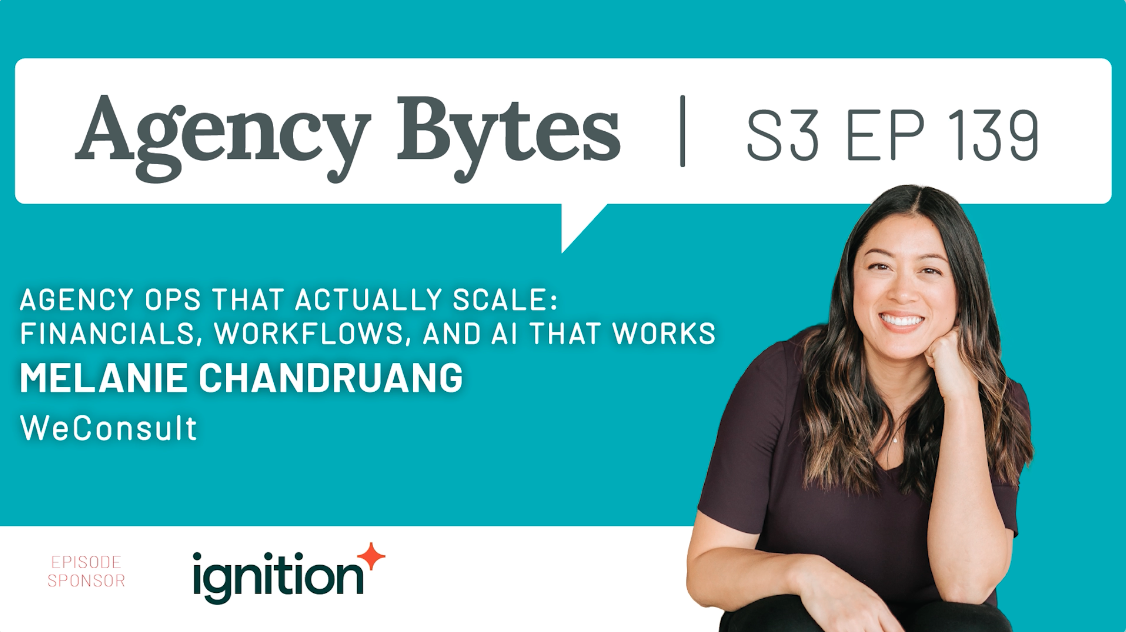
Ep 139 – Melanie Chandruang, We Consult – Agency Ops that Actually Scale: Financials, Workflows, and AI That Works
Agency Bytes is proud to partner with Ignition.
START YOUR FREE 14 DAY TRIAL
ignitionapp.info/agencybytes-trial
Use Code OUTSIGHT25 to save 50% off!
Listen & subscribe on the platform of your choice
Featuring: Melanie Chandruang, We Consult
In episode 139, I sit down with Melanie Chandruang, founder of WeConsult and a strategic operations partner for creative agencies. Melanie has spent the last seven years helping agencies tighten up their financials, streamline workflows, and build stronger leadership teams—while also navigating two maternity leaves, a cross-country move, and re-entering the industry in one of its toughest seasons.
We dig into how she rebuilt WeConsult after stepping away to have kids, what’s changed in the agency landscape since 2023, and why she’s now staying higher-level as a fractional ops leader instead of getting buried in implementation. Melanie breaks down what healthy leadership actually looks like, why so many founders remain the bottleneck even after hiring “senior” people, and how clear ownership, scorecards, and trust change everything.
We also get tactical: what she looks for first in the financials, the operational metrics that matter most, and why agencies without documented processes are struggling the most with AI adoption. We wrap by talking about leading through uncertainty, avoiding burnout, and the simple practice Melanie uses to remind herself of the value she’s creating—plus her very 90s go-to karaoke song.
Key Bytes
• Clean financials and clear reporting are the true foundation of scalable ops
• Workflow ownership matters — if it’s nobody’s job, it’s nobody’s job
• Founders stay bottlenecks when leadership has no autonomy or scorecards
• Agencies with documented systems adopt AI faster (and with fewer messes)
• Strong leadership = trust, clarity, and shared problem-solving
• Self-care and boundaries are essential for sustainable agency ownershipChapters
00:01 Intro and how Melanie rebuilt WeConsult after kids and a cross-country move
02:48 Stepping away from client work, losing momentum, and clawing back into a changed industry
05:36 Why Melanie now stays high-level and pushes implementation to internal teams and automation
07:42 Founders as bottlenecks and what a truly strong leadership team looks like
11:15 Ego, scale, and the operational shifts required for owners to get out of the way
15:36 Where Melanie starts operationally: financials, workflows, and clear ownership
18:07 The agency financial metrics that actually matter (profitability, cash, utilization, and more)
22:03 Why documented systems are the key to successful AI adoption (and how messy it gets without them)
26:00 Leading through uncertainty, rebuilding a business, and protecting your own wellbeing
28:38 AI note-takers, imposter syndrome, and Melanie’s “value” practice
31:36 Melanie’s 90s karaoke pick and where to learn more about WeConsult
Melanie Chandruang is the Founder of WeConsult and a Strategic Operations Partner for creative agencies. With over 15 years in the industry, she helps agency owners boost profits, streamline operations, and move big initiatives forward so they can focus on growth and what matters most.
Connect with Melanie on their website.
-
Steve / Agency Outsight (00:01.098)
Welcome to Agency Bites. I'm your host, Steve Guberman from Agency Outside, where I coach agency owners to build the business of their dreams. My guest this week is Melanie Chandrewang, the founder of WeConsult, a strategic operations partner for creative agencies. With over 15 years in the industry, she helps agency owners boost profits, streamline operations, and move big initiatives forward so they can focus on growth and what matters most. And man, that is super valuable for agency leaders. Melanie, thanks for joining me. How are you?
Melanie Chandruang (00:29.762)
doing well. Thanks for having me. I'm excited to be here.
Steve / Agency Outsight (00:33.384)
Yeah, it's long overdue, man. We first connected, gosh, it's gotta be right before you relaunch this thing. I think you were kind of like working through like what's next transition kind of stuff. And then had the pleasure of seeing you in in war torn Portland, Oregon at leadership love an amazing event. And I was like, man, we are overdue for this. So give kind of like, what's that backstory you, you, you you, you coming back into what you're doing now from where you were and what you're doing with we consult.
Melanie Chandruang (00:39.586)
Mm-hmm.
Melanie Chandruang (00:43.203)
Yup.
Melanie Chandruang (00:48.994)
Such a good event. I know!
Melanie Chandruang (01:01.72)
Yeah. Yeah. So I've been running Weconsult for about seven years. And in those seven years, I've had two kids. And so I chose to step away during, after each baby was born, first baby, it was five months and it felt like a lifetime. And then second baby was born and I had also moved across the country and kind of left a...
life behind that I had had for 15 years in San Diego and now I'm in Michigan and I was like you know what I'm getting acclimated to reactivated because I'm actually from Michigan but I've been gone for 20 years getting reacclimated to new surroundings about to have a second baby I just need to really
spend some time with myself, with my new family, and that's what I chose to do for about a year and a half. It was almost until I started working again. And it was tough to take that time away. As someone who has been very much intertwined with their career, their entire lives, I've worked since I was a teenager to take that time. Yes, I loved being with my family, but I also
was really, really wanting to use that strategic part of my brain.
At the beginning of 2024, I said, you know what, I'm gonna step back into things. But I knew that the industry had changed in just the year that I had been away. A lot of agencies that I had worked with previously, they had downsized. They had shut their operations down completely. Agencies had taken a hit in those years, the last couple of years. And so I didn't quite know what I was getting into if there was even a space for me to continue doing what I was doing before.
Melanie Chandruang (02:48.846)
And I stepped in and I clawed my way back. then in mid 2024, then I kicked off my first client again. And it felt like it was so long, but it really wasn't. wasn't. But when you're in that headspace of
feeding a baby, diapering a baby, getting a baby to sleep. That's all you're focused on and you're feeding your family. It's five things to keep everyone up and functioning to then switch my brain back into strategy and having discussions with clients and thinking about their business and their employees. All of that felt so foreign to me because I had not had any discussions around that in the past year.
Steve / Agency Outsight (03:28.799)
Mm-hmm.
Steve / Agency Outsight (03:36.466)
Yeah, you're talking about diapers and formula and, you know, maternity things. so, so you completely shut it down. Transitioned out your clients and then step back into it. What do you think was the driving force behind? Like what gave you the confidence to rebuild like at that time? And then also I'm curious what's been different about this new chapter. You talked about how agencies are different. Like what were some of those massive differentiators and what's different in this chapter with Weconsult for you?
Melanie Chandruang (03:39.522)
Yeah.
Melanie Chandruang (03:43.309)
Yeah.
Melanie Chandruang (03:58.006)
Mm-hmm.
Melanie Chandruang (04:04.588)
Yeah, those are good questions. So the confidence to step back in, I don't know if it was confidence. Sometimes I lack the confidence. I think it was just the desire to do the work. I really wanted, I'm.
I really thrive in an environment where I am forced to constantly learn. And I wanted to challenge myself to do that, to know that I can tap back into that part of my brain. And I'm sure that was a lot to do with that phase of my life and the phase that I'm currently still in. My kids are still young. Is I want to know that I still have the skills to be able to deliver value to my clients.
And I enjoy the work, I really do. It's such a fun thing to, not a lot of people say that about operations, that it's a fun thing to do. It's usually all the crap that no one else wants to handle. But for me, it really is fun to be that catchall and to take all of that crap, turn it into something that's really productive, that's gonna move the business forward. And so that's what drove me. I was really excited to get back into that seat.
And what was the second question in terms of the changing landscape? Yeah.
Steve / Agency Outsight (05:23.475)
Like what are you seeing that's different from when you stepped away and into the agencies you're digging into now and how are you showing up differently? Like what is we consult as an organization or as you an operations expert doing differently to show up?
Melanie Chandruang (05:36.79)
Yeah, I'm actually staying more high level than I ever have. I used to be way more entrenched in implementation and it was almost like I was a part of their team, which I very much still am, but I have more boundaries and very clear, I think, what are they called? Just.
very clear of what I can handle and what I can't and what's going to provide the best value for my clients. Because if I'm in there and I'm spending, because I'm fractional, so it's a limited amount of time that I'm with each client. If I'm spending that time doing very hands-on tactical work that could be done by someone internal or maybe even bringing in another contractor, that's something that I am constantly pushing for in this chapter because agents
are leaner now. They're having to work with less in terms of, you know, their financial resources and really put that money to make sure that every, I don't know if I can word this correctly, but making sure that every dollar counts even more so. And so,
having me come in and do implementation work is still powerful, but as long as I can still stay high level. So that's one big difference is, you know, there's so many more efficiencies that can be done through other people, through automation, through AI. And so it's allowed me to stay in that seat, which has been great, a great change. Yeah.
Steve / Agency Outsight (07:14.164)
Yeah. Yeah. So you've leveled up like no longer. Do you need to be tinkering in the nuts and bolts? You can do more of strategic level work for them and they can implement the operators, whether it's people or robots or the mix of the two. absolutely they've got, know, agencies are finding ways to kind of squeeze more value out of the dollar or the hour. You know, you can interchange those easily and doing more with less through these new automations and robots and things. So I love that. Talk about your
Melanie Chandruang (07:21.795)
Yeah.
Melanie Chandruang (07:37.805)
Yes.
Melanie Chandruang (07:41.452)
Yeah.
Steve / Agency Outsight (07:42.782)
You know, big into leadership, strong leadership teams. How do you define what, what strong leadership means and like, how do you help founders get there when they're used to wearing all these hats?
Melanie Chandruang (07:53.976)
Yeah.
It's so difficult. It's so difficult, especially after hearing about the stories at leadership love, you know, the bureau leadership love. It's so difficult to let go of those reins for, for whatever reason that is. A lot of the time it's a personal reason of why founders find it so difficult. But I have seen firsthand so many times where leadership that is an unhealthy balance. just doesn't, even if you have the best employees, you have the best talent, you're bringing
Steve / Agency Outsight (07:56.233)
Yeah.
Melanie Chandruang (08:24.496)
those people in thinking that's gonna solve the problem and that's just not the answer because if you have the best talent and you're not willing to let go of the reins and give them the autonomy and utilize them in their...
to their highest potential, you're still the bottleneck. You're still the bottleneck and everyone's looking for you to you for the answers and it's exhausting. And so there's so many agency owners are like, I am dying in meetings and having to respond to people and reviewing things. And I'm like, do you have to do that?
And it's so easy for me to say that because it's like from an outside perspective. And so it's helping build systems to allow them to slowly take, to move that ownership onto someone else. But it's hard. It's really hard. Yeah.
Steve / Agency Outsight (09:09.162)
So I wanna dig into that because I see that so much. I've got people and I spend a trillion dollars a year on my leadership team, but then you don't trust them to work autonomously, to do what you've hired them to do. And the mindset that's there, I have such a tough time also with clients I work with, helping them really delegate. And delegate doesn't mean go do this and report back and then let me come back and micromanage. Delegate means I'm asking you to do this, this is your job, I'm trusting you to do it.
Melanie Chandruang (09:18.104)
Yep.
Melanie Chandruang (09:22.05)
Yeah.
Melanie Chandruang (09:33.58)
Yeah.
Steve / Agency Outsight (09:39.024)
What do you see as some of those barriers like mindset or otherwise that gets in their way?
Melanie Chandruang (09:44.322)
Hmm.
Melanie Chandruang (09:47.672)
think it's hard as leaders, specifically founders of an agency, because they've worn all the hats. And when you've worn all the hats, you've been in that situation with that maybe you're bringing in someone new to walk that same path. And you're like, well, I've done that. And I could do that in a different way faster. Or I have a different idea of how I can get to that solution, because you've already had to play that role.
And so to then watch someone else do it, and there's an onboarding period in any company that someone walks into, and they don't allow for that proper onboarding and teaching of here are my philosophies and what's important to me, and then letting them run with it and make the mistakes that they have to. It's too painful for owners, I think, to see that happen. And so then they step in and they save the day, and then that happens over and over.
person that gets brought in loses confidence and they have to almost get approval and they second guess themselves and it becomes this vicious cycle. So it's, yeah, yeah.
Steve / Agency Outsight (10:47.88)
Yeah. My pushback there is often so if I've, if I've worn all the hats and I've done all these things, I've done them at smaller scale and now we're at a bigger size and I'm bringing somebody in who's, who's got a layer of expertise that maybe I have on a smaller scale, but I don't have, where we are now at whatever seven figures or eight figures, however big the agency might be. And so, so there's an ego play there that says that, I've done it.
Melanie Chandruang (10:58.381)
Yeah.
Melanie Chandruang (11:04.536)
Mm-hmm.
Melanie Chandruang (11:11.062)
Right.
Steve / Agency Outsight (11:15.39)
But and what I did at that smaller size is still applicable at this bigger size. And so I do think it, you you hear like whether it's equipped or not, like surround yourself with smarter people. And I believe wholly in that as good leaders hire smarter people than them in in their specific roles. But I also think there's operational shifts, mindset shifts. What are you? What do you see from like an operational shift that needs to happen to like get that founder out of the bottleneck?
Melanie Chandruang (11:19.724)
Yeah.
Melanie Chandruang (11:34.072)
Mm-hmm.
Melanie Chandruang (11:44.396)
Hmm. Yeah, I think number one is to identify what someone truly owns and then give them.
Steve / Agency Outsight (11:44.427)
in this scale mindset.
Melanie Chandruang (11:52.894)
the what's the scorecard that they're aiming for? Like what, what shows them that they're hitting the mark or not? It has to be something tangible. And that I think is missing a lot of the time. If you put someone in a role, they know their job description, but do they know what success looks like? What that metric of success is? And, and without that, it's really hard for an owner to say, are they doing their job well or are they not? And so if they're unsure of it, they then get into the weeds and they poke and pry, and then they insert themselves.
Whereas if you have someone that knows their role and they know what the measure of success is then an owner can easily Check in on that on whatever that KPI looks like and then that is going to Help inform them without having to enter into the day-to-day details. So that's number one I think number two is to allow though those team members to
So if ideally if you have a leadership team, those people are really relying on each other and whenever you see a problem or have a vision of where you want to go or maybe you have an idea, you toss it over to the team and you let them analyze. How do we, how do we come to a solution for that? What are our ideas? How are we going to prioritize that against all the other things that we have? It really gives them ownership of, of the business. And that's the biggest thing that owners complain about is like the way it is
Steve / Agency Outsight (13:16.81)
Mm-hmm.
Melanie Chandruang (13:19.77)
all on my shoulders and they don't understand how hard it is to carry all of this, well then give some of that over to someone else or a team of people. And so I think that is, if people can really have that team and be able to lean on each other and they're not pitted against each other, I mean, they're all working toward the same goal. yeah, yeah, those are two big things that come to mind.
Steve / Agency Outsight (13:44.317)
It's interesting. So I'm working with an agency in Philadelphia. They're about 30 people now. Eight or 10 of them are offshore and the rest is kind of in the region. So they're not always in the same building together, but the CEO is currently doing that very thing because of this micromanagement and because of the insanity it's causing in their lives. And probably maybe a quarter or so ago, three or four months ago, they did exactly what you're talking about of here's the challenge. I want you guys to come back to me with a solution.
Melanie Chandruang (13:56.408)
Yeah.
Steve / Agency Outsight (14:13.18)
And the freedom it gave the CEO to do their operational work and not be in the weeds of this thing. It reminded me of like one of the times when I owned my agency and I took it took vacation and I came home, you know, came back from vacation and the agency was still operating. And then the following year, the agency had signed on a new client while I was on vacation. And like these things were happening without me. And that's what you're talking about is allow things to happen without you trust that they're going to make the right decisions. They're invested in.
Melanie Chandruang (14:17.911)
Yeah.
Melanie Chandruang (14:29.826)
Yeah.
Melanie Chandruang (14:34.092)
Amazing. Yeah. Yeah. Yep.
Steve / Agency Outsight (14:42.558)
their jobs, in the business, in the clients, in their coworkers, and they want to win. So allow them to do the work that's going to let them win.
Melanie Chandruang (14:48.003)
Yeah.
Yeah, yeah. And what you said is that stands out is that they want to win. That is so true. I have met with so many people on leadership teams and they desperately want this agency or whatever the business is to succeed. And oftentimes they're like, I just want the owner to get out of the way so that we can make this happen. And that's so unfortunate to see them, you know, having to come up against that over and over. And that's, that's what gets in the way. Yeah.
Steve / Agency Outsight (15:20.062)
Yeah. When you start working with an agency, what are some of the things that you see most commonly that like low hanging fruit that can be operationalized either through like automation or a new piece of software as a system or just an SOP or something like that.
Melanie Chandruang (15:36.842)
Mm-hmm. Well, number one that is important to me is the financials. I dig in heavily into the financials because without that data, you really can't get a proper...
I think you just need that in order to understand the foundation of what you're building everything else on. So the financials are number one. If the financials aren't clean and the data isn't useful to people in order to make business decisions, then I always start there. So that's number one. And then the next thing is looking at the major workflows. I look at the workflows and then set up.
Okay, what are the workflows? And if they're not documented, then yes, let's create an SOP for this or a workflow and then SOP for some of the more smaller pieces of, okay, this is a process that needs to happen within a workflow and then create those. What is the most important in a workflow is, is aside from the roles and making sure that everyone understands what their roles are, it's within a workflow who owns what? It's all about ownership.
If no one owns, no one knows who the owner is in a certain step of the process, things can go really slow and it's just so inefficient. And so if you can declare who an owner is of a process or an entire workflow, then that makes it so much easier. Cause that person gets to make the call and they don't have to second guess who is saying yes or no at the end of the day.
Steve / Agency Outsight (17:12.362)
Yeah, the person that owns or champions that part or the entire process. A, you've got accountability there and B, if it's nobody's job, like, I don't even know how to say this properly. If it's nobody's job, then it's nobody's job. And it's like, I thought you were doing it kind of thing. And no, we don't know who's doing that next phase.
Melanie Chandruang (17:16.332)
Mm-hmm.
Melanie Chandruang (17:22.22)
Yeah. Yeah. Yeah.
Yes, and when you're in that situation, there's a Thai word for this. It's called greng chai. It means you're reluctant to step on anyone else's toes and you hold back because you don't want to overstep. And that happens often when you don't have a clear owner is everyone's trying to just skirt and be polite enough for the most part. Most people are like that. And so then again, it's this inefficiency that ends up happening. And so instead of saying, just being,
Steve / Agency Outsight (17:57.012)
Yeah.
Melanie Chandruang (17:58.886)
saying, okay, no, I don't think that that's the right solution. We're going to go this way instead. There needs to be that, that someone to say it. Yeah.
Steve / Agency Outsight (18:07.85)
agreed. Yeah. I guess we can't. So before I jump to that, you talk financials. Are you talking like cleaning up QuickBooks or building out dashboards for visibility or both? what are some of the? All right. So what are some of the key metrics that you think that they need to keep an eye on in a dashboard?
Melanie Chandruang (18:18.72)
all of
I mean, it's going to be all of the basic ones plus some agency specific ones So when I say basic I'm talking about are you monitoring what the P &L looks like and how much you're spending on? Compensation in terms of revenue on operational costs in terms of revenue Are you tracking cash flow? That's obviously an important piece in any business is what does your cash flow look like it gets a little dicey for agencies that are
that have a ton of pass-through costs. And that's where cash flow gets really unpredictable. And it's so much more important to make sure you have a manage on that. making sure all of the financials, all the data is clean going into whatever.
accounting software that you have is one step, right? You can make sure that all that happens. And then it's, do you have someone that is taking that and reporting it on a regular cadence? Because that's another thing is most owners aren't wanting to go into QuickBooks or to Xero and run reports and be like, what does this mean to me? It's you have someone that's presenting it to you on a regular cadence, ideally monthly, and then quarterly and saying, here's where we're at for the month.
Melanie Chandruang (19:45.066)
Here is what our financials are telling us in terms of the story. We had a net loss this month. Here's why. Here are all the things that we're looking at. And in terms of metrics, mean, so many metrics that you can track, I think it can get a little overwhelming. One of the things that, obviously, it's going to be profitability at the end of the month. What do your profit numbers look like? And year to date, what does that mean? And then for the annual amount, what does that look? Where are you projected to be at the end of the year?
number one, and then cash, looking at that. And then the metrics for agencies specifically, it's gonna be metrics like utilization, how well is the team being utilized on billable work? And are they efficient in the work that they're executing on? So it's...
It's a lot of things to track, which is why I always encourage owners to get someone in to help them with it because you can get so much value in the financials and it's not so much of a weight of, I wonder what I should do and what I can do with where we're at in the finances. It's having that support and someone kind of feeding that to you, which would be the ideal.
Steve / Agency Outsight (21:03.658)
Yeah, I'd offer that third from coaching and operational coaching that you do. A CFO advisor is probably the third best investment they would make, second to somebody like you and I, obviously. I don't know if know Brandon from Aura. He introduced the idea and I never really tracked it as an agency owner, I definitely, it was something that my bookkeeper would always advise us on when we did monthly reporting, but he talks about days till zero.
Melanie Chandruang (21:13.005)
Yep.
Melanie Chandruang (21:17.026)
Yeah.
Steve / Agency Outsight (21:32.971)
as it relates to cashflow as a key metric that founders need to keep their eye on in a dashboard that can be fed in from their bookkeeper or CFO or whatever. Because yeah, they shouldn't be going into QuickBooks or whatever app they're using, Ignite, things like that. And they should have something that is more actionable from a dashboard standpoint that they can visit. Maybe not daily, because that's a little obsessive, but monthly at a minimum. So yeah, I love those numbers.
Melanie Chandruang (21:33.228)
Hmm. Yeah.
Melanie Chandruang (22:00.908)
Yeah, absolutely.
Steve / Agency Outsight (22:03.39)
We can't talk ops and not talk AI. And I know you're big into strong systems and documentation and, you know, jumping back in, you know, I guess you jumped in about a year ago. So that was maybe a year. I guess I'm trying to do rough math in my head a year and half, two years after chat. TPT was announced. Right. So what, what are you seeing agencies like response react time as it comes like comes down to layering AI in with what you're advising on?
Melanie Chandruang (22:23.02)
Yeah, yeah.
Melanie Chandruang (22:32.747)
Yeah, yeah, it totally depends on where the agency is at with their internal processes. If an agency has had processes put in place, and when I say processes, I mean, are their workflows clear? Is there a written documentation of how to do a...
something in the business, any kind of process, and is it documented from start to finish? If they already have that, they're able to utilize AI so much faster because you already have that.
information to feed into AI. And without that, there's nothing to feed because AI needs that information from you. It's not going to create it for you. So if they've already had that, they're stepping into AI and utilizing it way faster. I've seen some agencies that don't have that and are trying to step into AI and it has gotten very messy very quickly. And I know it sounds really boring and no one wants to think about documentation or, or organize.
organizing their drive, their storage, cloud storage in a way.
Steve / Agency Outsight (23:37.534)
What do mean? That's fascinating stuff. What do you mean?
Melanie Chandruang (23:39.638)
I know, I know, but it, it, really gets you off the ground faster in terms of AI. If everything's well organized, if every document is templatized. So the team just plugs their information in because AI also needs to have things organized in a specific way, in order to not get tripped up. So that is, it really depends on where the agency was at starting and the success is obviously, I think the success of it also depends on
the culture around AI, if it's a, let's all come together and we're going to test things out and then establish what the official way that we're going to do it is and have some one person or maybe a small group of people say, here is what the standard is and here's what we're going to be rolling out to the team. What I have not seen work well is that it's a free for all and people are just using AI and it gets really confusing of what tools are we using? What's the standard for using this tool?
and connecting all the different departments and roles within that is very, very messy. Yeah.
Steve / Agency Outsight (24:47.668)
Yeah, having kind of a leadership team dedicated to the AI roadmap and integration plan is essential. But you said something I think is super fascinating that I think 10 years ago when a business was like, all right, what do I need to scale? You need systems, you need documented systems. And there was no thought of AI or robots or whatever doing these things. was open a Word document and write down how you do things and assign ownership to it. And when this happens, then this happens. And so that
Melanie Chandruang (24:51.822)
Mm-hmm.
Melanie Chandruang (25:02.53)
Yeah. Yeah. I know.
Steve / Agency Outsight (25:16.81)
Principle still is essential in a scale environment. If you want to scale, whether it's with people, more clients, more whatever, now you're adding in a layer of automation, you still need that foundational, like, just have this operational manual. This is how we do things. So I think that's super important to note.
Melanie Chandruang (25:21.294)
Yeah.
Melanie Chandruang (25:25.452)
Mm-hmm. Yeah.
Melanie Chandruang (25:33.762)
Yeah, absolutely. Yeah. Yeah. And the automation and AI is just the icing on top that makes the team more efficient. What would normally have taken the team 20 hours, maybe it's taking them 10 hours because you have that automation or AI built in. And so, but yeah, the processes and having all of that documented and systemized is essential before you move into that phase. Yep.
Steve / Agency Outsight (26:00.373)
Yeah. So you've made some people, literally. You've rebuilt your business now a couple of times, because you've come back both times after having children and you're guiding agencies through some really tumultuous times, major transformations. What have you learned about leading through some of this uncertainty and what advice do you have for agency owners that are maybe feeling stuck, maybe, you know, their own uncertainty now?
Melanie Chandruang (26:06.446)
I know.
Melanie Chandruang (26:13.676)
Yep.
Melanie Chandruang (26:30.509)
Yeah.
What advice? I think the advice, it's corny. It's take care of yourself first. Take care of yourself and your mental well-being first and your physical well-being first before every, I mean, that's the most important piece. If you are...
grinding every day and you're not having any time to come up for air and repair yourself and really put back into yourself. It's a very slow or quick road to a losing battle in this industry. It is such a tough industry and so I think it's making sure that you're thinking about yourself first in terms of that.
How can you lean on other people to lessen the burden on yourself and really have time and resources to fill your own cut back up? That's number one. I see so many owners that are just stressed beyond belief and it's really painful to see that. It's not, I hate seeing that. It sucks. I've seen it, my husband went through it having been an agency owner that closed down his agency and so it doesn't have to be that way.
I would say that first. that's gonna look, the solution to that is gonna look different for everyone. I think I don't have a blanket solution of like, here's the cure-all. It's what is going to fill your cup? What is going, if you don't wanna be in meetings all day, then find a way to not be in meetings all day. Don't be that essential person. Build a team that you can have help you in those responsibilities. Yeah.
Steve / Agency Outsight (28:09.162)
Yeah, I love that. Take care of your mind, body, mind and spirit. You know, do the things that nourish you and delegate the things that are not doing you, that either you shouldn't be doing or you don't want to be doing. Yeah. Yeah, that's powerful. Um, all right. I want to wrap up with a couple of rapid fire questions. So not, not too heady, but you know, uh, what's one everyday tool or app that you can't function without that most people would never guess is part of your operational toolkit. And it can be personal or professional.
Melanie Chandruang (28:20.577)
Right, right, yeah.
Melanie Chandruang (28:38.7)
never guess. don't, I feel like everyone could guess this and I feel like everyone's using it, but it's the AI note takers. I literally could not function without it in this day and age. mean, when I go into my clients and I do discovery and taking all that information into my head is overwhelming. And then trying to jot it down when people are speaking or even meetings with people on a regular cadence. It's like capturing that and being able to go back to it and ask my,
you know, note taker questions of, okay, what were the takeaways? What were the main, what was the main piece of like nugget that I want to take away from this conversation? That has been a game changer for me by far, best tool.
Steve / Agency Outsight (29:21.032)
Agreed. then feeding that into an automation tool is like next level for me. So yeah, I agree. I used to have stacks of like field notebooks and moleskines and like all these notebooks and every meeting I'm writing notes and writing and I don't do that anymore. So yeah, it's just amazing. I've saved trees. Thanks AI. What's something that you learned about yourself since coming back to rebuild your business?
Melanie Chandruang (29:28.268)
Yeah, yeah.
Melanie Chandruang (29:37.206)
Yeah. Yeah.
Melanie Chandruang (29:43.33)
Yeah, yeah.
you
Melanie Chandruang (29:52.82)
that I know a lot more than I thought that I did. I, like many owners, suffer from imposter syndrome. I think a lot of us are self-made and we're scrappy and gritty and we just figure out a way to get things done. But when you come from that background, it's a, what do I actually know? How do I have this knowledge? I have, I'm still working on that. It's to remind myself of that, but it's been really, I
I think a great reminder to myself, I've shown myself that I can do it and I have the skills that a lot of people find value in. And so that's been just a reminder to me. Yeah.
Steve / Agency Outsight (30:35.466)
All right, so follow on, because I do believe we all suffer random days, imposter syndrome. What's, I guess, a practice or a tool or a habit or something that you do to kind of flip the script on yourself on any given day.
Melanie Chandruang (30:48.078)
I have a appointment reminder that is just something that says value and it's a practice of where have I created value for in my life or in someone else's life whether it be you know through work or through a conversation with a friend that I know has given them value I think that's been really important to me is to just have that reminder because otherwise
I don't know if this is just me or typical ops people, but we're always like, how could this be better? How could I have done that differently? How can I improve on this? It's constant. But we're never looking at what did we do really well and where did we provide immense value for someone else? That's been really helpful. Yeah.
Steve / Agency Outsight (31:28.986)
I love that. That's amazing. All right. And then finally, to wrap things up, what is your go-to karaoke song?
Melanie Chandruang (31:36.106)
my God, it's really bad. Okay, wait, do I know the name of it? It's No Doubt when Gwen Stefani had No Doubt and it's, it called Spiderwebs? I don't know if that's just the main. my God, no, I cannot say that. gosh.
Steve / Agency Outsight (31:48.83)
Just sing it. mean, that's the only way we all know for sure. An agency bites first. Walking through a spiderweb, something, something. Yeah.
Melanie Chandruang (31:59.928)
Sorry, I'm not home right now. I'm walking in the spiderweb. So leave a message and I'll call you back. God, please cut that. No. staying in it's staying in.
Steve / Agency Outsight (32:10.11)
We don't do editing here, sorry, that's amazing.
Melanie, thank you so much for joining me. Folks, check out weconsult.io. Brilliant work that you're doing with agencies. Grateful for your time. Thank you very much for joining us.
Melanie Chandruang (32:25.528)
Thank you. This was great.